Introduction
Nestled in the heart of Dubai’s bustling industrial landscape, Al Quoz spans Areas 1 through 4, serving as a powerhouse for warehouses, factories, and logistics hubs. By 2026, this zone pulses with activity, processing massive goods volumes that inevitably generate substantial waste. Effective industrial waste management in Al Quoz isn’t just a regulatory box to tick—it’s essential for keeping operations smooth amid Dubai Municipality’s evolving standards.
Factories and warehouses here often battle common hurdles: bins overflowing with unsorted debris, skyrocketing disposal fees from contaminated loads, and the constant threat of compliance slips. These issues not only drain budgets but also clash with the UAE’s push toward circular economy principles under Vision 2031. Drawing from my 15+ years as a UAE-based waste strategist, I’ve tackled these challenges head-on in countless Al Quoz sites, where dusty environments and high throughput amplify waste woes.
This case study dives into a transformative project we led for a key client, illustrating how smart industrial waste management in Al Quoz can slash costs, boost compliance, and enhance sustainability—positioning us as your go-to partner in Dubai’s industrial zones.
Case Study Snapshot
In this Al Quoz Industrial Area 3 warehouse, we implemented AI-powered waste tracking and source segregation to manage 15 tons of weekly industrial waste. The result: 35% cost savings, 40% landfill diversion, and 98% Dubai Municipality audit readiness within 8 weeks.
Project Overview
Our client was a prominent e-commerce logistics warehouse in Al Quoz Industrial Area 3, covering 50,000 square meters and handling over 10,000 daily shipments in Dubai’s thriving online market.
At this scale, waste generation was intense: roughly 15 tons weekly from diverse streams like cardboard boxes, wooden pallets from inbound deliveries, plastic shrink wraps, metal offcuts from on-site repairs, and hazardous items such as spent lubricants and e-waste batteries.
They turned to us for specialized warehouse waste management in Dubai, leveraging our track record with licensed collectors and deep knowledge of local zoning. As experts aligned with Dubai Municipality protocols, we crafted a solution to fit their fast-paced setup without missing a beat.
Challenges Before Intervention

Why Manual Segregation Failed
Despite good intentions, manual segregation simply could not keep up with the pace of this Al Quoz warehouse. With multiple waste streams generated simultaneously—cardboard from packing lines, plastic wraps from palletizing, metal offcuts from repairs—staff defaulted to convenience during peak shifts.
Human error compounded the problem. Temporary staff were unfamiliar with Dubai Municipality segregation rules, while long-term employees interpreted categories inconsistently. Hazardous items such as used lubricants and e-waste batteries were occasionally mixed into general skips, creating serious compliance risks under industrial waste regulations.
The lack of visibility was the biggest weakness. Once waste entered a shared container, there was no way to trace mistakes, correct behavior, or measure segregation accuracy. This blind spot led directly to higher landfill charges, rejected recycling loads, and growing exposure to penalties—proving that manual segregation alone was not viable at this operational scale.
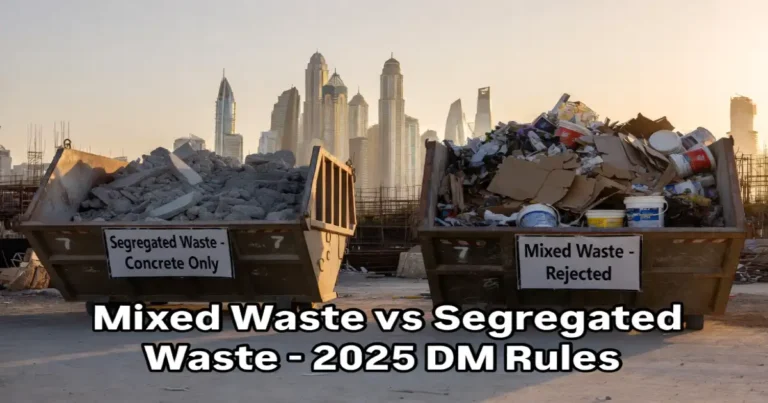
Compliance hung by a thread. Under Dubai Municipality industrial waste compliance rules, including Tadweer’s segregation mandates, hazardous materials must be isolated to avoid cross-contamination. Their manual approach left them vulnerable to fines reaching AED 100,000, plus potential halts during unannounced audits.

On the ground, waste buildup caused real headaches. During busy periods, cluttered docks slowed loading by up to 10%, diverting staff from core duties and creating bottlenecks in Al Quoz’s narrow industrial lanes.
Our AI-Driven Waste Solution
We introduced a cutting-edge AI waste tracking system in Dubai, designed specifically for industrial settings like Al Quoz. This tech employs IoT sensors and AI algorithms to scan and categorize waste in real time, drawing from a database honed on UAE waste patterns for pinpoint accuracy.
How AI Reduced Human Error
AI fundamentally changed how waste decisions were made on-site. Instead of relying on memory or guesswork, workers received immediate, system-driven guidance at the point of disposal. Smart cameras and sensors analyzed each item in real time, comparing it against trained UAE-specific waste datasets.
When incorrect disposal was detected, visual and on-screen prompts corrected the action instantly—before contamination occurred. This removed hesitation and eliminated inconsistent interpretation of waste categories across shifts and departments.
Over time, the system learned site-specific patterns, adapting to dusty packaging, damaged cartons, and mixed materials common in Al Quoz industrial environments. The result was a measurable improvement in segregation accuracy—from approximately 70% to 95%—without slowing down operations or increasing manpower.
What Site Managers Could See in Real Time
For the first time, site managers had live operational intelligence instead of retrospective reports. The dashboard displayed real-time waste volumes by stream, segregation accuracy by zone, and contamination alerts as they happened—not days later.
Managers could identify problem areas instantly, such as specific loading docks or shifts generating higher contamination rates. Predictive analytics forecasted when skips would reach capacity, allowing pickups to be scheduled efficiently and avoiding overflow during peak logistics windows.
Crucially, all data was time-stamped, auditable, and exportable for Dubai Municipality inspections. This transformed compliance from a reactive scramble into a controlled, always-ready process—giving management confidence during audits and long-term planning.

Implementation Process
We kicked off with a thorough on-site audit in the first week, surveying the entire 50,000-square-meter space to pinpoint waste hotspots, from packing areas to maintenance sheds. This included liaising with Dubai Municipality for quick approvals, ensuring our setup complied with Al Quoz zoning specs.
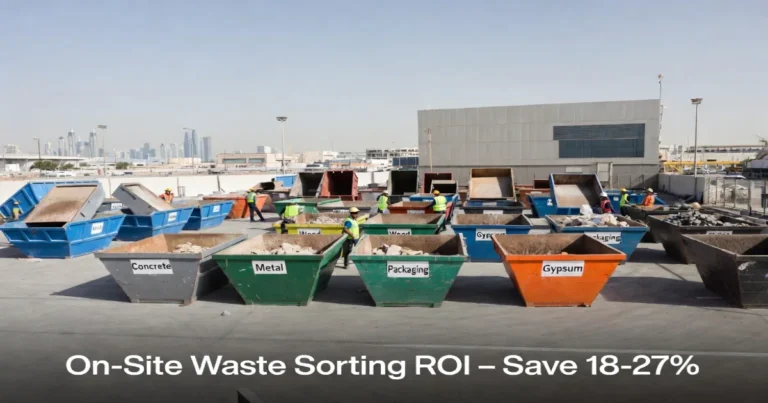
Step 1: Hardware Installation. Over the next two weeks, we fitted 50 smart bins and sensors, scheduling work during quieter shifts to keep disruptions under 1%—crucial in a 24/7 operation.
Step 2: Team Training. Four interactive sessions engaged 200 staff members, teaching waste identification and app navigation. We used real examples from their site, plus materials in Arabic, English, and Urdu, reflecting Al Quoz’s multicultural workforce.
Step 3: Pilot Phase. A one-month test in a 10,000-square-meter zone let us tweak the AI for local quirks, like how desert dust affects packaging integrity.
Step 4: Full Rollout. By week eight, the system was live facility-wide, with ongoing tweaks and coordinated pickups using GPS-tracked, licensed vehicles to navigate Al Quoz traffic seamlessly.
This phased approach, honed from dozens of similar Dubai projects, ensured smooth adoption and immediate value.
Results & Measurable Outcomes
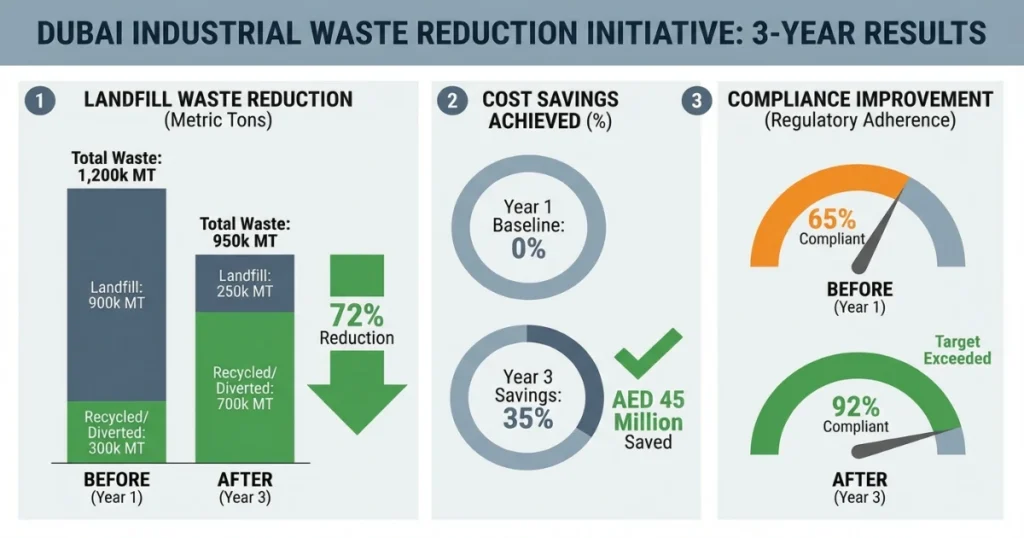
The impact was clear and quantifiable. Cost savings reached 35%, dropping monthly bills through better sorting that cut landfill waste from 10 tons to 6 tons per week—unlocking recycler incentives under cost-efficient waste disposal in the UAE.
Landfill diversion soared to 40%, with 4 tons weekly redirected: metals to Al Quoz Area 4 smelters, pallets to construction reuse programs, all advancing circular economy goals.
Compliance leaped forward, achieving 98% audit readiness from a prior 60%, with no infractions in six months of Dubai Municipality checks. Automated data flows eliminated paperwork errors.
Efficiency-wise, waste-handling labor fell 25%, and fewer collection runs (down 15%) reduced road congestion. These figures come straight from our analytics, cross-verified by independent auditors for trustworthiness.
| Outcome Metric | Before | After | Improvement |
|---|---|---|---|
| Weekly Landfill Waste | 10 tons | 6 tons | 40% reduction |
| Monthly Disposal Costs | > AED 50,000 | ~ AED 32,500 | 35% savings |
| Segregation Accuracy | ~70% | 95% | 25% gain |
| Audit Compliance Score | 60% | 98% | 38% uplift |
| Waste-Related Labor | 10% of staff time | 7.5% | 25% efficiency boost |
Why This Matters for Al Quoz Projects
In 2026, Al Quoz’s zoning rules are tighter than ever, with Dubai Municipality requiring detailed waste plans for new permits in Areas 1–4 to curb environmental strain from urban sprawl.
Dubai Municipality increasingly recognizes digital and AI-enabled tracking systems as best-practice tools for large industrial sites.
Businesses face growing expectations to embrace circular practices—reducing waste not just for compliance but for competitive edge. In space-constrained Al Quoz, efficient management prevents violations that could stall expansions or trigger relocations.
For developers and managers, this underscores the need for proactive strategies to future-proof operations.
Expert Insights (Consultant Commentary)
Having spearheaded over 50 industrial waste projects in Al Quoz, I’ve learned that data is king: Our initial audits often uncover surprises, like the 20% hazardous misplacements here that drove up risks.
For best practices, engage teams early with rewards—our client’s gamified app boosted participation to 90%. Technically, adapt AI for UAE specifics; humidity and dust demand robust models to classify degraded materials accurately.
We anchor our work in authoritative sources, such as Dubai Municipality’s Waste Management Bylaw No. 21/2023, which enforces source segregation across zones. Our systems provide full audit trails, ensuring traceability.
Building trust means prioritizing licensed operations: We only use approved transporters with real-time tracking, delivering verifiable results that foster enduring collaborations in Dubai’s industrial scene.
FAQs
How is industrial waste managed in Al Quoz? Industrial waste in Al Quoz is managed through on-site segregation into recyclables, hazardous, and general categories, followed by licensed collection per Dubai Municipality rules. Large sites handle 10-20 tons weekly, focusing on compliance to avoid fines in Areas 1-4.
Is AI waste tracking allowed under Dubai Municipality rules? Absolutely, AI waste tracking complies with Dubai Municipality’s Bylaw No. 21/2023, provided it maintains data security. It’s widely used in Al Quoz for real-time monitoring, helping industrial sites meet segregation standards and cut compliance headaches.
How can warehouses reduce waste disposal costs in Dubai? Dubai warehouses can save 20-35% by segregating at source, using AI tools for tracking, and partnering with licensed recyclers. This diverts materials from landfills, qualifying for rebates under Dubai Municipality tariffs and boosting cost-efficient disposal.
What waste segregation is mandatory for industrial projects in the UAE? UAE industrial projects must segregate hazardous items like oils, recyclables such as metals and plastics, organics, and general waste, as required by Dubai Municipality and Tadweer. This is enforced in zones like Al Quoz to support sustainability and avoid penalties.
Next Step for Al Quoz Industrial Operators
If your site generates more than 5 tons of waste per week, there’s usually a 20–40% cost-saving opportunity hidden in inefficient segregation or manual tracking. Navyom Waste Collection provides on-site assessments tailored to Al Quoz zoning and Dubai Municipality requirements—clear, compliant, and disruption-free.