Restaurant Food Waste Collection Dubai: Grease Trap, F&B Waste & Compliance Explained
Restaurant food waste collection in Dubai requires licensed waste contractors, mandatory grease trap servicing, and source-separated organic and general waste streams — all governed by Dubai Municipality (DM) regulations. Getting any one of these wrong doesn’t just risk a fine; it can trigger an operational suspension during a health inspection.
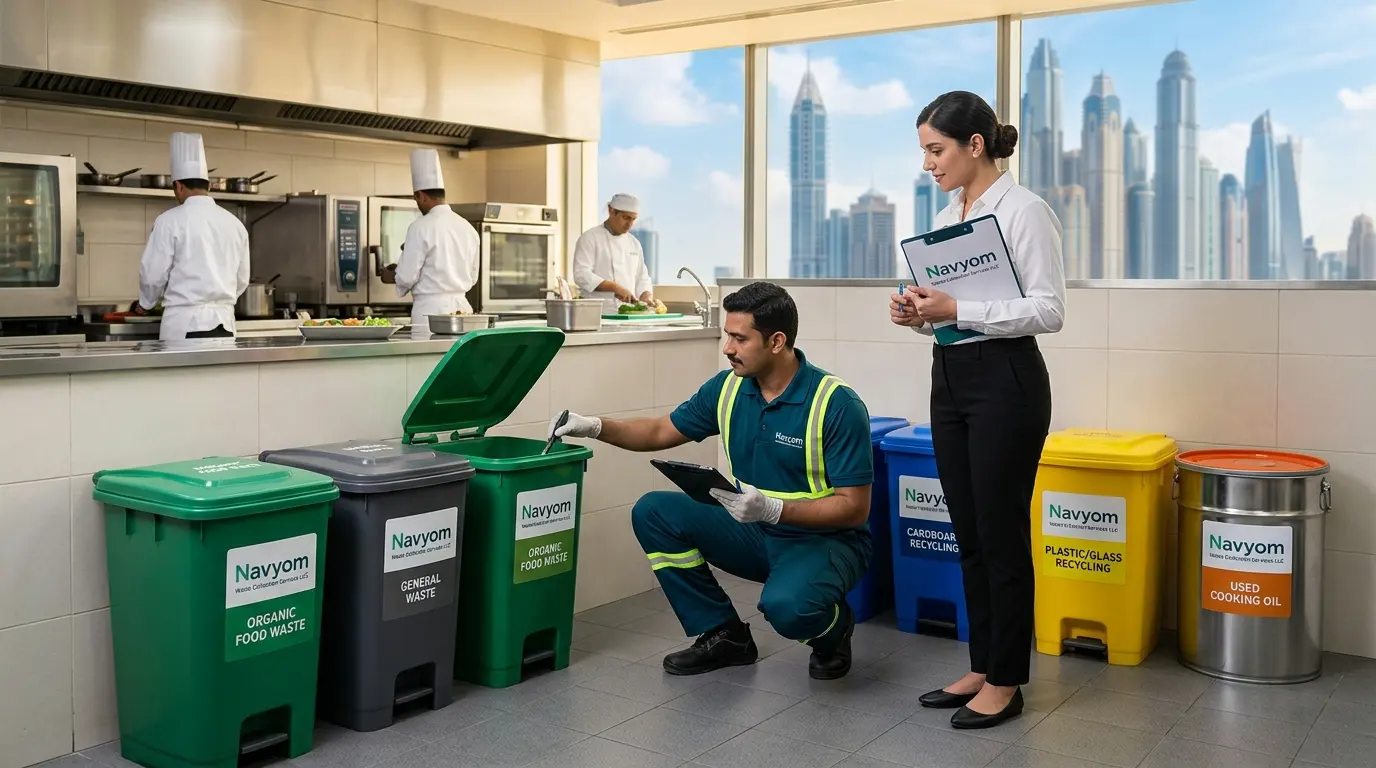
Running a food and beverage operation in Dubai means managing more waste streams than most operators expect. You’ve got your daily food scraps, used cooking oil, grease trap sludge, cardboard and packaging, glass, general dry waste — and depending on your setup, possibly clinical or chemical waste if you’re in a hotel or commissary kitchen. Each one has its own handling requirements.
The problem isn’t usually a lack of awareness. It’s that most restaurant owners focus on getting food to the table and end up delegating waste to whoever showed up with a truck last. That approach worked fine until Dubai Municipality started tightening F&B waste enforcement — particularly around grease trap documentation, food waste diversion, and licensed contractor requirements. Now the gap between “we manage our waste” and “we manage it correctly” is becoming a compliance issue, not just an operational one.
This guide breaks down exactly what restaurant food waste collection in Dubai should look like in practice: what’s required, what’s commonly missed, and how to build a waste system that doesn’t become a liability during your next DM inspection.
Why F&B Waste Is Treated Differently in Dubai
Not all commercial waste is created equal in Dubai’s regulatory framework. Food and beverage businesses sit in a particularly scrutinised category because their waste presents a combination of risks: high organic content that decomposes rapidly in the UAE heat, fats, oils and greases (FOG) that can block drainage infrastructure, and high daily volumes that can overwhelm poorly planned collection schedules.
Dubai Municipality’s Food Safety Department and the Environment & Public Health department both have an interest in how F&B waste is handled. That dual oversight is important to understand. A failed health inspection can flag your waste practices just as easily as your kitchen hygiene — and the two are often assessed together.
The regulatory expectations cover four main areas:
- Grease trap installation and regular servicing — mandatory for most commercial kitchens connected to the drainage network
- Proper storage of food waste — sealed, refrigerated (where volumes are high), and removed before decomposition creates odour or pest issues
- Licensed contractor use — all waste, and especially liquid waste from grease traps, must be collected by a DM-approved or municipally licensed operator
- Documentation — service records, contractor approvals, and waste manifests need to be available on request
Many F&B tenants in malls and mixed-use developments assume their landlord or facilities management company handles waste compliance on their behalf. In practice, the F&B outlet is typically responsible for its own grease trap maintenance and organic waste management — even when operating inside a mall. Always confirm this in your tenancy agreement before assuming otherwise.
Understanding Grease Traps: What They Are and Why They Matter
A grease trap (also called a grease interceptor) is a plumbing device installed between your kitchen drains and the main sewer line. Its job is to separate fats, oils, and grease from wastewater before that water enters Dubai’s drainage infrastructure. Without it — or with a poorly maintained one — FOG enters the sewer system, solidifies, and causes blockages.
DEWA (Dubai Electricity and Water Authority) and Dubai Municipality both take FOG contamination in drainage networks seriously, and most commercial food establishments in Dubai are required to have an appropriately sized grease trap installed. The size depends on the volume of wastewater your kitchen generates, which correlates broadly with how many meals you serve per day.
How Often Should a Grease Trap Be Cleaned?
Cleaning frequency depends on the size of the trap and the volume of grease being generated. A small café might need servicing every four to eight weeks. A high-volume restaurant kitchen, particularly one doing a lot of frying, might need monthly or even fortnightly servicing. The general rule: if the grease layer and solids together exceed 25% of the trap’s liquid depth, it needs pumping.
Letting a grease trap go too long between services doesn’t just cause odour problems in your kitchen — it allows FOG to pass through into the sewer, which is exactly what regulators are trying to prevent. Inspectors can and do request service records. If you can’t produce them, that’s a compliance gap regardless of whether your trap is technically functioning at the time of inspection.
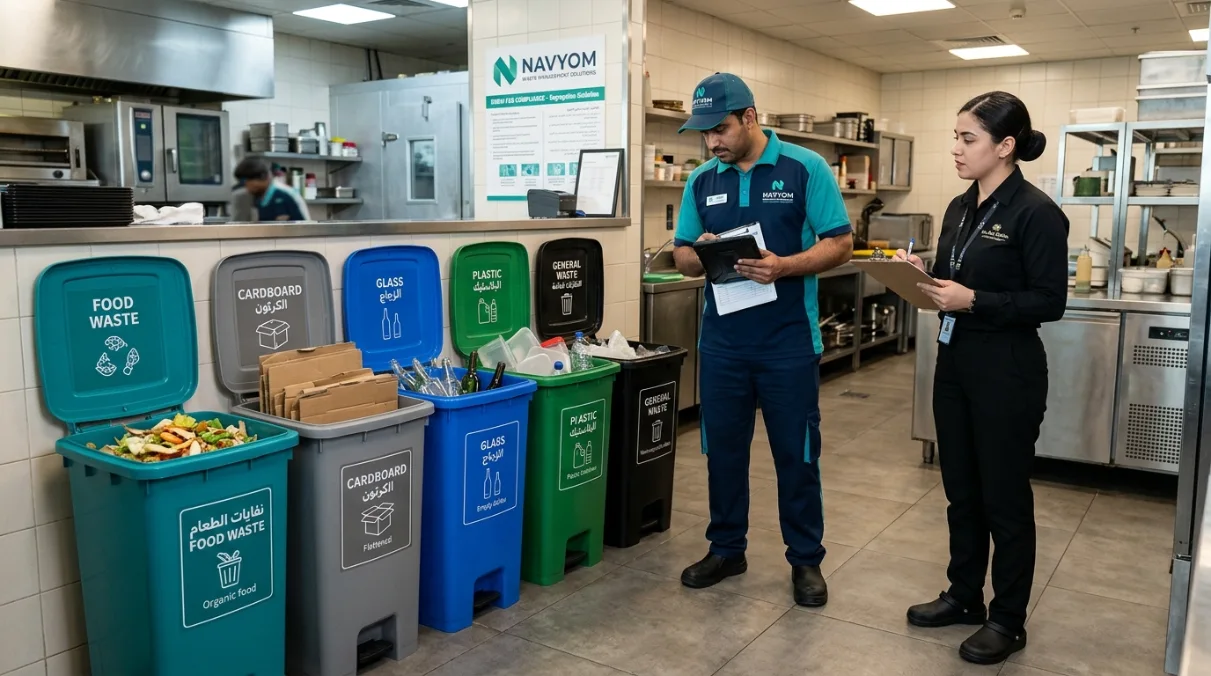
🔧 How to Set Up Compliant Grease Trap Management: Step by Step
- Confirm your trap size is adequate — have a qualified contractor assess whether your installed capacity matches your actual kitchen output. Undersized traps fill faster and require much more frequent service.
- Choose a DM-licensed liquid waste contractor — only approved contractors should be removing and disposing of grease trap contents. Ask for their licence number and verify it before signing a service agreement.
- Set a servicing schedule and stick to it — don’t wait until there’s a smell or a blockage. Schedule proactively based on your kitchen’s FOG load.
- Maintain a service log on-site — every service visit should be documented with date, contractor name, volume pumped, and disposal destination.
- Review the log at least quarterly — if servicing is being skipped or delayed, you’ll catch it before a regulator does.
Food Waste Segregation and Collection: The Daily Reality
Food waste from restaurant operations falls into two practical categories: preparation waste (vegetable trimmings, eggshells, coffee grounds, expired produce) and post-consumer waste (plate scrapings, leftover food from customer tables). Both need to be managed, but post-consumer waste is the higher-risk category because it involves mixed contamination and higher organic load.
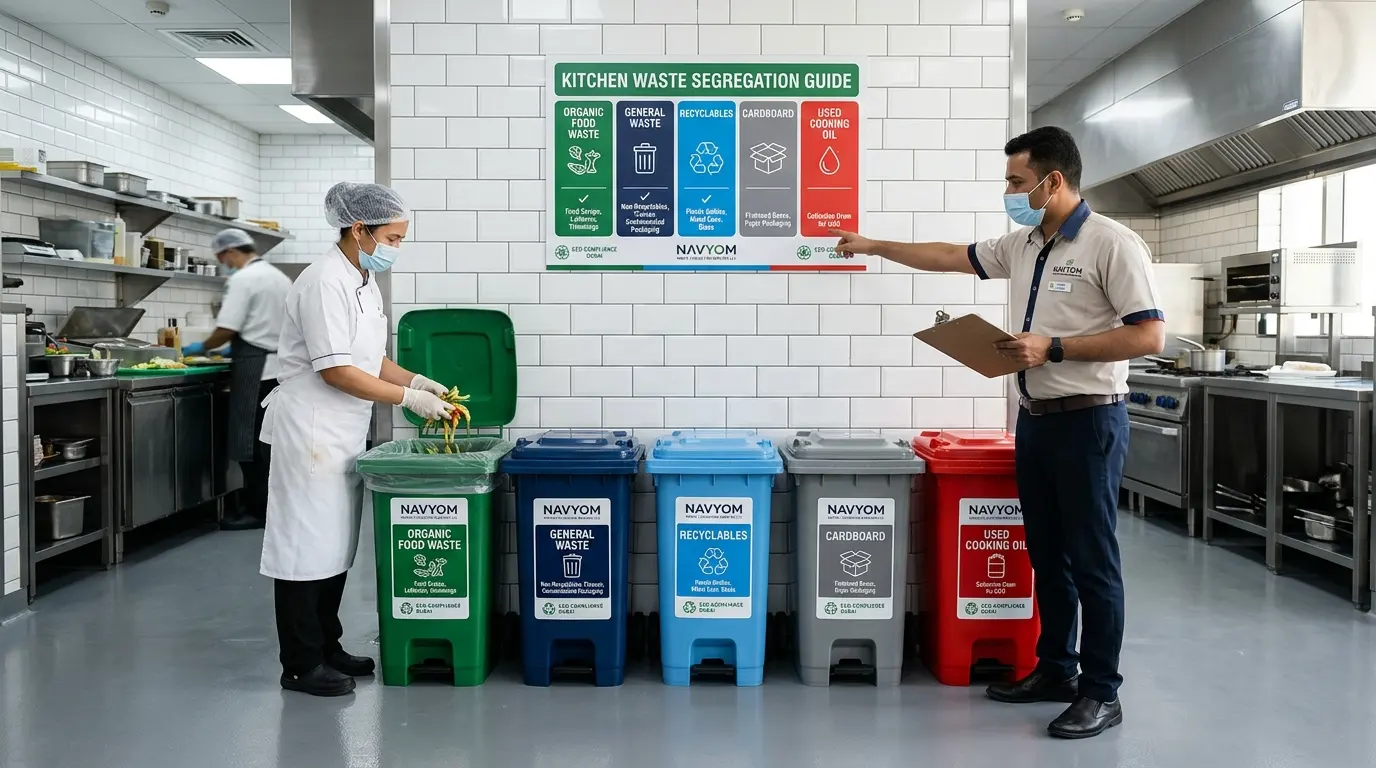
Dubai Municipality’s waste management framework pushes toward source segregation — separating organic waste from dry recyclables and general waste at the point of generation, rather than mixing everything together. For restaurants, that means having separate, clearly labelled bins for organic waste in the kitchen. It’s not universally enforced at every single F&B outlet right now, but the direction of regulation is clearly toward greater segregation and organic waste diversion, particularly for larger operators and hotels.
What Happens to Collected Food Waste?
Properly collected and segregated food waste in Dubai typically goes to one of several end destinations depending on the contractor and volume: anaerobic digestion facilities, composting operations, or in some cases biogas production. The key phrase is “properly collected” — food waste that’s been mixed with non-organic waste becomes much harder and more expensive to process, which is why contamination matters even for organic streams.
If you’re using a licensed organic waste contractor, they’ll often provide dedicated bins (usually brown or green lidded containers) and a collection schedule that aligns with your kitchen’s output volume. High-volume operators — hotels, large restaurants, ghost kitchens — may benefit from refrigerated storage for organic waste if collection is less than daily, particularly during the summer months when ambient temperatures accelerate decomposition significantly.
Under Dubai’s broader waste management strategy, the emirate has set ambitious landfill diversion targets. Organic food waste from commercial sources is one of the highest-priority streams for diversion because of its volume and environmental impact. F&B businesses that implement proper segregation now are better positioned as compliance requirements evolve — and increasingly, ESG-reporting hotel groups and restaurant chains are required to demonstrate diversion rates to their parent companies and investors.
Cooking Oil Disposal: A Separate Stream With Separate Rules
Used cooking oil (UCO) is not the same as grease trap waste, and it can’t go into your regular food waste bin. It’s a liquid waste with value — refined UCO is a feedstock for biodiesel and other industrial uses — and in Dubai there are licensed collectors who will pick it up, sometimes at no cost or even for a small payment depending on volume and quality.
The compliance concern here is simpler: pouring used cooking oil down the drain is illegal and accelerates grease trap blockages. Disposing of it in general waste bins is incorrect practice and creates safety and pest risks. The right approach is to store it in sealed, dedicated containers (often provided by your UCO collector) and arrange regular collection. Most active F&B areas in Dubai — Al Quoz, JLT, DIFC, Downtown, Business Bay — have UCO collectors operating commercially.
Comparison: Key Waste Streams for Dubai Restaurants
| Waste Stream | Storage Requirement | Collection Frequency | Licensed Contractor? | Disposal / End Use |
|---|---|---|---|---|
| Food / Organic Waste | Sealed bin; refrigerated for high volumes in summer | Daily to every 2 days | Yes (DM-approved) | Composting, anaerobic digestion, biogas |
| Grease Trap Waste | Contained in trap; log service dates | Monthly to fortnightly (based on load) | Yes — liquid waste licence required | Licensed liquid waste facility |
| Used Cooking Oil | Sealed dedicated container; not with other liquids | Weekly to bi-weekly | Yes (UCO specialist or DM-approved) | Biodiesel / industrial refining |
| Cardboard / Paper Packaging | Flattened, dry, separate from food waste | 2–3x per week | Yes for collection; recyclers preferred | Paper recycling mills |
| Glass (bottles, jars) | Rinsed, separate bin | Weekly | Recycler or DM-approved | Glass recycling (cullet) |
| Plastic Packaging | Segregated, clean where possible | Weekly to bi-weekly | Yes (recycler or licensed waste collector) | Plastic recycling; varies by type |
| General / Residual Waste | Standard covered bins | Daily | Yes (DM municipal or licensed private) | Waste-to-energy or landfill (Jebel Ali) |
Situation-Based Guidance: Your Setup Changes the Answer
Small Café or Kiosk
You’re generating relatively modest volumes, but you still need a grease trap if you’re doing any cooking or dishwashing connected to the drain. Your biggest compliance risk is usually documentation — specifically, not having a service record for your grease trap, or using an unlicensed contractor because a cheaper option presented itself. Prioritise getting the right contractor over saving a few hundred dirhams.
Full-Service Restaurant (50–200 covers)
You’re likely generating 30–80 kg of food waste per day depending on cuisine type and service style. At this scale, you need a proper food waste collection agreement, not ad hoc arrangements. A structured collection schedule — typically daily or every two days — prevents buildup and keeps your cold store from becoming a decomposing mess. Review whether your current grease trap size is adequate for your actual covers, not just the original design spec.
Hotel F&B / Large Restaurant Groups
Multiple outlets, high volumes, and corporate sustainability targets mean your waste management has to be documented, audited, and reportable. You’ll need waste manifests for all streams, regular contractor performance reviews, and increasingly, diversion rate reporting. Consider a waste cost audit to understand where your current spend is going versus where segregation could reduce it.
Cloud Kitchen / Ghost Kitchen
Cloud kitchens often operate in industrial areas like Al Quoz, DIP, or Jebel Ali, which can affect which municipal services are available and what licensing requirements apply. If you’re sharing a facility with other operators, clarify in writing who is responsible for each waste stream — ambiguity here is a common source of compliance failures during inspections.
Mall or Food Court Tenant
Your landlord almost certainly handles general waste collection, but grease trap servicing for your specific unit is typically your responsibility. Don’t assume it’s covered in the service charges. Check your fit-out handover documentation and your FM agreement carefully.
Not Sure What Your Waste Costs Should Be?
The DubaiWaste.com Waste Management Cost Estimator helps F&B operators benchmark collection costs by waste stream, volume, and frequency — so you can tell whether your current arrangement is fair, overpriced, or dangerously under-serviced.
Try the Cost Estimator Check Your Compliance RiskCommon Mistakes F&B Operators Make — and What Inspectors Actually Look For
This is the section most waste guides skip. Here’s what actually goes wrong in Dubai restaurant operations, based on recurring compliance patterns:
- Using an unlicensed contractor for grease trap pumping. It’s cheaper, faster to arrange, and almost impossible to distinguish from a legitimate service — until an inspector asks for the contractor’s licence number and disposal manifest. If you can’t produce them, the liability is yours, not the contractor’s.
- No food waste segregation in the kitchen. Mixing food waste with general waste doesn’t just create compliance risk — it makes recycling of other materials (cardboard, glass, plastic) impossible because everything gets contaminated. It also increases the weight and cost of your general waste collection.
- Grease trap size mismatch. A restaurant that has grown its covers since fit-out often has an undersized grease trap. The trap fills faster, requires more frequent servicing, and fails intermittently — all of which creates documentation gaps and potential drainage issues.
- Pouring used cooking oil down the drain or into general waste. This is both an environmental offence and a practical problem. It accelerates grease trap blockages dramatically.
- Letting waste storage areas become a pest attractant. Inspectors assess the entire food handling environment, and an overflowing or poorly sealed waste storage area adjacent to a kitchen is a red flag in its own right — separate from the waste compliance question.
- No service records retained on site. Even if your grease trap is being serviced correctly, if you can’t show the log, you have no proof. Keep at least 12 months of service records in a dedicated file, either physical or digital.
Some of the guidance in this article is based on operational best practice rather than hard regulatory mandates that apply universally across all F&B settings in Dubai. The specific requirements for your outlet depend on its size, location, licence type, and the nature of food preparation. Always verify current requirements directly with Dubai Municipality or a licensed waste consultant before making structural changes to your waste management setup — particularly around grease trap specifications and contractor obligations.
Cardboard, Packaging, and Dry Recyclables: Don’t Let the Easy Wins Go to Landfill
Restaurants generate significant volumes of cardboard — deliveries come in boxes every day. Most of that cardboard goes straight into a general waste skip and ends up at landfill or incineration, which is unnecessary both environmentally and economically. Cardboard recycling is readily available across Dubai’s commercial districts, and many licensed contractors will collect segregated cardboard either at a reduced rate or as part of a recycling arrangement.
The same applies to glass bottles (particularly for licensed venues or restaurants with bar operations), plastic packaging, and aluminium cans. None of these are complex to segregate. They just require a separate bin in the storage area and the right collection arrangement. For a guide to how glass recycling works specifically in the Dubai context, see glass recycling in Dubai and the plastic waste recycling guide on DubaiWaste.com.
Documentation: The Part That Actually Gets You Through an Inspection
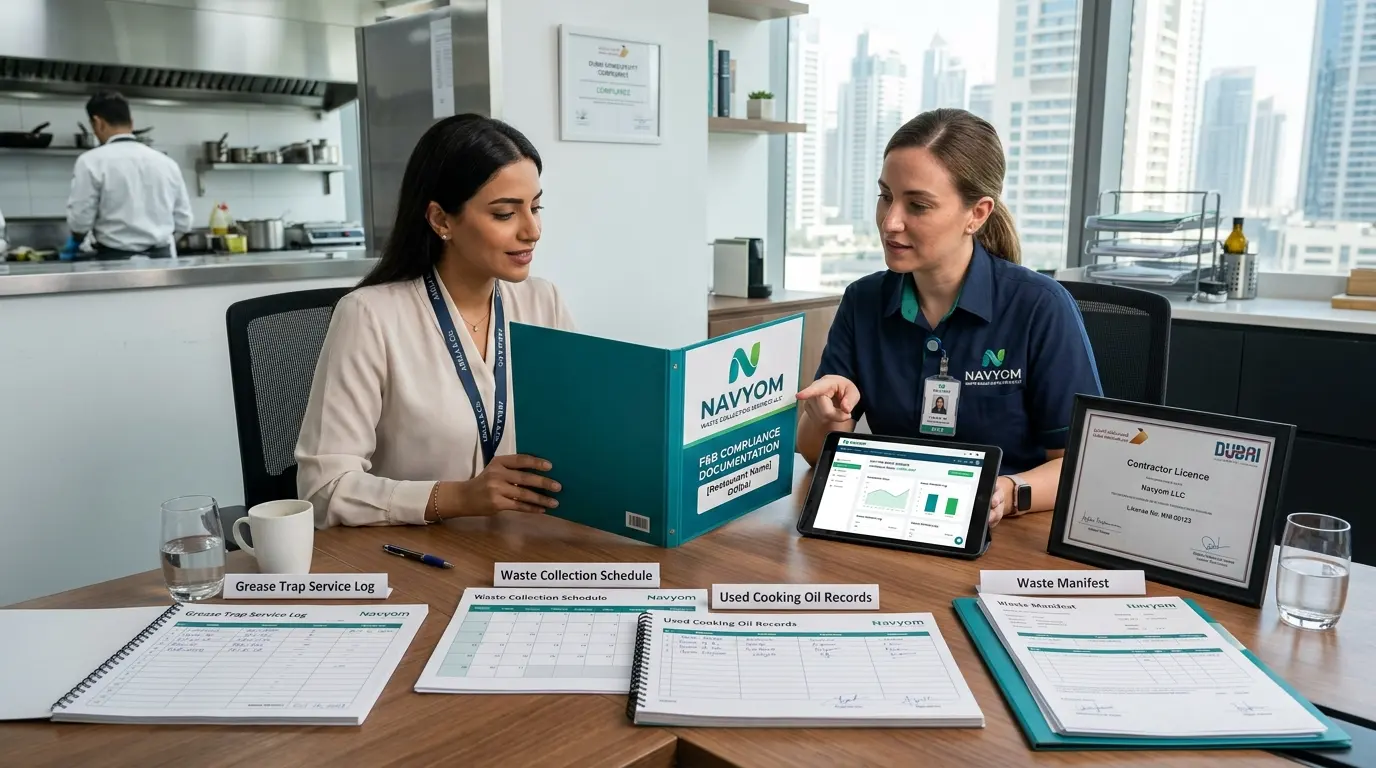
Good waste practice without documentation is like a clean kitchen without a health certificate — it may be real, but it won’t protect you during an official visit. The paperwork that F&B operators need to have accessible includes:
- Grease trap service log (contractor name, date, volume pumped, disposal destination)
- Copy of your waste contractor’s DM licence or relevant municipal approval
- Waste collection schedule and agreement (written, not just verbal)
- Used cooking oil collection records
- Any waste manifests or transfer documentation issued by your contractor
If any of this is missing or out of date, address it before your next scheduled inspection, not after a notice has been issued. Review your current documentation level against the Dubai waste management guide to see where the gaps typically are for F&B businesses.
Your Fast-Track Cheat Sheet: Top 3 Actions to Take
- Get your grease trap situation in order first. Confirm your trap is adequately sized, schedule regular servicing with a DM-licensed liquid waste contractor, and start maintaining a service log today. This is your highest-compliance-risk area.
- Segregate food waste from general waste at source. Put a dedicated organic waste bin in your kitchen, identify a licensed food waste collector, and set a collection schedule matched to your kitchen’s daily output. Don’t mix it — mixing it makes everything more expensive and less compliant.
- Build your documentation folder now, not after a notice. Collect contractor licences, service records, and collection agreements into one accessible file. If you can’t produce these on request during an inspection, the fact that the work was done correctly becomes very hard to prove.
Frequently Asked Questions: Restaurant Food Waste Collection Dubai
Do Dubai restaurants need a licensed waste contractor for food waste collection?
Yes. All commercial waste collection in Dubai — including food and organic waste — must be carried out by a contractor approved by Dubai Municipality or the relevant local authority. Using an unlicensed collector doesn’t just risk a fine; it means your waste handling can’t be verified or documented for compliance purposes.
How often does a grease trap need to be cleaned in Dubai?
Typically every four to eight weeks for lower-volume operations, and monthly or fortnightly for high-volume kitchens with heavy frying activity. The practical trigger: service is needed when the combined grease and solids layer exceeds 25% of the trap’s liquid depth. A licensed liquid waste contractor can assess the right frequency for your specific setup.
Can I pour used cooking oil down the drain in Dubai?
No. Disposing of used cooking oil into the drainage system is prohibited and contributes directly to sewer blockages. UCO must be stored in sealed containers and collected by a licensed used cooking oil contractor. Several UCO collectors operate commercially in Dubai and many offer free pickup for sufficient volumes.
What documents should I keep for waste compliance as a restaurant in Dubai?
At minimum: your grease trap service log (date, contractor, volume, disposal destination), your contractor’s DM licence, any written collection agreements, and UCO collection records. Retain at least 12 months of records on site. These may be requested during a Food Safety or Environment Department inspection.
Who is responsible for grease trap maintenance in a mall food court?
Typically the individual F&B tenant, not the mall landlord — even though the landlord may handle general waste. This isn’t universal, so you need to check your specific tenancy and facilities management agreement. Assuming it’s covered in service charges is one of the most common compliance errors for food court operators in Dubai.
Does Dubai require restaurants to segregate food waste from general waste?
Dubai Municipality encourages and increasingly requires source segregation, particularly for commercial food businesses. Formal requirements are more stringently applied to larger operators and hotels, but the regulatory direction is clear — segregation is expected practice across the F&B sector, and operators with poor waste practices are more exposed during inspections.
What is the fine for improper waste disposal by a restaurant in Dubai?
Fines vary by the nature of the violation, the authority involved, and whether it’s a first or repeat offence. Serious infractions — like discharging grease into the drainage system or using unlicensed contractors — can result in significant penalties and potential operational suspension. Use the Waste Fine Risk Checker on DubaiWaste.com to assess your current exposure.
Can cloud kitchens in Dubai use the same waste collection setup as traditional restaurants?
It depends on location. Cloud kitchens in industrial areas like Al Quoz or DIP may fall under different municipal jurisdiction than those in commercial zones. Shared facility operators need to formally agree which tenant is responsible for each waste stream. Verify requirements with your licensing authority and confirm contractor approvals for your specific address.