Dubai Waste
Management
Guide 2026
The definitive resource for Dubai businesses — covering regulations, costs, WTN compliance, industry-specific rules, and licensed solutions under Law No. 18 of 2024.
Waste management in Dubai is a government-regulated system overseen by Dubai Municipality (DM) under Law No. 18 of 2024. All Dubai businesses must segregate waste into classified streams, use a DM-licensed contractor, and issue a Waste Transfer Note (WTN) for every regulated collection via the Montaji digital portal. Non-compliance carries fines ranging from AED 500 to AED 500,000. Dubai’s waste system covers six primary waste types: general, construction & demolition, hazardous, medical, electronic, and organic waste.
- All commercial waste movements require a Waste Transfer Note (WTN) submitted digitally via Dubai Municipality’s Montaji platform within 24 hours
- Using an unlicensed waste contractor exposes the business owner (not just the contractor) to fines of AED 10,000–50,000
- Waste segregation is mandatory — mixing hazardous with general waste carries fines up to AED 200,000
- General waste costs AED 100–250/tonne; hazardous waste can reach AED 300–800/tonne
- Dubai’s Warsan Waste-to-Energy plant processes 1.8 million tonnes/year — the largest in MENA
- Dubai targets 75% landfill diversion by 2030 under the Clean Energy Strategy
Dubai’s Waste Stream Breakdown
Dubai generates over 22 million tonnes of waste annually across the UAE. Construction & demolition waste dominates the stream at 76%, followed by municipal solid waste and organic materials from the city’s booming hospitality sector.
Understanding your waste composition is the first step to cost reduction and compliance. Businesses that accurately classify their waste streams save 15–30% on disposal costs.
Calculate My Waste Costs →Source: Dubai Municipality Environment Report 2025
Waste management in Dubai is a government-regulated system overseen by Dubai Municipality (DM) covering the collection, segregation, transfer, recycling, and disposal of all waste. Businesses must use licensed contractors and comply with Law No. 18 of 2024. The system spans six primary waste types: general, construction, hazardous, medical, electronic, and organic.
Licensed contractors collect waste and issue a Waste Transfer Note (WTN) for every load via the Montaji portal. Waste moves to approved transfer stations, then to the Warsan Waste-to-Energy plant (1.8M tonnes/year capacity), recycling facilities, or permitted landfill — depending on waste classification and quality.
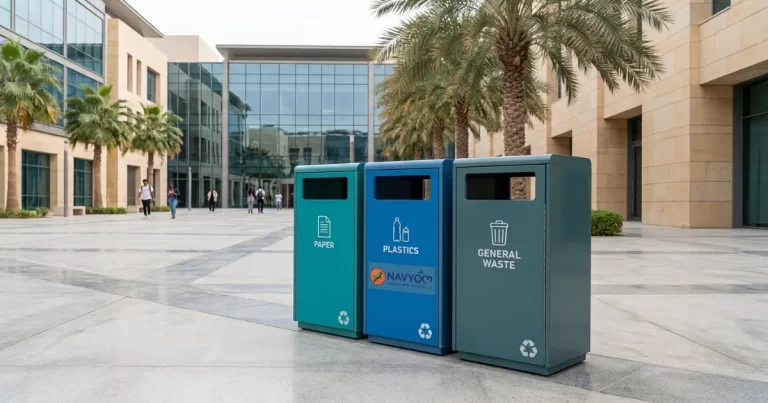
All Dubai businesses must: (1) segregate waste at source using colour-coded bins, (2) use a DM-licensed contractor, (3) obtain a WTN per collection via Montaji, and (4) maintain a hazardous waste register if applicable. Hazardous, medical, and construction waste require specialised contractors and additional documentation under Law No. 18 of 2024.
Dubai waste disposal costs: general waste AED 100–250/tonne, construction waste AED 150–400/tonne, hazardous waste AED 300–800/tonne, medical waste AED 400–1,200/tonne. Landfill gate fees are AED 100–400/tonne (Dubai Municipality regulated). Use our free cost estimator for a business-specific quote.
A Waste Transfer Note (WTN) is a legally required digital document in Dubai recording waste type, quantity, origin, and destination. Every business generating, transporting, or receiving commercial waste must issue a WTN via Dubai Municipality’s Montaji platform within 24 hours of collection. Missing WTNs attract fines of AED 5,000–50,000.
How Waste Management Works in Dubai
Dubai operates one of the most advanced waste management systems in the Middle East, governed by Dubai Municipality (DM) under the Environment Department. The system spans every stage from waste generation through to energy recovery.
Waste Generation & Segregation
Businesses separate waste at source into colour-coded streams: general (black), recyclables (yellow), organic (green), and hazardous (red), per Dubai Municipality guidelines.
Licensed Collection
A DM-licensed contractor collects your waste and issues a Waste Transfer Note (WTN) via Montaji, documenting quantity, type, and destination for every load.
Transfer & Digital Tracking
WTNs are submitted via the Montaji system in real time. Waste is transported to a registered transfer station where it is weighed, logged, and sorted for processing.
Processing & Final Disposal
Waste is directed to the Warsan Waste-to-Energy plant (1.8M tonnes/year capacity), recycling facilities, or permitted landfill — depending on waste classification and quality.
Types of Waste in Dubai
Dubai Municipality classifies waste into six primary categories. Each carries specific rules, disposal methods, and penalties for non-compliance. Understanding your waste stream is the foundation of legal compliance and cost control.
Construction & Demolition Waste
Includes concrete, rubble, steel, timber, plasterboard, tiles, and excavated soil from construction, renovation, or demolition activities. C&D waste accounts for approximately 76% of Dubai’s total waste volume — making it the highest-risk category for violations.
Site Obligation: Every construction site must have a Site Waste Management Plan (SWMP) and a licensed contractor issuing WTNs per load. Full construction waste guide →
Medical & Clinical Waste
Encompasses sharps, infectious materials, anatomical waste, pharmaceuticals, and pathological waste from hospitals, clinics, laboratories, and dental practices.
Medical waste must be stored in UN-approved, colour-coded containers and collected by a DHA-approved contractor. Full medical waste guide →
Hazardous Waste
Includes chemicals, solvents, oils, paints, pesticides, batteries, contaminated soil, and asbestos. Common in manufacturing, automotive, printing, and construction industries.
Businesses must maintain a Hazardous Waste Register and contract a TSDF licensed by Dubai Municipality’s Environment Section.
Electronic Waste (E-Waste)
Includes computers, phones, printers, servers, TVs, and end-of-life electronics. E-waste contains recoverable materials (gold, copper) alongside toxic substances including lead and mercury.
Corporate bulk e-waste must be handled by a Tadweer-certified recycler with full chain-of-custody documentation and data destruction certificates.
Organic & Food Waste
Food waste from restaurants, hotels, and food processors. Organic material makes up approximately 40% of Dubai’s municipal solid waste. Mandatory segregation for HORECA businesses under Dubai’s Zero Food Waste initiative.
Hotels serving >200kg of food/day must report food waste volumes to Dubai Municipality and use an approved organic waste contractor.
General Municipal Solid Waste
Non-recyclable, non-hazardous waste from offices, retail, and residential premises — packaging, office rubbish, and mixed non-segregated waste streams.
Even general waste requires a licensed contractor and WTN. Mixing hazardous or medical waste with general waste is a serious offence under Dubai law with fines up to AED 200,000.
Dubai Waste Laws & Compliance (2024–2026)
Dubai’s primary waste legislation was significantly updated with Law No. 18 of 2024, strengthening penalties for illegal disposal, tightening WTN requirements, and expanding business accountability across all sectors.
Fines & Penalty Schedule — Dubai Municipality 2024
| Violation | Fine (AED) | Severity | Repeat Offence |
|---|---|---|---|
| Illegal dumping of general waste (minor) | 500 – 2,000 | Level 1 | Double + mandatory clean-up |
| Failure to segregate waste at source | 1,000 – 5,000 | Level 1 | 5,000 – 15,000 |
| Operating without a licensed waste contractor | 10,000 – 50,000 | Level 2 | License suspension |
| Missing or falsified Waste Transfer Note | 5,000 – 50,000 | Level 2 | Criminal referral |
| Abandoning construction waste on public land | 20,000 – 100,000 | Level 3 | Site closure order |
| Mixing hazardous with general waste | 50,000 – 200,000 | Level 4 | Criminal prosecution |
| Illegal disposal of medical/clinical waste | 100,000 – 500,000 | Level 5 | Criminal prosecution + closure |
| Unlicensed hazardous waste treatment | 200,000 – 500,000 | Level 5 | Criminal + civil liability |
Business Compliance Checklist — Dubai Municipality 2026
- Waste segregation bins installed and colour-coded per Dubai Municipality specification
- Current contract with a Dubai Municipality-licensed waste contractor (verify DM licence number)
- Waste Transfer Notes (WTN) issued and archived for every collection via Montaji portal
- Montaji or Trakhees portal account active, credentials current, and accessible to compliance team
- Hazardous waste register maintained and updated (if applicable)
- Medical waste stored in UN-approved, colour-coded containers (clinics/hospitals)
- Site Waste Management Plan (SWMP) in place for all active construction sites
- All staff trained on waste segregation procedures and contractor contact protocols
- Annual waste audit conducted and documented for ESG reporting and DM inspection readiness
Generate a custom checklist for your industry: WTN Compliance Checklist Generator →
Cost of Waste Management in Dubai (2026)
Waste management costs in Dubai vary based on waste classification, volume, collection frequency, and contractor. Understanding the full cost structure helps businesses budget accurately and identify 20–40% savings opportunities.
Collection + transfer + disposal
Includes skip hire + haulage
Treatment + documentation + disposal
Specialist contractor + incineration
Dubai Municipality regulated rate
6 Factors That Affect Your Waste Management Cost
Waste Classification
Hazardous and medical waste costs 3–5× more than general waste due to specialist handling, documentation, and disposal requirements.
Volume & Frequency
Higher volumes attract lower per-tonne rates. Daily collection is more expensive than scheduled weekly or bi-weekly contracts.
Segregation Quality
Contaminated recyclable loads are reclassified at the facility and charged at the higher general waste rate — plus possible fines.
Location in Dubai
Businesses in free zones (JAFZA, DIP) may have separate contractor frameworks. Remote areas incur additional haulage charges.
Container Type
Oversized skips or bins for small volumes inflate cost per tonne. Right-sizing containers to actual generation rates reduces spend.
Contractor Choice
Rates vary 15–30% across licensed contractors. Bundled multi-stream contracts typically yield lower blended per-tonne rates.
Industry-Specific Waste Management in Dubai
Each sector in Dubai generates distinct waste streams, faces different compliance requirements, and needs tailored solutions.
Hotels & Hospitality
HORECA · High VolumeHotels generate food waste, mixed recyclables, linen, chemical waste, and construction debris during renovations.
- Mandatory food waste segregation for properties >100 covers
- DTCM audit compliance for waste documentation
- Chemical waste (cleaning & laundry) requires hazardous handling
- Green Key certification requires full waste data reporting
Restaurants & F&B
F&B · Organic-HeavyF&B operators face strict DM food waste obligations under Dubai’s Zero Food Waste initiative.
- Separate collection: food waste, cardboard, glass, grease traps
- Grease trap waste needs a licensed liquid waste contractor
- Dubai Municipality inspections can be unannounced
- Proper waste storage essential to avoid pest infestation fines
Construction Companies
C&D Waste · High RiskC&D projects are the highest-risk category for waste violations. A single site can generate thousands of tonnes requiring full documentation.
- Site Waste Management Plan (SWMP) required at permit stage
- Separate skips for concrete, metal, wood, and general C&D waste
- WTN mandatory for every skip or bulk load leaving site
- Asbestos and contaminated soil require specialist management
Offices & Corporate
Commercial · ESG ReportingOffice buildings generate paper, packaging, e-waste, and general waste with growing ESG reporting requirements.
- Paper/cardboard recycling can reduce general waste by 30%
- E-waste must be separately collected and documented
- ESG waste data required by corporate reporting frameworks
- Waste audits support Estidama and LEED certification
Healthcare & Clinics
Medical · Strict ProtocolHealthcare facilities face the strictest obligations in Dubai. Non-compliance carries criminal penalties.
- DHA-approved clinical waste contractor mandatory
- Colour-coded UN-certified containers at every point of care
- Sharps bins sealed at ¾ capacity — never overfilled
- Annual DHA waste management audit for licence renewal
Waste Management by Area in Dubai
Waste management requirements and contractor availability differ across Dubai’s key business and industrial zones.
JAFZA uses Trakhees-based WTN system. Industrial and hazardous waste volumes are high. Separate authorisation required for hazmat.
JAFZA waste guide →Dense industrial operations with mixed waste. DM enforcement is active with regular inspections.
Al Quoz waste guide →Mixed commercial towers generate office, F&B, and renovation waste. Shared building contracts offer cost savings.
Business Bay guide →Strict environmental management requirements. DIP-approved contractors only; quarterly environmental compliance reports required.
DIP waste guide →High-footfall retail and F&B generate large general and organic volumes. Smart compactors widely deployed.
Downtown guide →Aviation and logistics waste regulated by GCAA and DAFZ rules in addition to Dubai Municipality. Multi-authority compliance required.
Dubai South guide →Smart Waste & AI Systems in Dubai
Dubai is a global frontrunner in smart waste technology, integrating AI-driven inspections, IoT-connected bins, and blockchain-backed documentation into its waste infrastructure.
AI-Powered Inspections
Dubai Municipality deploys AI-enabled drone surveillance and fixed CCTV with computer vision to detect illegal dumping, open waste burning, and non-compliant skip placement. Automated fine notices are issued within 48 hours. In most urban zones, illegal dumping is effectively impossible to conceal.
Smart Bins & Sensor Networks
Over 10,000 smart bins with fill-level sensors are deployed across Dubai. Data feeds into DM’s centralised operations platform, enabling dynamic collection scheduling — reducing unnecessary collections by up to 40% and cutting carbon emissions from waste fleets.
Digital WTN Tracking (Montaji)
Dubai Municipality’s Montaji platform digitises the full Waste Transfer Note lifecycle. WTNs are issued, signed, and submitted in real time from the collection vehicle. Businesses access a full audit trail dashboard. Paper WTNs are no longer accepted for most commercial waste streams as of 2025.
Dubai Waste Management Tools
Free, purpose-built tools for Dubai businesses to estimate costs, check compliance, and generate documentation.
Waste Cost Estimator
Enter industry, waste volume, and collection frequency. Get an instant, market-calibrated cost estimate including landfill fees and contractor rates.
WTN Checklist Generator
Answer 5 questions about your business. Receive a customised Waste Transfer Note compliance checklist for your team or contractor.
Fine Risk Checker
Select your industry and current waste practices. Instantly identify which Dubai Municipality violations you may be exposed to with corrective action guidance.
Landfill Savings Calculator
See how much your business could save by diverting waste from landfill through recycling or waste-to-energy. Calculate ROI on segregation investments.
How to Reduce Waste Management Costs in Dubai
Dubai businesses can typically reduce waste management spend by 20–40% by implementing these strategies — without compromising compliance.
Implement Source Segregation
A basic 3-bin system prevents expensive contamination reclassification. Clean recyclables cost far less to process than mixed waste. Savings: up to 25%.
Maximise Recycling Volume
Cardboard, paper, metals, and clean plastics often carry zero or negative collection costs when volumes are sufficient. Offset disposal fees with recovered material value.
Right-Size Your Containers
Oversized skips result in paying per lift for partially full containers. Track actual waste volumes over 4 weeks, then right-size containers and collection frequency.
Avoid Load Contamination
A single contaminated recyclables load gets reclassified as general waste at the higher rate plus potential fines. Staff training pays for itself within months.
Negotiate Bundled Contracts
Using one licensed contractor for all waste streams typically yields 15–20% lower blended rates than separate single-stream contracts with multiple providers.
Divert Organic Waste
For F&B businesses, organic waste is heavy, costly to landfill, and increasingly regulated. Composting or anaerobic digestion partnerships significantly reduce landfill tonnage and fees.
Sources: Dubai Municipality, UAE Ministry of Climate Change, Warsan Clean Energy (2025)
Dubai Waste Management — Frequently Asked Questions
Authoritative answers to the most common questions about waste management in Dubai — structured for Google AI Overviews, People Also Ask, and LLM citations.
What is waste management in Dubai?+
How much does waste collection cost in Dubai?+
What happens if waste is mixed in Dubai?+
Do businesses need a WTN in Dubai?+
Who regulates waste management in Dubai?+
What is the Warsan Waste-to-Energy plant?+
How do I find a licensed waste contractor in Dubai?+
Are there special rules for construction waste in Dubai?+
What is Dubai’s waste diversion rate?+
What fines apply to hotels for waste violations in Dubai?+
Get Compliant Waste Collection
in Dubai Today
Stop risking fines. Get a Dubai Municipality-compliant waste collection service with full WTN documentation — tailored to your business type and location in Dubai.
*Subject to terms. Applies when using our recommended licensed contractors and documented WTN process.