Introduction: Demolition at the Water’s Edge
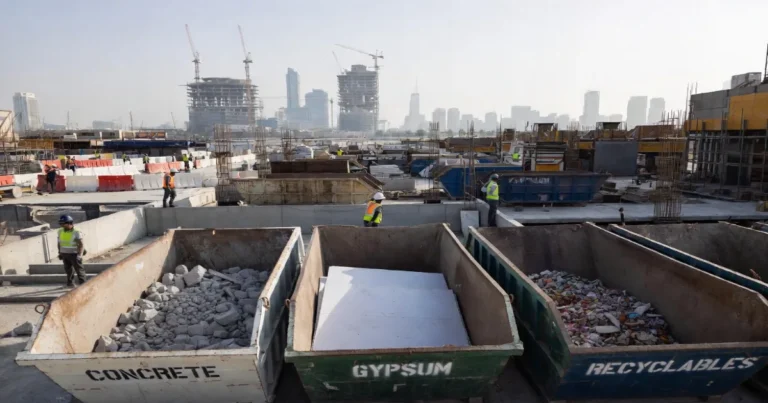
A demolition crew begins dismantling an older structure along Dubai’s coastline. From the surface, it looks similar to any other project. Concrete is broken down. Materials are sorted. Skips are positioned nearby.
But unlike inland sites, the boundary of this project is not a fence or road. It is the sea.
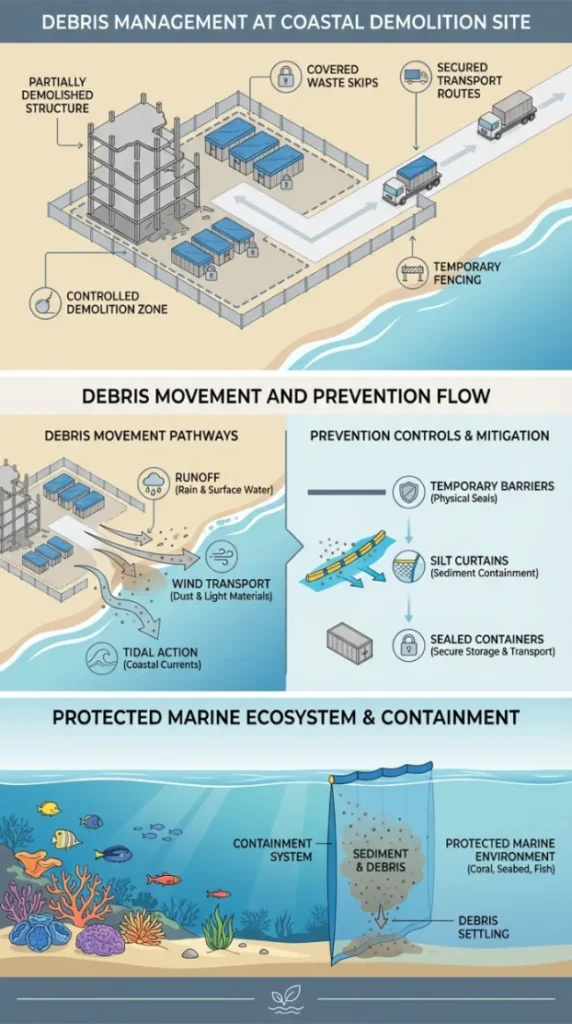
Tides rise and fall. Wind patterns shift throughout the day. Fine dust does not settle where it falls. Water used for dust suppression does not stay on-site. What leaves the demolition zone can move quickly and invisibly into marine environments.
This is why coastal demolition is fundamentally different from inland work. Small oversights can have large environmental consequences. Managing demolition debris near the sea is not just a logistical task—it is an environmental responsibility that affects marine ecosystems beyond the project footprint.
Dubai’s coastline supports coral systems, shallow marine habitats, and sensitive seabed environments. These ecosystems recover slowly from disturbance. Once contamination occurs, reversal is difficult, costly, and sometimes impossible.
For this reason, demolition projects near the coast require higher levels of planning, control, and accountability from the earliest stages.
Why Coastal Demolition Is Environmentally Sensitive
Tidal movement multiplies risk
On inland sites, debris generally stays where it falls unless physically moved. In coastal environments, tides introduce constant motion. Materials deposited near the shoreline during low tide may be submerged hours later and carried offshore.
Even fine particles that seem insignificant on land can travel long distances once they enter tidal water.
Fine debris behaves differently in water
Concrete dust, gypsum powder, and coating residues do not immediately sink and settle. Many remain suspended in the water column, reducing clarity and slowly depositing on coral, rocks, and seabeds.
Thin sediment layers—sometimes only millimeters thick—can block light, interfere with feeding, and stress marine organisms over extended periods.
Exposure of sensitive marine habitats
Dubai’s coastal zones include coral formations, seagrass beds, and mangrove ecosystems. These environments are particularly vulnerable to sedimentation and chemical exposure.
Unlike land vegetation, marine systems cannot be fenced off or quickly rehabilitated once contamination occurs.
Long-term environmental impact
Marine contamination often progresses quietly. Damage may not be visible from the surface, yet recovery can take months or years depending on water movement and ecosystem resilience.
This long recovery timeline is why coastal demolition is treated as an environmentally sensitive activity requiring stricter controls.
Common Types of Demolition Debris in Coastal Projects
Concrete and reinforcing steel
Concrete is the dominant material in most coastal demolitions. While structurally stable on land, fine cement particles increase water alkalinity and reduce oxygen levels when dispersed in marine environments.
Exposed reinforcing steel corrodes in saltwater, releasing metals into surrounding sediments over time.
Gypsum and drywall materials
Gypsum-based materials break down rapidly when exposed to moisture. In water, they dissolve and disperse, altering chemical balances and affecting aquatic life.
Because gypsum is lightweight and friable, it is particularly risky if not fully contained near the coast.
Treated and engineered wood
Coastal structures often use treated timber to resist moisture and pests. These treatments may contain preservatives that are stable on land but can leach into water once submerged or fragmented.
Wood debris can float, travel with tides, and introduce contaminants far from the original site.
Paints, coatings, and sealants
Older beachfront buildings frequently contain multiple layers of protective coatings. During demolition, flakes and residues can detach easily.
Even small quantities of coating material can affect marine organisms when dispersed repeatedly over time.
Plastics and insulation materials
Lightweight plastics, foams, and insulation travel easily by wind and water. Once in the marine environment, they degrade into microplastics that persist for decades.
Recovery of these materials after dispersal is extremely difficult.
How Marine Ecosystems Become Contaminated: Mechanisms Explained
Runoff during demolition
Cause: Water used for dust control or cleaning mixes with debris.
Effect: Contaminated runoff flows toward tidal zones.
Consequence: Pollutants enter marine systems and spread beyond the site.
Windborne particulate movement
Cause: Cutting and breaking materials generates fine dust.
Effect: Coastal winds carry particles offshore.
Consequence: Sediment settles on coral and seabeds.
Accidental material release
Cause: Poorly secured skips or manual handling errors.
Effect: Debris falls into water or near tidal edges.
Consequence: Immediate contamination with limited recovery options.
Inadequate containment
Cause: Insufficient barriers or uncovered storage.
Effect: Debris migrates during tides or weather changes.
Consequence: Repeated, low-level exposure over time.
These pathways are rarely unpredictable. In most cases, they result from known site conditions combined with inadequate controls.
Dubai Municipality Oversight for Coastal and Beachfront Sites
Coastal demolition projects in Dubai are treated differently from inland works because of their environmental risk profile. Dubai Municipality applies closer scrutiny to sites located near water bodies.
Why coastal sites receive additional attention
Water contamination spreads faster and is harder to contain than land-based pollution. Once debris enters the marine environment, recovery becomes complex and costly.
As a result, coastal projects are expected to demonstrate stronger preventive controls.
Key areas of regulatory focus
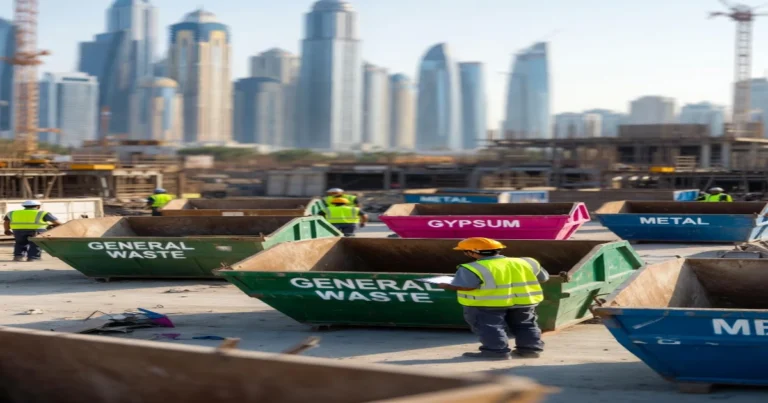
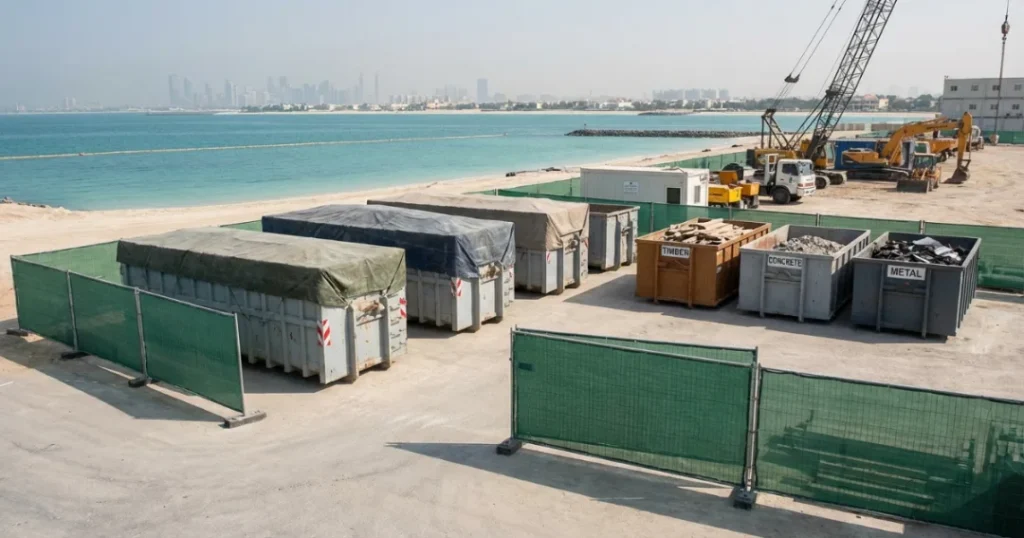
- Waste segregation: Materials must be separated to prevent cross-contamination.
- Transportation controls: Vehicles and routes must prevent leakage and spillage.
- Approved disposal pathways: Waste must reach facilities equipped to handle specific material types.
- Clear documentation: Records provide traceability and accountability throughout the process.
Importance of early compliance
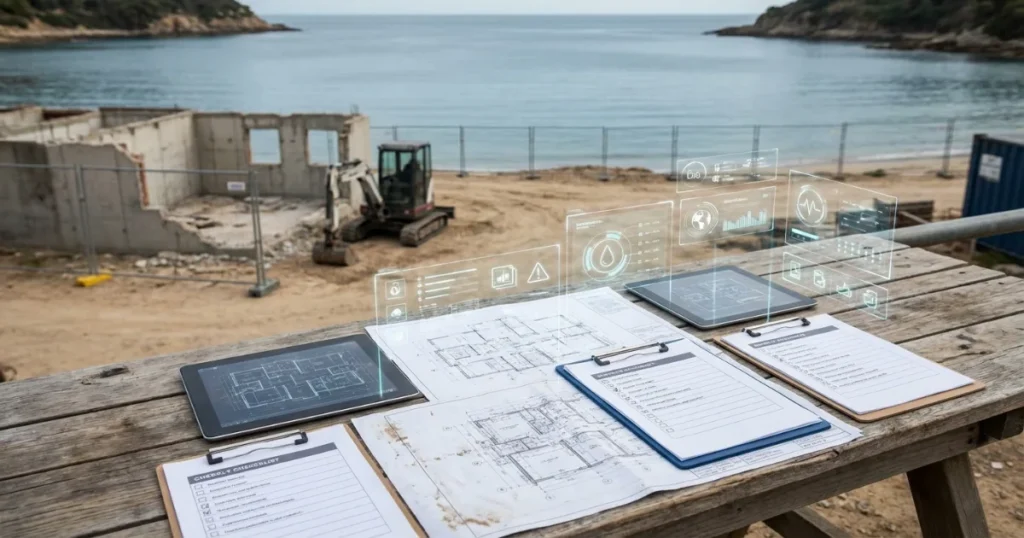
Many compliance issues arise before demolition begins. Incorrect skip placement, missing approvals, or poorly planned sequencing can create risks that escalate once work starts.
For coastal sites, compliance must be built into planning—not retrofitted after problems appear.
Practical Best Practices for Coastal Demolition Waste Control
Controlled demolition sequencing
Breaking structures in stages allows debris to be secured and removed before exposure increases. This is particularly important along water-facing edges.
Physical barriers and silt control
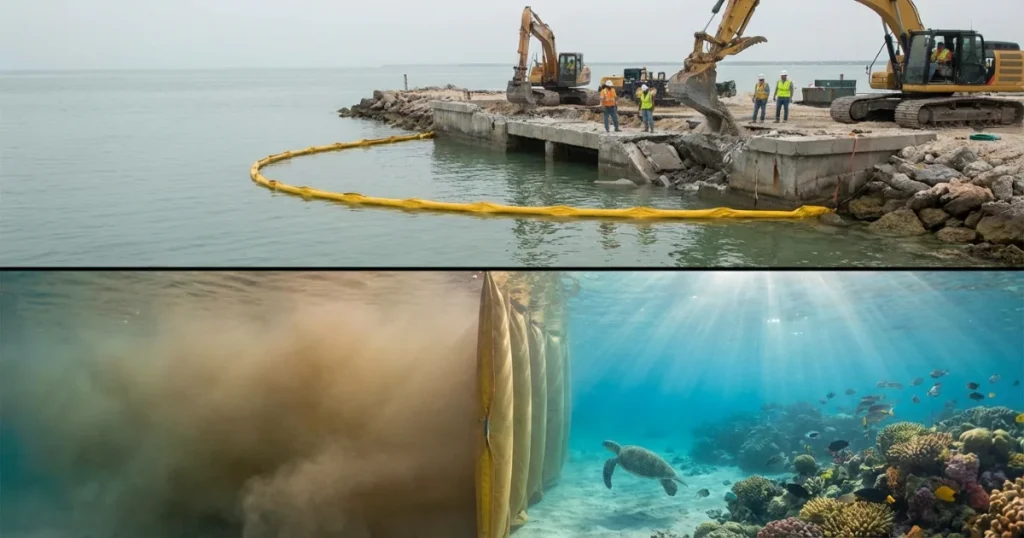
Temporary barriers and silt curtains reduce debris migration into water. These controls are most effective when installed before demolition begins.
Covered and sealed waste containers
All skips and containers near the coast should be covered. Where fine materials are involved, sealed containers provide additional protection.
Frequent debris removal
Leaving waste on-site increases exposure risk. Daily or staged removal reduces the chance of materials entering the marine environment due to tides or weather shifts.
Tide and weather awareness
Scheduling demolition around tide cycles and wind conditions significantly lowers contamination risk. Avoiding high-risk periods is a simple but effective control.
Protecting Marine Life During Demolition Activities
Underwater impacts are rarely visible from the site boundary.
Sediment clouds reduce visibility, affecting how fish feed and navigate. Fine debris can coat coral surfaces, blocking light and slowing growth. Over time, repeated exposure alters seabed composition.
Noise and vibration also matter. Marine species rely on sound for communication and orientation. Excessive vibration near water can disturb habitats, particularly in shallow coastal zones.
Zero-leakage handling is critical. Every container, skip, and transport vehicle must be treated as a potential pollution source. Prevention is always more effective than cleanup after release.
Operational Mistakes That Lead to Environmental Violations
The contamination mechanisms described earlier are usually triggered by operational errors rather than deliberate negligence.
Common failures include:
- Mixing waste types, increasing dispersion risk
- Using uncovered skips near tidal zones
- Delaying waste removal during active demolition
- Selecting transport routes without spill safeguards
- Underestimating the impact of fine dust
These mistakes often occur when inland demolition practices are applied to coastal environments without adjustment.
Financial and Project Consequences of Poor Coastal Waste Control
Environmental incidents on coastal sites rarely remain isolated.
Corrective actions can halt demolition work, disrupt sequencing, and require additional inspections. Cleanup costs often exceed preventive control costs by a significant margin.
For high-profile beachfront developments, reputational impact is also a factor. Environmental issues attract attention and can affect investor confidence and future approvals.
Repeated problems may lead to increased scrutiny on subsequent projects, extending timelines and raising compliance costs.
Responsibility and Accountability in Coastal Waste Handling
Effective coastal waste management relies on clear allocation of responsibility.
- Developers are responsible for ensuring compliant planning and approved systems.
- Contractors must execute demolition with appropriate controls.
- Transport operators are responsible for secure movement of waste.
- Disposal facilities must be authorized to handle specific materials.
Professional waste management providers may support these roles, but accountability remains distributed across the project team. Clear coordination reduces risk and improves outcomes.
Coastal Construction Compliance Trends Beyond 2026
Environmental oversight in coastal construction is becoming more data-driven.
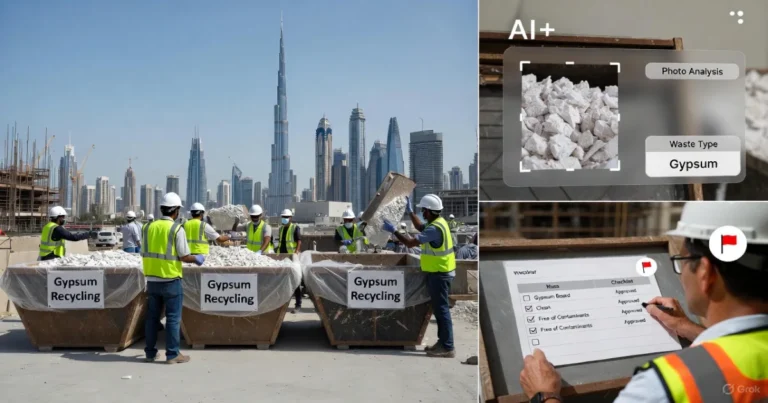
Greater emphasis is being placed on traceability, photographic verification, and real-time accountability. Monitoring systems increasingly focus on prevention rather than response.
Marine protection is now integrated into project evaluation, not treated as an afterthought. Developers who embed environmental controls early face fewer disruptions later.
Sustainability expectations from buyers and investors are also rising. Responsible coastal development increasingly influences long-term asset value.
Conclusion: Building Along the Coast with Long-Term Perspective
Coastal demolition requires a higher standard of discipline than inland projects. Proximity to the sea introduces risks that cannot be managed through routine practices alone.
Dubai’s coastal development can continue to progress while protecting marine ecosystems when waste control is planned, executed, and monitored with care.
Managing demolition debris properly is not just a regulatory requirement. It is a commitment to preserving the environment that makes coastal projects desirable and sustainable in the first place.
For coastal demolition projects in Dubai, debris management is most effective when it is planned as part of the environmental compliance strategy—not treated as a last-minute operational task. Reviewing containment methods, transport controls, and disposal pathways early helps reduce marine exposure risks and avoid disruption once demolition begins.
Teams working on beachfront or marine-adjacent sites often coordinate with experienced operators such as Navyom Waste Collection Services Co. LLC to ensure demolition debris is handled using coastal-appropriate controls and Dubai Municipality–approved processes. Understanding how coastal waste logistics differ from inland projects supports better planning, smoother approvals, and long-term protection of Dubai’s marine ecosystems.
FAQs: Coastal Demolition and Marine Protection
How is demolition waste managed near the sea?
Demolition waste near the sea is managed through sealed containment, controlled sequencing, and frequent removal to prevent marine exposure.
Additional measures include physical barriers and scheduling work around tides and weather conditions.
Can demolition debris harm marine life?
Yes. Fine particles reduce water clarity and can smother coral and seabeds. Chemical residues from treated materials may also affect marine organisms over time.
Damage often develops gradually rather than immediately.
Are there special rules for coastal construction in Dubai?
Yes. Coastal sites face stricter oversight related to waste segregation, transport, disposal, and documentation due to environmental sensitivity.
These requirements reflect the higher risk of irreversible contamination.
What happens if debris enters the ocean during demolition?
Once debris enters the ocean, recovery becomes difficult and costly. Fine materials disperse quickly and may require marine intervention to address.
Such incidents often lead to inspections and corrective action.
How can construction teams protect marine life during demolition?
Protection comes from prevention: proper containment, zero-leakage handling, controlled sequencing, and environmental awareness throughout the project.
Planning with marine impact in mind is essential.
Why is coastal demolition riskier than inland demolition?
Water movement and wind spread debris beyond site boundaries. Inland sites allow easier containment and recovery.
Near the coast, mistakes travel further and persist longer.
Which materials pose the greatest coastal risk?
Gypsum, fine concrete dust, treated wood, coatings, and lightweight plastics pose higher risks due to dispersion and chemical interaction with water.
How do developers avoid environmental penalties on beachfront projects?
Early planning, approved disposal pathways, proper segregation, and consistent site controls reduce compliance risk.
Preventive measures are far more effective than reactive cleanup.
Will coastal environmental requirements continue to tighten?
Yes. Oversight is becoming more systematic, traceable, and prevention-focused.
Projects that adapt early face fewer delays and lower long-term risk.