Executive Summary: The AED 100/Tonne Reality
Landfill disposal in Dubai is no longer a minor operational line item.
The shift from the historical AED 10 gate fee to AED 100 per tonne for mixed waste has transformed waste management into a direct financial risk variable.
For financial controllers, that change is not administrative.
It is structural.
For developers, it directly impacts:
- Project cash flow
- Margin protection
- Compliance exposure
- Tender competitiveness
- ESG reporting credibility
The good news?
40–70% disposal cost reductions are achievable through structured waste segregation, digital compliance, and strategic vendor alignment.
This guide breaks down:
- What the landfill fee landscape really means in 2026
- The hidden financial risks most budgets ignore
- The ROI math behind segregation
- The compliance traps causing WTN rejections
- A practical action framework for financial leaders
1. Understanding Dubai’s Landfill Fee Landscape
The Regulatory Evolution
Before 2018, landfill gate fees were a nominal administrative afterthought—approximately AED 10 per tonne. Today, under the frameworks established by Executive Council Resolution No. (58) of 2017 and reinforced by the recent Law No. (18) of 2024 on Waste Management in Dubai, waste disposal is a highly regulated, tightly monitored financial variable.
This shift is not temporary; it is structurally aligned with the Integrated Waste Management Strategy 2021–2041 and the UAE’s Zero Waste to Landfill mandates.
The Contamination Trap: What Actually Triggers the AED 100/Tonne Fee?
Many developers mistakenly believe that all construction waste costs AED 100 per tonne to dispose of. This is a costly misconception. Pure Construction & Demolition (C&D) waste—like concrete, asphalt, and sand—carries a gate fee of AED 20 per tonne when landfilled directly (as per Executive Council Resolution No. (58) of 2017, effective from 2020 onwards and still in force).
Even lower rates apply (AED 2 per tonne) if sent to approved waste treatment plants for processing. The AED 100 per tonne fee applies to Municipal/General Waste landfilling. Cross-contamination with municipal elements (e.g., food wrappers, plastics, office waste) triggers reclassification of the entire load to municipal waste at the gate, multiplying costs by 5x.
| Waste Type | Typical Fee (AED/tonne) | Financial Risk Level |
|---|---|---|
| Pure C&D Waste (Rubble, Concrete, etc.) | AED 20 (landfill) | Low |
| Treated/Recycled C&D (to approved plants) | AED 2 | Very Low |
| General/Municipal Waste | AED 100 | High |
| Contaminated C&D Loads | AED 100 (Reclassified) | Severe” |
If site workers throw food wrappers, plastic bottles, or general office waste into a skip meant for C&D rubble, Dubai Municipality inspectors at the landfill gate will flag the contamination. The entire load is immediately reclassified from C&D to General Waste, instantly multiplying your disposal cost by 5x.
2. The Real Financial Impact on Your Projects
Let’s move from theory to real project numbers to see how the “Contamination Penalty” bleeds project margins.
Case Study: The Contamination Multiplier on a 20-Storey Project Assume a standard 20-storey commercial build with a 3-year duration and 100 on-site workers. The site generates two distinct waste streams:
- Structural Waste (C&D): 3,000 tonnes of concrete offcuts, timber, gypsum, and rubble.
- Worker/Site Office Waste: 100 workers generating 2.3 kg of general domestic waste a day over 3 years = ~250 tonnes of municipal waste.
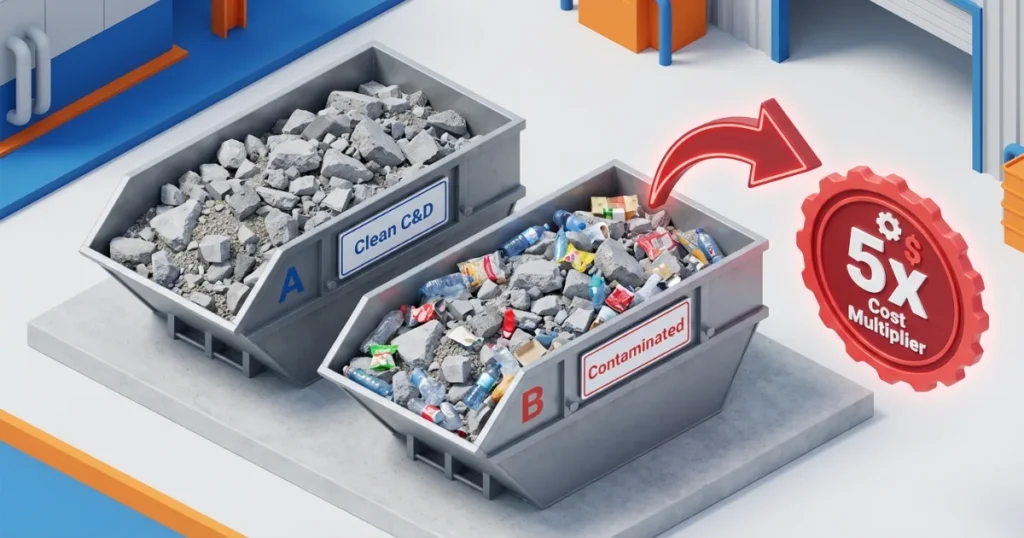
Scenario A: Disciplined Segregation (The Budgeted Cost) If strictly segregated, the structural waste costs AED 60,000 (3,000t × AED 20), and the worker waste costs AED 25,000 (250t × AED 100).
- Total Expected Disposal Cost: AED 85,000.
Scenario B: Unmanaged Waste (The Reality for Most Sites) Due to poor site supervision, workers throw daily lunch packaging and plastics into the main construction skips. At the landfill gate, inspectors flag the municipal contamination and reclassify the entire 3,250-tonne combined load as General Waste.
- The Mixed Waste Penalty: 3,250 tonnes × AED 100 = AED 325,000.
That is a AED 240,000 budget leak on a single project—simply because site management didn’t isolate the domestic waste from the rubble. Now, scale that margin erosion across a portfolio of five or six concurrent projects.
3. CFO Risk Alert: The 3 Hidden Budget Traps
Beyond the obvious AED 100/tonne fee, three less-visible risks are bleeding project margins:
Trap 1: Cash Flow Timing Mismatch
- Mixed waste invoices arrive 30–45 days post-disposal
- Often surfaces after project phase budgets are locked
- Creates variance explanations and emergency reallocations
- Impact: Budget reporting credibility erosion, surprise month-end gaps
Example: A developer discovers AED 180K in waste overruns in Month 8—but the contamination happened in Months 4–6. The budget is already committed elsewhere.
Trap 2: Permit Freeze Exposure
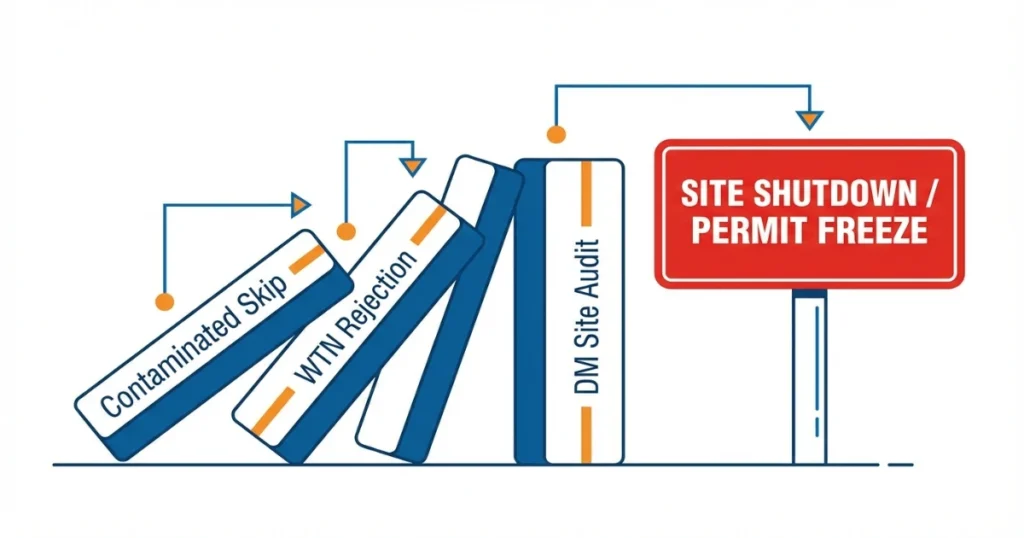
- Non-compliant WTNs can trigger Dubai Municipality site audits
- Audits can freeze permits and halt construction activities
- Each day of delay = lost contractor productivity + time penalties
- Impact: AED 50K–200K per day in idle costs on large projects
Example: A WTN rejection flagged during a random audit led to a 12-day permit hold while documentation was corrected. Total impact: AED 840K in lost time + contractor standby fees.
Trap 3: Insurance & Financing Clauses
- Some D&B insurance policies now include waste compliance clauses
- Non-compliance can affect claim eligibility in environmental incidents
- Sustainability-linked loans tie interest rates to ESG performance
- Impact: Higher insurance premiums, elevated financing costs
Example: A developer’s sustainability-linked loan triggered a 0.25% rate increase due to missed waste diversion targets—adding AED 625K in interest over a AED 250M facility.
Financial Controller Action: Review your current contracts for hidden waste-related clauses in:
- Insurance policies (environmental liability)
- Bank covenants (ESG performance metrics)
- Government tender terms (waste compliance requirements)
4. ESG, Tender Competitiveness & Investor Pressure
Waste compliance now affects:
- LEED certification scoring
- Estidama Pearl ratings
- Corporate ESG disclosures
- Bank financing conditions
- Investor due diligence
Many developers underestimate how landfill exposure influences:
- Prequalification scoring
- Government tender ranking
- Sustainability-linked funding
Waste diversion is no longer CSR.
It is commercial positioning.
5. The Cost of Inaction: 2026–2027 Enforcement Escalation
While 60% of Dubai developers still operate on legacy mixed-waste models, regulatory enforcement is tightening rapidly. Here’s what “business as usual” will cost you:
Ongoing 2026+: Advanced Digital & AI-Enhanced Monitoring at Gates Dubai Municipality continues to advance smart waste systems, building on Wastenet, RASID GPS tracking, and emerging AI tools for contamination detection (including pilots and deployments of AI-powered cameras and sensors for real-time monitoring of waste streams and illegal dumping). While full AI visual inspection at every landfill gate is part of the evolving Smart Waste Management framework, current and near-term enhancements already enable:
- Real-time flagging of contamination and mismatches via integrated data (photos, GPS, weighing)
- Automated reclassification and alerts for non-compliant loads
- Instant notifications and fines for violations
- Permanent digital records linked to licenses and developer profiles
Tightening Enforcement & Diversion Expectations (2026–2027+) Under Law No. (18) of 2024 on Regulating Waste Management in Dubai (effective since 2024), emphasis is on minimizing waste generation, increasing recycling/treatment rates, and diverting waste from landfills through mandatory segregation, private investment in recovery, and DM oversight.
While exact percentage targets for individual projects are aligned with broader emirate goals (e.g., high diversion under the Integrated Waste Management Strategy 2021–2041 aiming for near-zero landfill by 2041), enforcement includes:
- Required segregation at source and higher diversion rates
- Monthly/regular digital reporting via systems like Wastenet
- Permit holds or audits for non-compliance
- Integration of waste performance into tender and ESG evaluations
Financial Impact Timeline:
| Year | Inaction Penalty | Compliant Competitor Advantage |
|---|---|---|
| 2026 | +15–25% disposal costs due to AI reclassification | 40–70% cost reduction, enhanced ESG scoring |
| 2026–2027+ | Increasing audits, permit risks for low diversion | Enhanced approvals, stronger ESG/tender positioning |
| 2028+ | Exclusion from government tenders | Sustainability-linked financing access |
The Competitive Reality: Early adopters are already using waste diversion rates as differentiators in RFPs. Government entities and private developers are now requesting:
- 3-year waste performance history
- WTN rejection rate disclosures
- Digital compliance capability proof
Waiting means entering a market where your competitors have a 2–3 year compliance head start.
6. The Economics of Waste Segregation
Why Segregation Works Financially
Mixed waste: AED 100/tonne
Segregated streams: AED 30–50/tonne
That’s a 40–70% cost delta.
Breakeven Analysis
Costs of segregation:
- Color-coded skips
- Training
- Supervision
- Layout planning
Typical incremental cost: 2–3% of site operational budget.
ROI timeline:
- Small projects: 3–6 months
- Large projects: Immediate
For high-tonnage sites, segregation pays for itself in the first quarter.
Calculate Your Project’s Potential Savings See exactly how much your project could save with proper waste segregation:
Calculate Your Project’s Potential Savings
See exactly how much your project could save with proper waste segregation
7. Real-World Case Study: How One Developer Cut Waste Costs by 58%
Project Profile:
- Type: Mixed-use development (3 towers, retail podium)
- Duration: 36 months
- Value: AED 480M
- Location: Dubai
- Workforce: 220 on-site personnel
The Challenge:
In Month 6, the financial controller noticed waste disposal costs were tracking 40% above budget. Initial analysis revealed:
- WTN rejection rate: 14%
- Average disposal cost: AED 92/tonne (should have been AED 35–40 for segregated C&D)
- Monthly waste budget variance: AED 35K–50K
- Projected 36-month overrun: AED 1.2M
The Root Cause:
Site audit revealed systematic contamination:
- Workers disposing lunch waste in C&D skips
- Packaging materials mixed with concrete rubble
- No designated area for general waste
- Insufficient supervision during skip loading
The Intervention (Implemented Over 90 Days):
Phase 1 (Month 7): Infrastructure & Training
- Installed 12 color-coded skip zones with visual signage
- Conducted 8 toolbox training sessions (all crews)
- Assigned skip monitoring to 3 site supervisors
- Investment: AED 28,000
Phase 2 (Months 8–9): Digital Compliance
- Switched to vendor with live Wastenet integration
- Implemented photo verification before every pickup
- Weekly waste performance dashboards sent to PM and FC
- Investment: AED 15,000 setup + AED 3,500/month
Phase 3 (Month 10+): Optimization
- Negotiated scrap metal revenue sharing (AED 12–18/tonne)
- Established on-site concrete crushing (reduced haulage 30%)
- Monthly waste reviews in cost control meetings
The Results (Months 12–36):
| Metric | Before | After | Improvement |
|---|---|---|---|
| Average cost/tonne | AED 92 | AED 38 | 58% reduction |
| WTN rejection rate | 14% | 1.8% | 87% improvement |
| Diversion rate | 28% | 71% | +43 points |
| Monthly waste cost | AED 78K | AED 33K | AED 45K/month savings |
Total Financial Impact (24-Month Period):
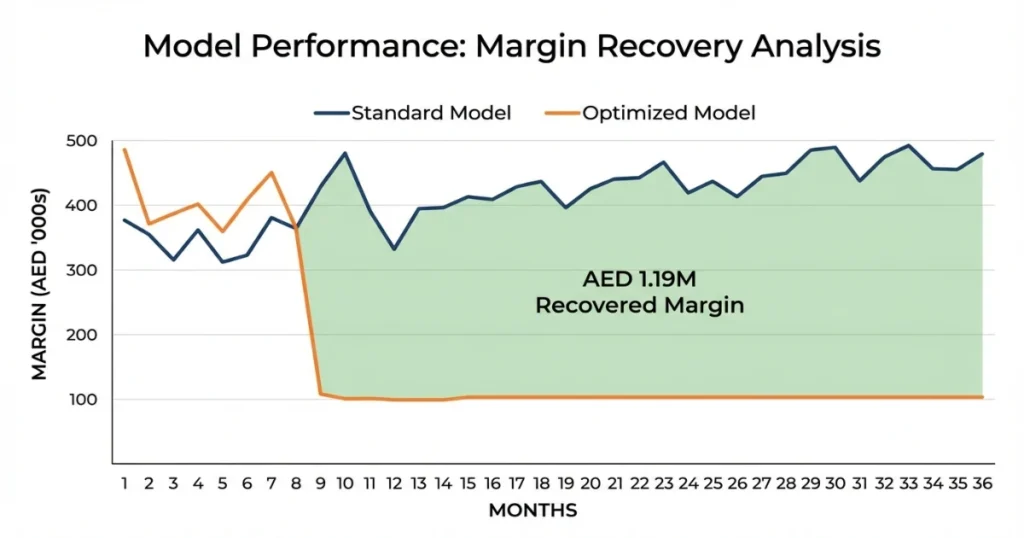
- Savings from cost reduction: AED 1.08M
- Revenue from scrap metal: AED 86K
- Avoided fines & rework: AED 140K (estimated)
- Total program investment: AED 112K
- Net benefit: AED 1.19M
- ROI: 962%
Key Lessons for Financial Controllers:
- Early intervention pays: Waiting until Month 18–24 would have cost AED 600K+ in lost savings
- Behavioral change is critical: Technology alone didn’t work—worker training was essential
- Vendor quality matters: Switching to a compliant, tech-enabled partner reduced rejection rate by 87%
- Monthly tracking prevents drift: Once implemented, weekly dashboards kept performance consistent
FC Quote (Anonymized): “We treated waste as an overhead line item for six months and bled margin. Once we treated it as a controllable cost with KPIs, behavior changed immediately. The ROI was better than our equipment leasing optimization.”
8. Implementing On-Site Segregation (Operational Blueprint)
Step 1: Define Streams Clearly
Separate:
- Concrete & masonry
- Metals & rebar
- Timber
- Gypsum
- Packaging
- General C&D
Gypsum must be handled carefully due to potential hazardous classification.
Step 2: Infrastructure Setup
- Clearly labeled skips
- Site zoning
- Supervisor accountability
- Visual guides for workers
Segregation fails when instructions are unclear.
Step 3: Worker Training
Toolbox talks should cover:
- Cost impact
- Fine exposure
- WTN implications
- ESG consequences
When workers understand the cost logic, contamination drops.
9. Technology-Enabled Waste Management (The Dubai Standard)
In 2026, manual waste tracking is a direct compliance risk. The Dubai Municipality has digitized the waste ecosystem, meaning developers and their financial controllers must rely on technology to stay compliant and audit-ready.

Advanced sites now integrate directly with Dubai’s mandatory regulatory systems:
- Wastenet Integration: Relying on paper Waste Transfer Notes (WTNs) leads to lost documents and rejected loads. Leading contractors use digital WTN platforms that mirror and integrate with Wastenet, ensuring accurate categorization and instant traceability.
- RASID Compliance: Dubai Municipality’s RASID system mandates smart tracking, GPS monitoring, and weighing sensors for all waste transport vehicles. Utilizing waste partners whose fleets are fully integrated with RASID prevents destination mismatch flags and illegal dumping fines.
- Photo & Metadata Verification: AI-based visual audits at the gates mean your site supervisors must capture timestamped, geo-tagged photos of clean, segregated skips before they leave the site to dispute any incorrect contamination penalties.
When your waste management partner utilizes these technologies, financial controllers gain access to real-time dashboards offering:
- Monthly automated waste cost reports
- Diversion rate tracking for ESG/LEED scoring
- Predictive modeling for upcoming project phases
Data completely replaces guesswork, transforming waste from a blind expense into a managed financial system.
10. Budget Planning Integration
Waste should be embedded into:
- Pre-construction financial modeling
- Tender documentation
- Vendor contracts
- Monthly cost control meetings
Allocate 2–3% of project value for structured waste management — not disposal alone.
This reframes waste from reactive expense to managed system.
11. Vendor Selection Criteria (Critical)
When selecting a waste partner, verify:
- Valid Dubai Municipality license
- WTN compliance track record
- Near-zero rejection rate
- Transparent pricing
- Digital reporting capability
Unapproved haulers expose you to:
- Fines
- Documentation invalidation
- Legal exposure
Vendor risk is financial risk.
12. Vendor Red Flags: 7 Warning Signs Your Waste Partner Is Exposing You to Financial Risk
You’ve selected a waste management partner, but how do you know they’re actually protecting your budget and compliance position? Here are the red flags financial controllers should monitor:
Red Flag 1: No Live Wastenet Integration
- What it means: They’re manually entering WTNs or using paper systems
- Your risk: Data entry errors, lost documents, audit trail gaps
- What to ask: “Can I access our WTN records through your portal in real-time?”
Red Flag 2: Pricing That’s “Too Good to Be True”
- What it means: Likely using unlicensed disposal sites or illegal dumping
- Your risk: Dubai Municipality fines (AED 50K–500K), legal liability, project shutdown
- Benchmark: If pricing is >30% below market average, investigate thoroughly
Red Flag 3: Cannot Provide GPS Transport Logs on Demand
- What it means: No RASID compliance, no proof of proper disposal
- Your risk: Destination mismatch penalties, environmental liability
- What to ask: “Show me last month’s GPS-verified transport routes within 24 hours”
Red Flag 4: High WTN Rejection Rate (>5%)
- What it means: Poor site training, contamination issues, documentation errors
- Your risk: Return trips, reclassification fees, project delays
- Benchmark: Best-in-class operators maintain <2% rejection rates
Red Flag 5: No Segregation Support or Training Capability
- What it means: They’re a hauler, not a waste management partner
- Your risk: You’re paying for disposal, not cost reduction
- What to look for: On-site training programs, segregation audits, worker education materials
Red Flag 6: Vague or Bundled Pricing
- What it means: Hidden fees, unclear cost allocation, no transparency
- Your risk: Budget surprises, can’t track cost per waste stream
- What to demand: Line-item pricing by waste category with per-tonne breakdowns
Red Flag 7: Slow or No Digital Reporting
- What it means: You’re operating blind on waste performance
- Your risk: Can’t track diversion rates, ESG reporting gaps, no audit trail
- What to expect: Monthly dashboards showing tonnage, costs, diversion %, WTN status
Immediate Audit Action for Financial Controllers:
Schedule a 30-minute call with your current waste vendor and request:
✅ Last 90 days of WTN records with GPS verification
✅ Current rejection rate data
✅ Dubai Municipality license renewal date
✅ Wastenet integration proof (screenshot of live portal)
✅ Itemized invoice breakdown by waste stream
If they cannot provide these within 48 hours, you have a vendor risk problem that needs immediate attention.
13. Revenue Opportunities from Waste
Waste is not only cost.
It is material.
Scrap Metal
Copper, aluminum, steel have resale value.
Recycled Aggregates
Up to 40% cheaper than virgin materials.
Concrete Crushing
On-site crushing can reduce haulage costs.
LEED Points
Up to 4 points for diversion.
Diversion increases asset valuation and marketing leverage.
14. Benchmarking Your Waste Performance: Are You Above or Below Industry Standard?
Financial controllers need context. Here’s how your projects should compare to Dubai’s current industry benchmarks:
Construction Waste Diversion Rates (2026 Industry Averages)
| Project Type | Low Performers | Industry Average | Best-in-Class |
|---|---|---|---|
| Residential High-Rise | 15–25% | 35–45% | 60–75% |
| Commercial Office | 20–30% | 40–50% | 65–80% |
| Mixed-Use Development | 25–35% | 45–55% | 70–85% |
| Infrastructure | 30–40% | 50–60% | 75–90% |
WTN Compliance Metrics
| Metric | At Risk | Acceptable | Excellent |
|---|---|---|---|
| Rejection Rate | >10% | 3–5% | <2% |
| Documentation Accuracy | <85% | 90–95% | >98% |
| Average Processing Time | >7 days | 3–5 days | <48 hours |
Cost Per Tonne Benchmarks (Segregated Waste)
| Waste Stream | Your Target Range |
|---|---|
| Pure C&D (Concrete/Rubble) | AED 15–25 |
| Metals & Scrap | AED 0 (revenue) to AED 10 |
| Wood/Timber | AED 30–40 |
| Mixed Recyclables | AED 35–50 |
| General/Municipal | AED 90–100 |
How to Use These Benchmarks:
- Calculate your current diversion rate:
(Recycled tonnage ÷ Total waste tonnage) × 100 - Compare your average cost per tonne:
Total waste spend ÷ Total tonnage across all streams - Identify your gap:
If you’re below industry average, you have immediate savings opportunities
Example Calculation:
Project generates 5,000 tonnes total waste:
- 3,500 tonnes recycled/diverted
- 1,500 tonnes to landfill
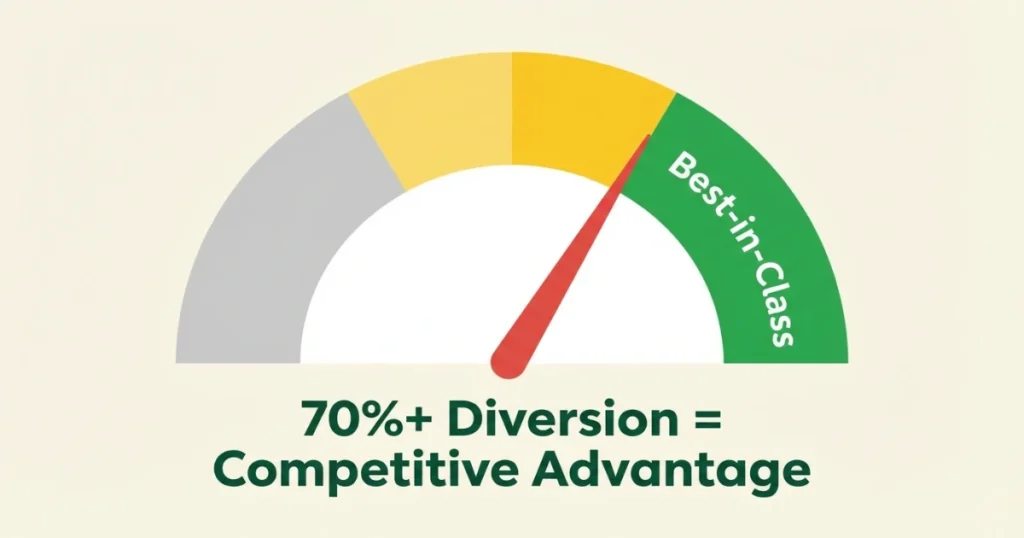
Your diversion rate: (3,500 ÷ 5,000) × 100 = 70%
Performance assessment: Best-in-class for residential high-rise
Financial impact: If industry average is 40%, you’re saving approximately AED 180,000 compared to peers on this project alone.
15. Compliance Risk Management Checklist
Financial controllers should ensure:
- Proper WTN categorization
- GPS-verified transport routes
- Approved facility destination
- Photo timestamp integrity
- Chain-of-custody records
- Hazardous waste segregation
Audit-ready documentation reduces risk exposure.
16. Future-Proofing Against Stricter Enforcement
Expect:
- Higher inspection frequency
- Expanded AI validation
- Potential fee increases beyond AED 100
- Circular economy mandates
- Extended Producer Responsibility frameworks
Projects without structured systems will struggle under tightening enforcement.
17. Quick Reference: Compliance Checklist for Every Project Phase
Use this checklist to ensure waste compliance from tender to handover:
Pre-Construction Phase
☐ Waste management plan submitted with permit application
☐ 2–3% budget allocation for waste management included
☐ Vendor shortlist verified (Dubai Municipality licenses current)
☐ Site layout includes designated segregation zones
☐ WTN process flow documented and approved
☐ Baseline waste generation estimate calculated
Mobilization Phase (Months 0–3)
☐ Color-coded skip zones installed and labeled
☐ Worker induction includes waste segregation training
☐ Site supervisors assigned skip monitoring duties
☐ Digital WTN platform access granted to PM and FC
☐ First monthly waste report generated (establish baseline)
☐ Emergency spill/contamination protocol in place
Active Construction Phase (Ongoing)
☐ Weekly skip inspection before pickup (photo verification)
☐ Monthly waste cost vs. budget variance review
☐ WTN rejection rate tracked (<5% target)
☐ Diversion rate calculated monthly (target: 50%+ for LEED/Estidama)
☐ Vendor performance scored quarterly
☐ GPS transport logs reviewed randomly (spot checks)
☐ Toolbox talks on waste every 2 weeks
Close-Out Phase (Final 3 Months)
☐ Final waste audit completed
☐ All WTN certificates archived (7-year retention required)
☐ Diversion rate calculated for ESG/certification reporting
☐ Lessons learned documented for next project
☐ Vendor final invoice reconciled against actual tonnage
☐ Waste performance data added to tender CV/portfolio
Post-Handover (Audit Preparedness)
☐ Digital archive of all WTNs accessible within 24 hours
☐ GPS verification logs retained
☐ Vendor license validity confirmed for full project period
☐ Waste cost summary available for financial audit
☐ Municipality inspection records filed
18. Action Plan for Financial Controllers
Immediate (0–3 Months)
- Audit current waste costs
- Review WTN rejection rates
- Verify vendor licenses
- Launch segregation pilot
Medium Term (3–12 Months)
- Full rollout of segregation
- Dashboard implementation
- Monthly diversion reporting
- Vendor performance benchmarking
Long Term (12+ Months)
- Multi-project waste contracts
- ESG integration
- Circular economy partnerships
- Waste KPI integration into financial dashboards
Frequently Asked Questions (SEO + Voice Optimized)
What is the landfill fee per tonne in Dubai in 2026?
The standard landfill disposal fee for mixed waste is AED 100 per tonne, with lower rates available for properly segregated recyclable streams.
How can construction projects reduce landfill costs in Dubai?
By implementing on-site waste segregation, using licensed haulers, maintaining accurate WTNs, and avoiding contamination penalties.
What happens if a WTN is rejected in Dubai?
The load may be returned, reclassified, recharged, and may trigger additional fines or inspection scrutiny.
Is waste segregation mandatory in Dubai?
For large construction and development projects, waste diversion requirements are embedded within regulatory and sustainability frameworks.
How much can a developer save with proper segregation?
Projects can reduce disposal costs by 40–70%, depending on waste composition and compliance discipline.
Landfill disposal in Dubai costs AED 100 per tonne for mixed waste. Developers can reduce this by 40 to 70 percent through structured segregation, compliant documentation, and licensed transport. Proper waste management protects budgets, avoids fines, and improves ESG performance.
Final Takeaway: Waste Is Now a Financial Control Variable
In Dubai’s 2026 regulatory environment, waste is no longer an operational overhead line item. It is a core pillar of:
- Margin Control: Protecting every Dirham from the 5x contamination penalty.
- Risk Management: Neutralizing the threat of permit freezes and site audits.
- Compliance Protection: Ensuring 100% RASID and Wastenet integrity.
- Tender Advantage: Positioning your project as a leader in ESG and circular economy metrics.
The difference between mixed and segregated waste is not just AED 80 per tonne. It is the difference between financial predictability and regulatory exposure.
If you are reviewing waste contracts across your project portfolio, don’t just compare prices per load. Compare the variables that actually protect your bottom line:
- Historical WTN rejection rates
- Real-time documentation and photo integrity
- Proven diversion performance
- Full RASID-compliant digital capability
Before the next inspection notice, before the next rejected load, and before the next budget overrun: Treat waste as a financial system — not a disposal activity.
Audit Your Exposure with Navyom
Don’t let legacy waste habits multiply your project risk. Navyom specializes in transforming waste from a “disposal headache” into a “financial asset.”
Ready to protect your margins? Partner with Navyom to implement a tech-enabled, RASID-compliant waste strategy that guarantees lower landfill exposure and higher ESG scores.
- Request a Waste Cost Audit: Let us identify the “hidden leaks” in your current disposal model.
- Get Your ROI Model: See exactly how much your specific project can save through Navyom’s segregation framework.
- Secure Your Compliance: Ensure your project is future-proofed against Law No. (18) of 2024.
Contact Navyom Today for a Compliance & Cost Review
Because in Dubai today, landfill exposure is not an expense. It is a risk multiplier. Navyom is the strategy that protects your margins, your timeline, and your reputation.