Industry Waste Management Dubai: A Practical Compliance & Operations Guide for Industrial Sites
📋 Quick Answer: Effective industry wast management dubai (industrial waste management in Dubai) isn’t about generic recycling — it’s about building a documented, segregated collection system that satisfies Dubai Municipality requirements, controls gate fees, and prevents rejected loads. Industrial sites that separate cardboard, plastics, metals, and general waste from regulated or hazardous streams consistently reduce disposal costs by 20–40% while cutting landfill diversion risk.
If you run an industrial facility, warehouse, manufacturing unit, or fabrication yard anywhere from Jebel Ali Industrial Area to Dubai Industrial City, you already know the waste volumes are different. What many operators miss is that the cost structure, compliance exposure, and recycling potential are also fundamentally different from commercial or residential waste. Industrial waste management in Dubai sits at the intersection of municipal regulation, operational efficiency, and growing ESG reporting pressure — and half-hearted segregation is the single most expensive mistake industrial sites make.
Why Industrial Waste Management in Dubai Can’t Follow a Generic Playbook
Walk through a typical warehouse in Al Quoz on collection day and you’ll see the problem instantly: pallet wrap tangled with cardboard, metal offcuts dumped into general waste skips, and a single mixed bin that the facility manager hopes will be accepted. That hope is expensive. Dubai’s waste infrastructure has matured rapidly — gate fees are tiered, contaminated loads are increasingly rejected at disposal and recycling facilities, and industrial zones now face routine compliance checks.
Industrial waste streams in Dubai fall into distinct categories that dictate how they must be handled, transported, and documented. A fabrication workshop producing metal scrap, used oil, and general packaging waste operates under different expectations than a food processing plant generating organic residue and plastic packaging. The industry wast management dubai landscape demands that site teams understand these distinctions — not just for compliance, but because the cost difference between a well-managed waste stream and a neglected one can reach six figures annually for a mid-sized facility.
Understanding Dubai’s Industrial Waste Classifications
Before you can fix a waste process, you need to know what you’re dealing with. Dubai Municipality classifies industrial waste broadly, but in practice, the waste that moves through your facility likely breaks down into:
- General Industrial Waste (non-hazardous): Packaging, cardboard, plastics, wood pallets, fabric offcuts, cafeteria waste, office waste from the facility — the largest volume stream for most industrial sites.
- Recyclable Industrial Fractions: Clean cardboard, baled plastics, separated metals (ferrous and non-ferrous), glass, and certain textiles. When kept clean, these offset mixed waste costs significantly.
- Regulated / Hazardous Industrial Waste: Used oils, solvents, paint sludge, chemical containers, contaminated rags, batteries, fluorescent tubes, electronic waste. These require a Waste Transfer Note (WTN) and a licensed hazardous waste transporter.
- Construction-Type Waste from Maintenance: Concrete rubble, metal beams, drywall, insulation, cabling — common during factory maintenance, shutdowns, or retrofit projects. Frequently misclassified as general waste, which leads to rejected loads.
The Core Operational Framework for Industrial Sites
Industrial waste management in Dubai works best when you treat it like any other operational process — with standard procedures, assigned responsibility, and measurable outcomes. Here’s the sequence that high-performing industrial sites follow:
1. Waste Stream Audit by Zone
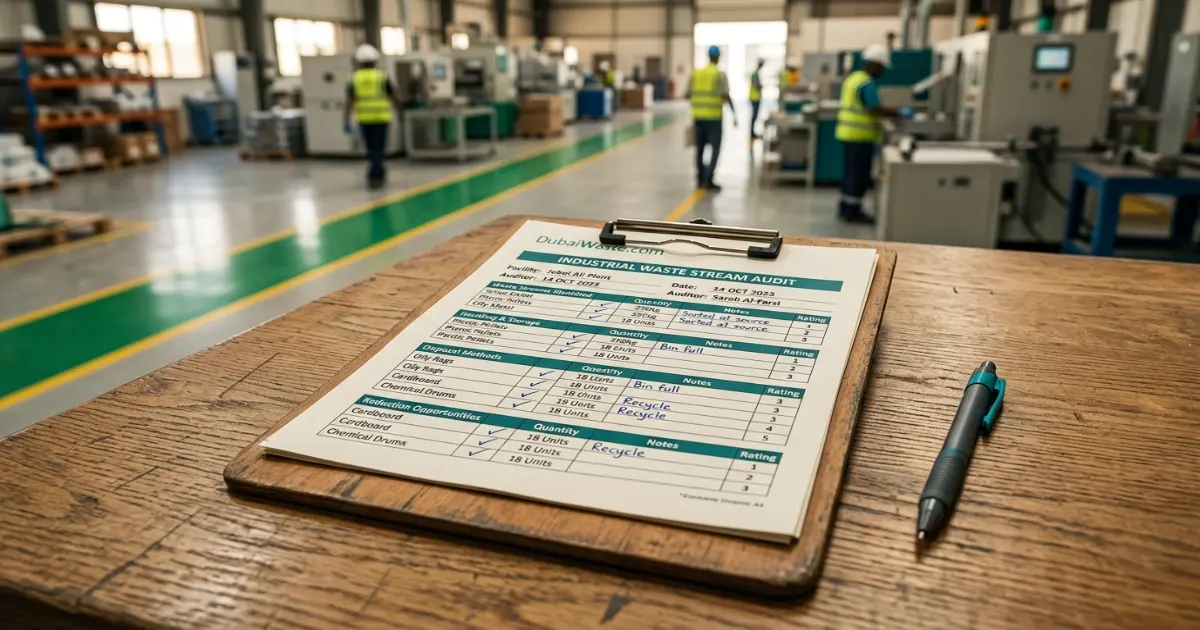
Map every area of your facility — production floor, packing, maintenance, warehouse, outdoor storage, canteen, offices — and document what waste is generated where, how much, and how frequently. A fabrication shop might produce 60% metal scrap and 30% packaging, while a logistics warehouse might be 70% cardboard and stretch wrap. You can’t manage what you haven’t measured.
2. Segregation Infrastructure That Actually Works
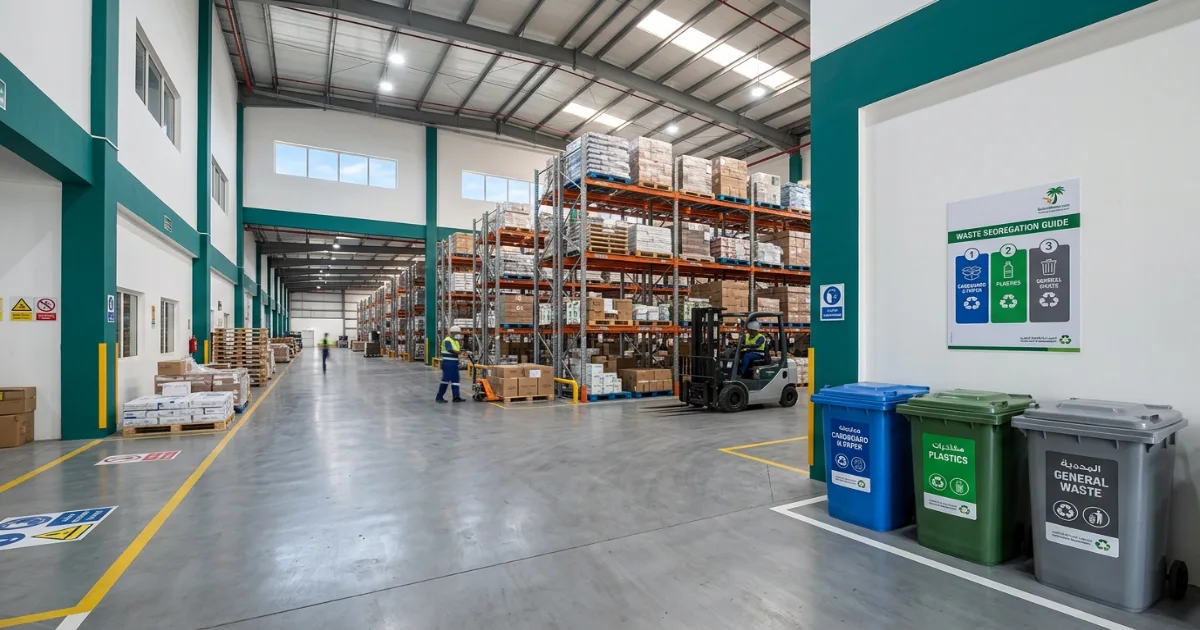
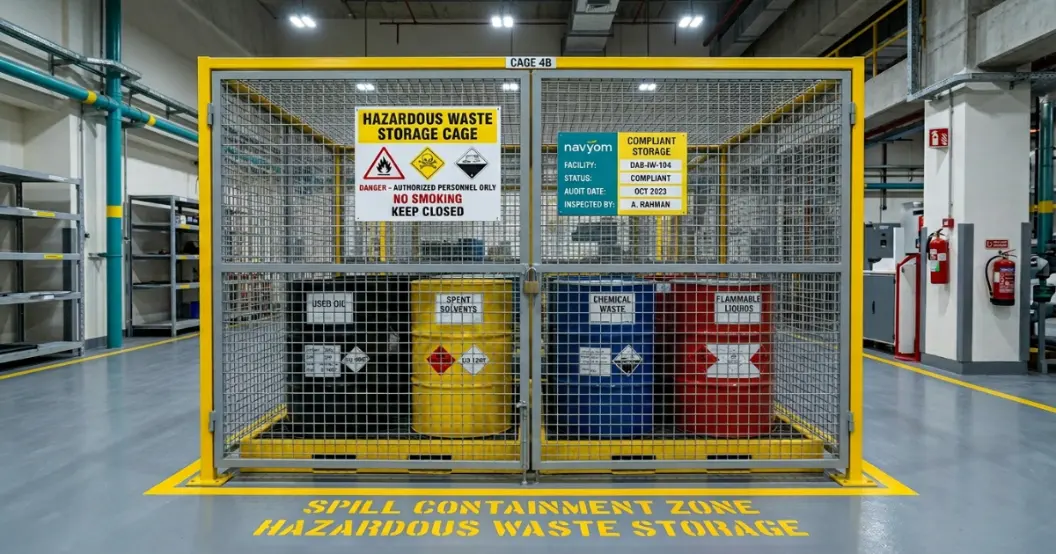
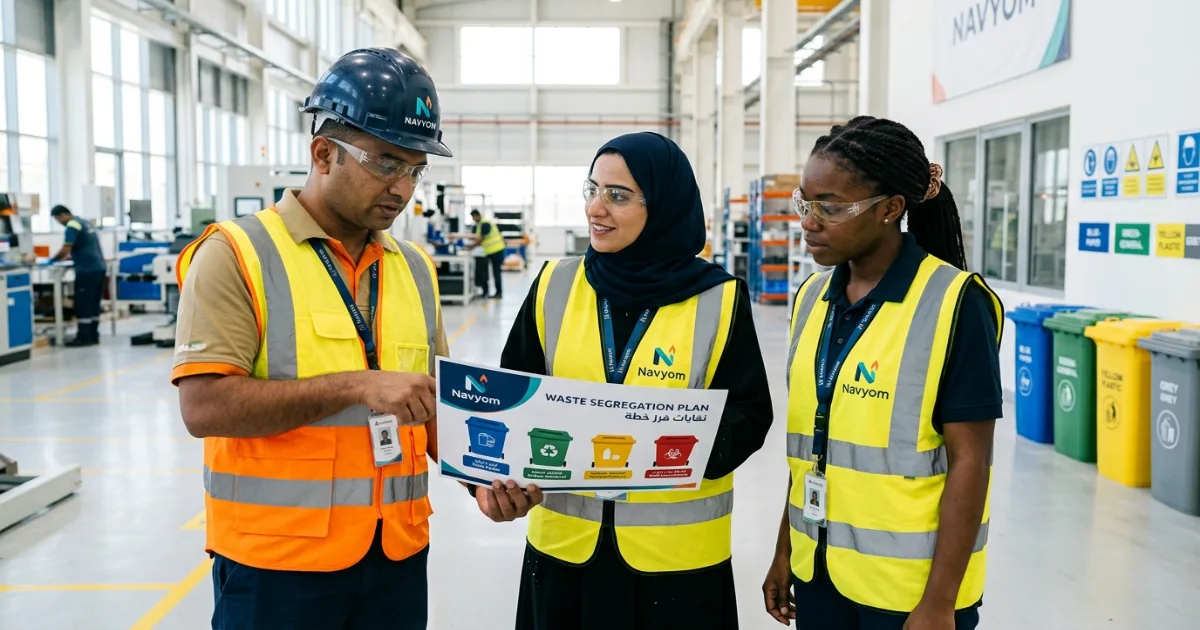
The biggest industrial sites install central waste stations with clearly labelled bays: cardboard, plastics, metals, wood, general, and a secured hazardous cage. Smaller facilities can use colour-coded wheelie bins or stillages at generation points. The goal is simple: the person throwing waste away should have zero ambiguity about where it goes.
3. Choose Your Collection Structure
Industrial sites in Dubai typically choose between skip-based collections (open or closed skips, 4 to 12 cubic yards, exchanged on schedule), compactor units for high-volume cardboard or plastic, or scheduled vehicle collections with dedicated bins. The decision depends on waste volume, space, and whether the material carries resale value (clean metal, baled cardboard).
4. Documentation and the WTN System
Every regulated movement of industrial waste in Dubai should be accompanied by a Waste Transfer Note. It documents what the waste is, where it came from, who transported it, and where it went. Even for non-hazardous streams, keeping internal WTN records protects your facility during audits and supports ESG reporting.
5. Continuous Monitoring and Contractor Review
Audit your waste contractor’s performance at least quarterly. Are they providing weight data? Are they rejecting loads? Are their collection frequencies matching your actual fill rates? Industrial sites that set KPIs — like diversion rate percentage, cost per tonne, or contamination incidents per month — consistently outperform those that don’t.
Comparison: Mixed Industrial Waste vs Segregated Industrial Waste in Dubai
This is where the real cost difference lives. The table below reflects typical industrial waste management scenarios in Dubai, based on gate fees, collection costs, and compliance risk:
| Factor | Mixed Industrial Waste (Unsorted) | Segregated Industrial Waste |
|---|---|---|
| Disposal Gate Fee | Higher — everything goes to landfill or incineration at full rate | Lower — recyclable fractions diverted, reducing chargeable tonnage |
| Collection Cost | Often cheaper per pickup, but more frequent collections needed | Slightly higher per stream, offset by fewer overall pickups and rebates |
| Recycling Revenue | Zero — contaminated material has no market value | Positive — baled cardboard, clean metals, and some plastics generate rebates |
| Compliance Risk | High — risk of hazardous contamination, rejected loads, documentation gaps | Low — transparent chain of custody, cleaner WTN records |
| ESG / Reporting Quality | Poor — diversion rates minimal, no verifiable recycling data | Strong — diversion percentages, material recovery data, verifiable metrics |
| Typical Cost Difference | Baseline (most expensive per tonne) | 20–40% reduction per tonne when segregation is maintained |
Compliance Documentation Industrial Sites Must Keep Ready
Dubai Municipality and the relevant free zone authorities (DIC, DIP, JAFZA, Dubai Industrial City) expect industrial facilities to maintain clear waste records. During a routine inspection, having the following documentation accessible makes the difference between a smooth visit and a follow-up enforcement action:
- Waste Transfer Notes (WTNs) for all regulated waste movements — retained for at least 2 years
- Waste contractor licence copy — verify your provider holds a valid Dubai Municipality waste transport permit
- Waste stream register — a simple log of waste types, volumes, collection dates, and destinations
- Segregation plan / site map — showing bin locations and waste routes
- Staff training records — basic evidence that site teams have been instructed on correct disposal
- Recycling / diversion reports — increasingly requested for ESG audits and free zone sustainability reporting
How Your Industrial Waste Setup Changes by Facility Type
There is no single “best” waste setup for every industrial site in Dubai. The right approach depends entirely on what happens inside your facility. Below is how the core waste management framework shifts based on common industrial facility types:
Manufacturing & Fabrication Workshops
Dominant streams: Metal offcuts, welding slag, used abrasives, packaging materials, occasional hazardous waste (oil, solvents, paints). These sites benefit most from a dedicated metal scrap skip that generates rebates, plus a separate general waste bin and a locked hazardous cage. Segregating clean metal from general waste alone can cut disposal tonnage by half.
Warehouses & Logistics Hubs
Dominant streams: Cardboard, stretch wrap, pallets, strapping, occasional broken goods. Logistics sites have a high cardboard-to-general-waste ratio. A baler for cardboard that reduces volume and creates a sellable commodity pays back quickly. Stretch wrap recycling programmes are also picking up momentum in Jebel Ali Free Zone logistics clusters.
Food Processing & FMCG Facilities
Dominant streams: Organic waste, food-contaminated packaging, plastics, cardboard. These facilities face a specific challenge: food residue on packaging disqualifies it from standard recycling streams. A dedicated organic waste collection (often sent to composting or biogas facilities) paired with rigorous cleaning protocols for recyclable packaging is the recommended path.
Maintenance Depots & Fleet Workshops
Dominant streams: Used oil, oil filters, tyres, batteries, metal parts, absorbents. This is the highest-risk category from a compliance perspective. Every litre of used oil must be captured, stored in bunded containers, and collected by a licensed hazardous waste transporter with a WTN. Zero liquid discharge to storm drains is the non-negotiable standard.
Common Mistakes Industrial Sites Make — And What to Do Instead
After working with industrial facilities across Dubai’s industrial corridors, certain patterns emerge. Here are the most expensive mistakes and the practical fixes:
- Mistake: Treating all waste as “general” to simplify operations.
Reality: Mixed loads are the costliest per-tonne disposal option and carry the highest rejection risk. Even basic cardboard separation reduces gate fees measurably. - Mistake: Placing one central bin far from waste generation points.
Reality: Distance kills segregation. When the nearest bin is 100 metres away, everything goes into it regardless of type. Place waste stations within 20 metres of active work zones. - Mistake: Not training staff because “they should know.”
Reality: Industrial workforces are diverse, transient, and often unaware of Dubai’s waste rules. A 15-minute induction on waste segregation — with visual guides in multiple languages — reduces contamination overnight. - Mistake: Choosing the cheapest waste contractor without auditing their compliance.
Reality: A contractor without proper licensing, tracking, or downstream visibility exposes your facility to risk. Verify licences, ask for destination reports, and visit their receiving facility if volumes justify it. - Mistake: Ignoring small hazardous streams (aerosol cans, fluorescent tubes, e-waste).
Reality: These accumulate and, when found in a general waste skip during a spot check, trigger escalation. Dedicate a small, clearly labelled cage for “special waste” and schedule quarterly collections.
How DubaiWaste.com Tools Help You Industrial Waste Decisions
Generic waste calculators don’t work for industrial sites — the waste mix is too specific. DubaiWaste.com has built calculators designed around real Dubai industrial conditions:
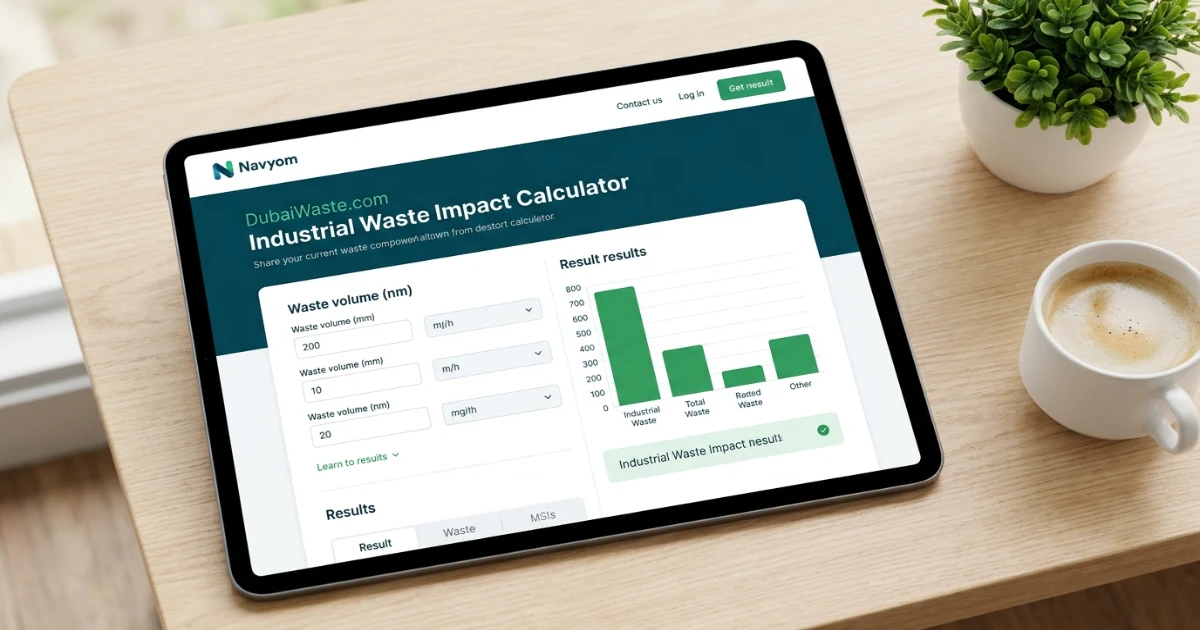
- Industrial Waste Impact Calculator: Input your monthly volumes of cardboard, plastics, metals, wood, general, and hazardous waste. The tool estimates current disposal costs, diversion potential, and the financial impact of improving segregation by even 15%.
- Waste Management Cost Estimator: Compare skip-based vs scheduled collection costs based on your site location (Al Quoz, Jebel Ali, DIP, DIC), waste volume, and collection frequency. The estimator factors in typical Dubai gate fees and contractor pricing bands.
- WTN Compliance Checklist Generator: Answer a short set of questions about your waste streams, and the tool generates a customised list of documentation requirements and record-keeping practices specific to your facility type.
- Landfill Savings Calculator: For sites already segregating, this calculator quantifies how much disposal cost you’ve avoided by diverting materials — useful for internal business cases and ESG reports.
These tools are free to use and built on real Dubai waste infrastructure data — not generic international assumptions. Try running your estimated volumes through the Industrial Waste Impact Calculator before your next contract negotiation.
Real-World Example: A Dubai Industrial City Packaging Facility
A cardboard packaging manufacturer in Dubai Industrial City was producing roughly 18 tonnes of waste per month — predominantly cardboard offcuts, stretch wrap, and general warehouse refuse. For two years they had been using a mixed-waste skip service. Their monthly waste bill averaged AED 8,500, and they had no visibility into where their waste went.
The operations manager used the DubaiWaste.com Industrial Waste Impact Calculator and realised that roughly 11 tonnes of their monthly waste was clean cardboard that could be baled and collected separately. They invested in a small vertical baler (payback period: 7 months), arranged a segregated cardboard collection with a local recycler, and negotiated a reduced general waste skip schedule since volumes dropped sharply.
The result: monthly waste spend fell to approximately AED 5,100 — a 40% reduction — and the facility gained a recycling rebate on the baled cardboard that partially offset the baler cost. Their diversion rate moved from near zero to over 60%, and they now have clean data for their annual ESG submission. This is not an exceptional case; it’s what happens when industrial waste management is treated as an optimisable operational process rather than a fixed overhead.
Common Pitfalls & When to Ignore Standard Segregation Advice
Not every industrial site should rush into full source segregation. There are scenarios where the standard advice — separate everything — creates more cost and complexity than value:
- Very low waste volumes (under 2 tonnes/month): The administrative and space cost of multiple waste streams may outweigh the benefit. In this scenario, focus on clean general waste and negotiate with your contractor for composition reporting to plan future segregation.
- Severe space constraints: Some older industrial units in Al Quoz or Al Qusais genuinely cannot accommodate multiple skips or a baler. A shared waste station approach — collaborating with neighbouring units — can sometimes solve this creatively, but if not, a well-documented single-stream service with a licensed contractor remains better than an unmanaged mess.
- Hazardous-generating sites without a segregation plan: If your site produces hazardous waste but hasn’t yet built a compliant storage area, do not introduce new segregation streams until the hazardous fraction is under control. Secure the regulated waste first, document the WTN chain, then expand to dry recyclables.
Frequently Asked Questions — Industry Waste Management Dubai
Do all industrial facilities in Dubai need a Waste Transfer Note (WTN)?
Is segregated industrial waste collection cheaper than mixed waste in Dubai?
What happens if contaminated industrial waste is rejected at a Dubai disposal facility?
Can I put used oil containers in the general industrial skip?
How frequently should industrial waste be collected in Dubai?
Do free zone industrial sites follow the same waste rules as mainland Dubai?
Is industrial waste recycling mandatory in Dubai?
How do I choose a compliant industrial waste contractor in Dubai?
✅ Your Fast-Track Cheat Sheet: Top 3 Actions for Industrial Waste Management in Dubai
- Audit your waste streams this month. Walk your facility, document what’s being discarded and where, and estimate volumes. Even a rough audit reveals the biggest cost-reduction opportunities hiding in plain sight — usually cardboard, metal, or packaging waste that’s currently being landfilled.
- Fix hazardous waste handling immediately. If your site generates any hazardous fraction — oil, chemicals, batteries, fluorescent tubes — ensure it is stored in a secured, labelled, bunded area and collected by a licensed transporter with WTNs. This is the highest-consequence gap in industrial waste management.
- Run your numbers through the Industrial Waste Impact Calculator. Before you renegotiate any waste contract, model your current volumes and segregation scenario. The calculator gives you a data-backed estimate of potential savings — which changes the conversation with your contractor from a cost discussion to an optimisation discussion.
Industrial waste management in Dubai is moving faster than many site teams realise. The combination of rising gate fees, tighter free zone sustainability mandates, and better recycling infrastructure means that the facilities that treat waste as a managed resource — rather than an unexamined overhead — are already pulling ahead on cost, compliance, and reputation. Start with an audit, secure your hazardous stream, and use the tools available on DubaiWaste.com to turn your waste data into decisions.