Across fit-out and renovation sites, gypsum-related misclassification accounts for a disproportionate share of WTN clarifications, delays, and rejections.
If you manage construction or fit-out projects in Dubai, you already know concrete mistakes are expensive.
What most contractors don’t realize in 2025?
👉 Gypsum waste is now the fastest way to get your WTN rejected.
Not hazardous.
Not heavy.
Not obvious.
Yet one damp gypsum board or drywall fragment inside the wrong skip can:
- Trigger AI mismatch flags
- Delay clearance
- Force reclassification
- Inflate disposal costs
- Increase site inspection frequency
At Navyom Waste Collection Services, we review WTNs daily.
And across Dubai, gypsum is now the most common silent failure — especially on fit-out, renovation, and finishing phases.
This guide explains exactly how gypsum waste disposal works in Dubai, why it’s treated differently in 2025, what it really costs, and how contractors keep gypsum loads approved every time.
(Disclosure: Navyom is a Dubai Municipality-approved waste hauler. These rules apply regardless of which licensed provider you use.)
Table of Contents
1. What Qualifies as Gypsum Waste in Dubai?
Under Dubai Municipality (DM) classification, gypsum waste includes:
- Drywall / gypsum boards
- Plasterboard offcuts
- False ceiling gypsum tiles
- Interior partition boards
- Gypsum powder residue (dry only)
❌ What Instantly Disqualifies a Load:
- Moist or water-logged gypsum
- Concrete or mortar residue
- Wood framing
- Plastic sheets or bags
- Insulation materials
- Paint buckets or adhesive containers
Important:
Even 5–10% contamination can cause reclassification.
2. Why Gypsum Is High-Risk Waste in 2025
Gypsum isn’t heavy — but it’s chemically sensitive.
When mixed or exposed to moisture, gypsum can:
- Produce hydrogen sulfide gas
- Create odor issues
- Contaminate inert waste streams
- Damage recycling processes
Because of this, DM treats gypsum as a controlled waste stream, not normal C&D debris.
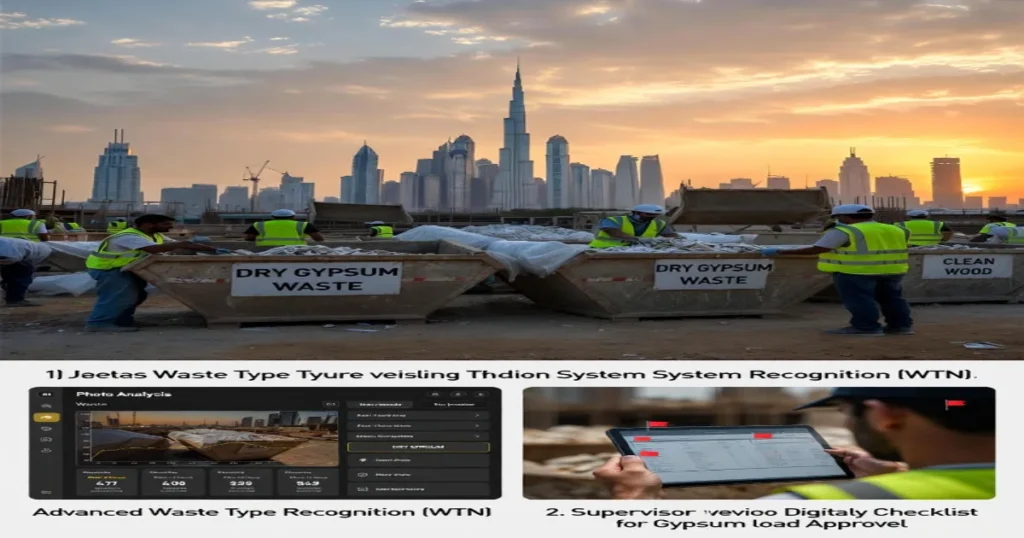
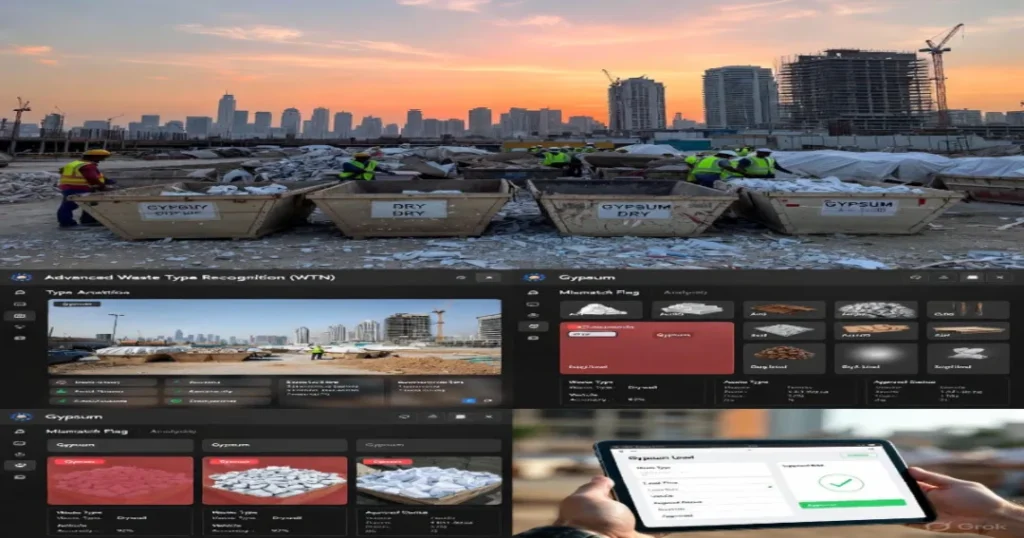
3. How Dubai’s Digital WTN System Flags Gypsum
In 2025, Dubai Municipality’s digital WTN system uses:
- Photo analysis
- Color and texture detection
- Moisture pattern recognition
- Category consistency checks
Gypsum triggers AI alerts because:
- It has a distinct pale color
- It breaks into flat fragments
- Wet gypsum changes texture visibly
- It contrasts sharply with concrete
If your WTN says “Concrete / Inert” but gypsum appears in photos → ❌ High-risk mismatch. Dubai’s digital WTN system relies on mandatory photo uploads, visual consistency checks, and category matching. Loads that visually contradict their declared waste type are flagged for manual review or rejection.
4. Gypsum vs Concrete vs Mixed Waste (Cost & Risk)
| Factor | Gypsum Waste | Concrete Waste | Mixed C&D |
|---|---|---|---|
| Disposal Cost | Medium–High | Lowest | Highest |
| Recycling Rate | Moderate | High | Very Low |
| WTN Risk | High | Low | High |
| Moisture Sensitivity | Very High | None | Medium |
| Rejection Likelihood | High | Very Low | High |
Key takeaway:
Gypsum is riskier than concrete, even though it looks harmless. Cost impacts vary by facility, project type, and compliance history. Figures shown are indicative ranges based on contractor invoices and routing outcomes observed in 2024–2025.
5. Most Common Gypsum WTN Rejection Triggers
From real site audits:
- Gypsum mixed into concrete skips
- Wet gypsum from washing or rain
- Gypsum with insulation attached
- Adhesive or joint compound residue
- Poor-quality WTN photos
- Mislabeling as “inert waste”
None of these are malicious — all are expensive.
6. The Real Cost of Mishandled Gypsum
Direct Costs:
- Higher disposal rates
- Reclassification fees
- Additional handling
Hidden Costs:
- Truck returns
- Reloading labor
- Schedule delays
- Supervisor time
- Increased inspection frequency
📊 Typical impact:
Projects mishandling gypsum lose 20–35% more on waste than planned.
7. Gypsum Recycling in Dubai: The Reality
Clean gypsum can be recycled — but only if:
- It’s dry
- Free from contamination
- Correctly routed
Once mixed or wet, recycling is impossible.
Gypsum waste is now one of the fastest ways contractors unintentionally trigger WTN delays or reclassification.
8. Approved Gypsum Disposal Routes in Dubai
Gypsum must go to:
- DM-approved gypsum handling facilities
- Licensed recycling yards (if clean)
- Controlled disposal routes
Never assume your normal landfill accepts gypsum.
9. When Gypsum Becomes Hazardous
Gypsum becomes high-risk when:
- Mixed with organic waste
- Saturated with water
- Stored improperly
- Left in sealed environments
In these cases, DM may:
- Require special handling
- Increase disposal fees
- Reject loads entirely
10. How to Keep Gypsum Loads Approved (Best Practices)
✔ Dedicated gypsum-only skips
✔ Covered skips to avoid moisture
✔ Clear signage
✔ Crew briefing (5 minutes)
✔ Photo check before dispatch
✔ Honest WTN classification
These steps eliminate the majority of gypsum-related rejections seen on active sites.
A Quick Reality Check (No Scare Tactics)
Not every WTN rejection in Dubai is caused by gypsum. Wood fragments, plastic packaging, cardboard, and misdeclared mixed waste also trigger rejections regularly.
Gypsum stands out not because it’s uniquely illegal — but because it’s commonly mistaken as “inert” or harmless, especially by subcontractors during interior works. That misunderstanding is where problems begin.

Free Download: Gypsum Load Approval Checklist (2025)
We’ve created a one-page, site-ready checklist used by supervisors to:
- Verify gypsum loads
- Pass WTN photo checks
- Avoid reclassification
- Reduce disposal cost surprises
Download checklist.
11. How Navyom Helps Contractors Stay Gypsum-Compliant
Navyom Waste Collection Services supports:
- Gypsum-only skip supply
- WTN category accuracy
- Photo pre-check
- DM-approved routing
- Emergency correction support
Result: fewer rejections, faster clearance, predictable costs.
FAQs: Gypsum Waste Disposal in Dubai (2025)
1. Why does gypsum cause more WTN rejections than concrete?
Because gypsum is moisture-sensitive and chemically reactive. Dubai’s digital WTN validation process flags it quickly when misdeclared or visually inconsistent with the selected waste category.
2. Can gypsum be mixed with concrete waste?
No. Even small amounts can reclassify the entire load.
3. Is gypsum hazardous waste?
Not inherently, but it becomes high-risk when wet or mixed.
4. What happens if gypsum is misdeclared in a WTN?
Reclassification, higher costs, delays, or rejection.
5. Can gypsum be recycled in Dubai?
Yes — only if clean, dry, and correctly routed.
6. Do small projects need gypsum segregation?
Yes. Small sites feel rejections more sharply.
7. How many skips are recommended?
At least one dedicated gypsum skip during fit-out stages.
8. How can I check before dispatch?
Send a photo to your hauler for pre-verification.
Final Thought: Gypsum Isn’t a Small Detail in 2025
Gypsum waste isn’t heavy.
It isn’t dramatic.
But in Dubai’s 2025 compliance environment, it’s one of the most expensive mistakes you can make.
If your WTNs keep getting flagged, look beyond concrete — gypsum is usually the culprit.
Gypsum Waste Should Never Delay Your Project
📞 Call / WhatsApp: +971 58 521 1155
🌐 Visit: Navyom Waste Collection Services
Prefer WhatsApp?
Send us your gypsum waste photo and we’ll confirm approval before the truck moves.