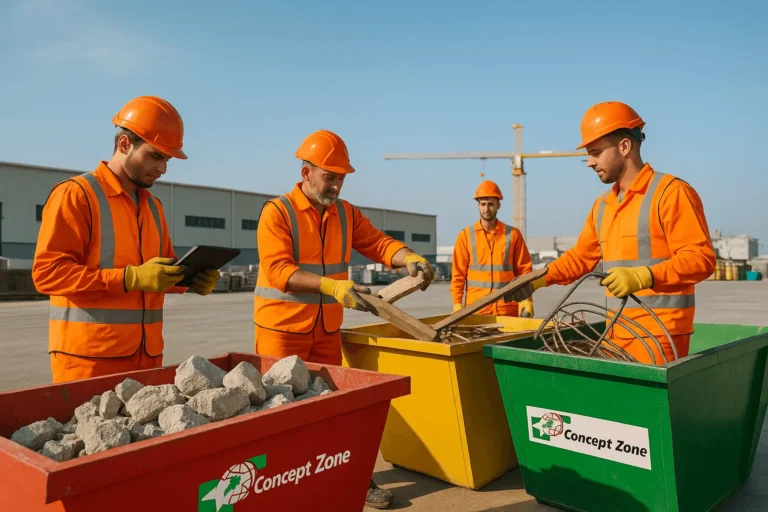
Dubai municipality waste management systems are the city’s waste collection, sorting, recycling, treatment and landfill control. Constructed on data-driven routing, energy recovery, and rigorous segregation protocols, the system follows waste flows from origin to final location.
Crucial components encompass intelligent bins, MRFs, WTE plants, and e-waste streams. Targets focus on increased diversion, reduced emissions and safer streets.
To provide context, the following sections outline policies, tech stack, KPIs, and vendor roles.
Key Takeaways
- Dubai has an integrated system linking collection, sorting, recycling, landfill and waste-to-energy enabled by smart infrastructure and licensed private providers with coverage across the entire city. They let readers trace their own waste trail from origin to ultimate processing to determine when smarter sorting and reprocessing can reduce expense and footprint.
- Source segregation is compulsory and facilitated by color-coded bins and public stations, increasing recycling rates and relieving landfill burden. Residents and businesses can sort recyclables, organics, and hazardous materials at the source for enhanced recovery quality.
- Smart technologies like IoT-enabled bins, GPS-tracked fleets, and real-time analytics optimize routes, reduce fuel use, and improve service reliability. Companies can embrace data dashboards and RFID tracking to measure waste volumes and establish concrete reduction goals.
- Waste-to-energy plants such as the Warsan facility transform unrecyclable waste into power with sophisticated emissions control, contributing to the country’s clean-energy objectives. Facilities and big sites can audit their residual waste streams to see what can be diverted to energy recovery after recycling.
- Rules mandate separation, proper disposal, and landfill diversion via permits, charges, and fines. Awareness initiatives spur engagement. Residents and companies can check existing regulations, prevent fines, and participate in municipal programs and competitions to increase community results.
- With medium- and long-term strategies that include achieving zero landfill waste by 2041 through waste reduction, circular economy initiatives, and reductions in plastic use. Annual diversion milestones were achieved, reusable materials were transitioned, and collaboration with certified recyclers aligned operations with Dubai’s sustainability pathway.
Dubai’s Waste Management System Explained
Dubai Municipality operates a closed loop through an integrated system connecting collection, sorting, recycling, energy recovery, and disposal. The Waste Management Department takes care of strategy, licensing, and compliance, and contracted operators do day-to-day services.
Designed for municipal, commercial, and industrial sectors, the plant complies with UAE legislation pertaining to air quality and waste management, including Cabinet Resolution No. 24 of 1999, which prohibits the dumping of pollutants into the sea. The aspirations are to achieve zero waste to landfill in two decades, supported by policies aiming for 75% diversion through source segregation, advanced facilities, and real-time monitoring.
1. Collection Framework
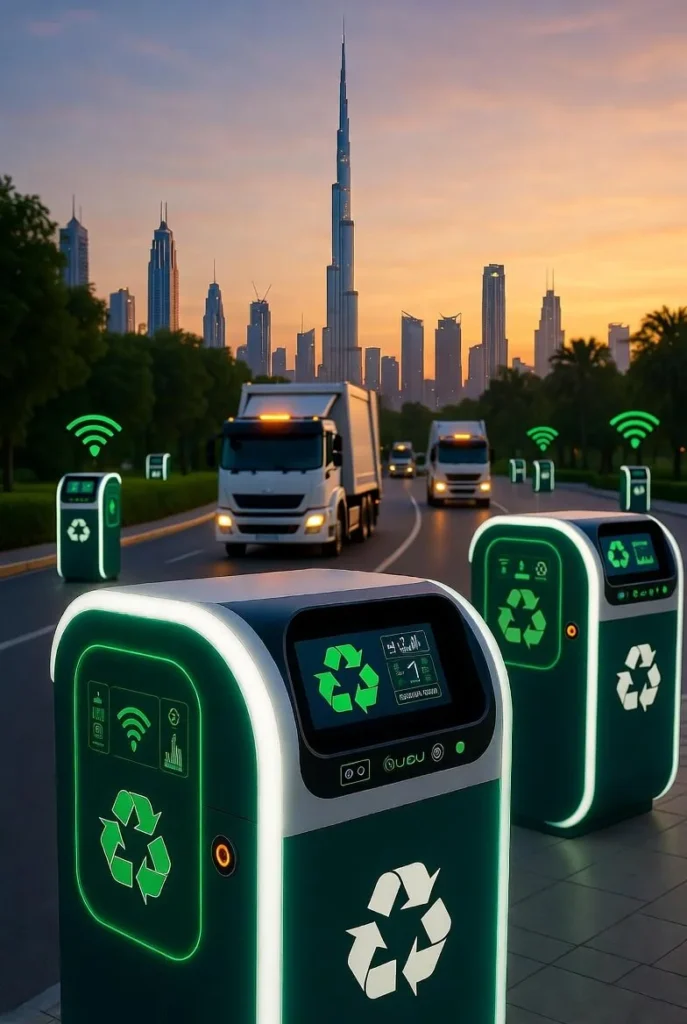
It covers bustling residential neighborhoods, free zones, tourism centers, and industrial areas. We cover everything from curbside pickup for homes, scheduled runs for businesses, and on-demand for construction and bulky items with night shifts along high-traffic sectors.
Routine, bulk, and specialty pickups operate on intelligent schedules powered by GPS, route optimization, and bin-level fill data. Licensed private firms take the burden off for high service levels and quicker response in peak seasons.
Container types vary by site: smart bins with automatic compaction, compactor bins for mixed loads, communal recycling stations in neighborhoods and malls, and sealed units for food waste and healthcare waste.
These intelligent bins not only prevent street overflow, but they minimize complaint volumes by compacting waste and alerting when they are almost full.
2. Sorting and Segregation
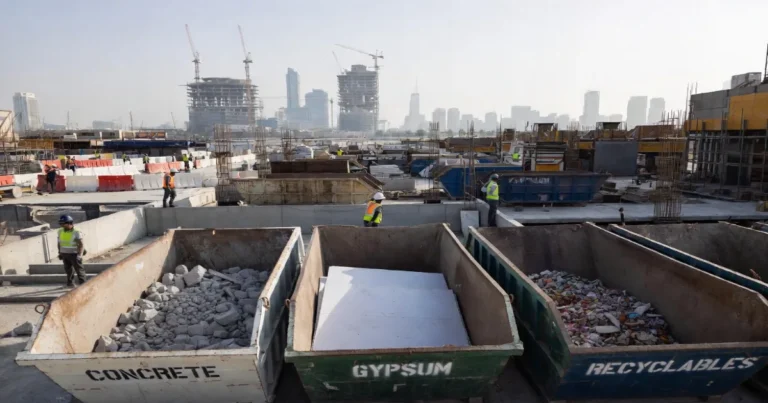
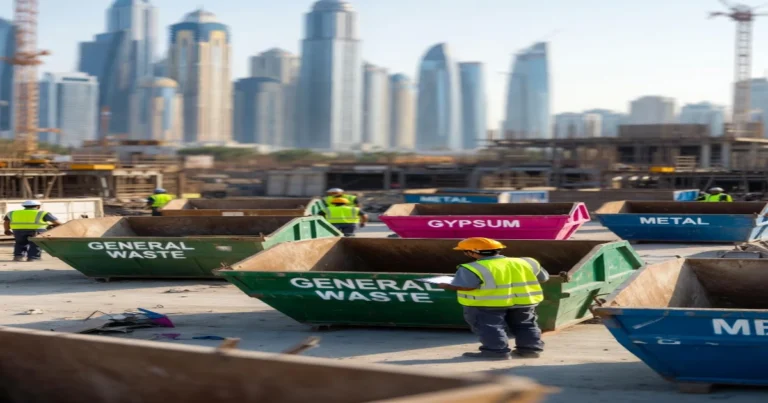
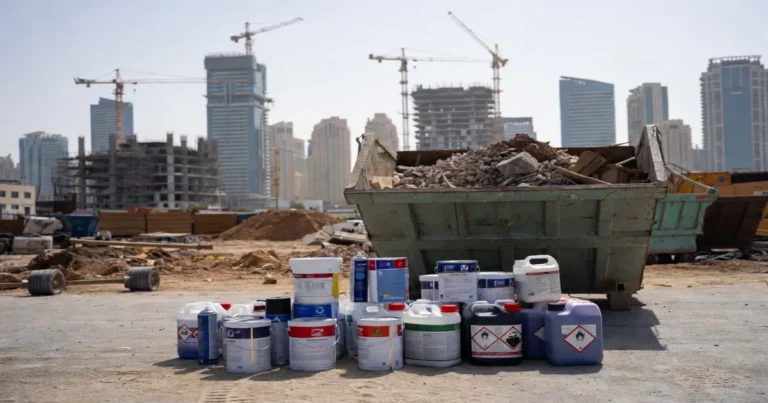
Source segregation is compulsory. Streams are usually recyclables, organics, general waste, and lab, clinic, or light industry hazardous waste.
Color-coded bins and public drop-off sites keep separation clear in parks, metro stations, and community centers. The Municipality unites audits, route checks, and education campaigns to raise compliance, with fines for stubborn mixing.
Improved segregation increases recycling rates, decreases contamination and landfill volumes, and decreases logistics costs per ton.
3. Recycling Infrastructure
A citywide combination of MRFs, community collection points, and reverse-vending machines cater to plastics, paper, metals, glass, and e-waste. Plants decontaminate and then bale for local markets.
Public private partnerships finance novelties lines such as PET flake, glass cullet, and WEEE disassembly. Initiatives range from school competitions, retail e-waste collection, supermarket carton drop-offs, and office paper recovery schemes.
4. Waste-to-Energy Conversion
Dubai’s Waste Management System Explained Its Warsan Waste Management Centre turns general waste, such as food wrappers, disposable cups, mixed packaging, and contaminated paper, into power.
Steam from combustion powers turbines and feeds the grid, aiding the Dubai Clean Energy Strategy and circular economy ambitions. State-of-the-art flue-gas cleaning, continuous emissions monitoring and ash handling are within environmental limits.
Biogas from organics complements incineration, shrinking methane at landfills and lowering carbon intensity.
5. Landfill Operations
Key sites are municipal landfills and the Hatta facility, operated with lined cells, daily cover, leachate collection, and odor control. Diversion is primarily accomplished through recycling and energy recovery, with landfills as a last resort.
Pricing and policies guide generators to licensed collectors, improve sorting, and approve plants to achieve a 75% diversion target and a national effort to cut the urban footprint.
Need Fast & Reliable Waste Collection in Dubai?
Navyom Waste Collection Services offers same-day pickups, eco-friendly disposal, and certified recycling solutions for homes and businesses across Dubai.
Book Your Pickup NowThe Technology Driving Change
Dubai Municipality combines digital technologies with defined policy objectives to enable sustainable waste management infrastructure to become more rapid, transparent, and scalable. IoT devices, GPS, RFID, and real-time analytics connect bins, trucks, and smart recycling centres into a single view. This fits the UAE’s larger blend of technology, education, and legislation to reduce landfill use and create a smart city prototype that others can follow.
Smart Bins
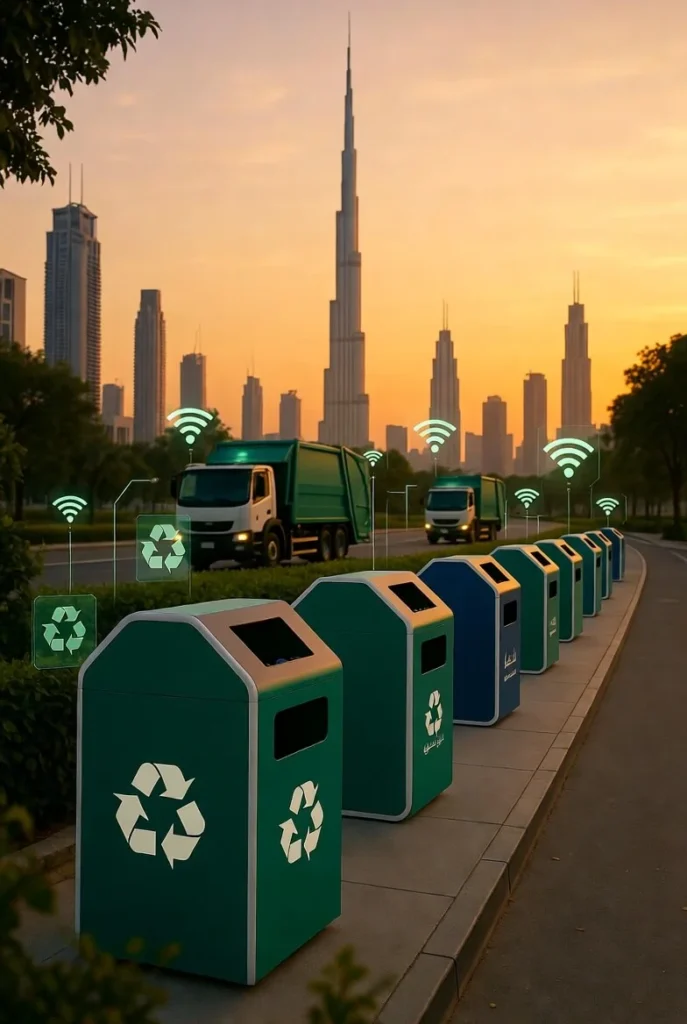
Smart bins and solar compactor bins dot across high-footfall areas, transit hubs, beaches and neighborhoods. Along the Sheikh Zayed Road corridor, fully contained units provide defined recycling streams for rapid sorting on the go. They prevent olfactory offense and ensure safe, clean streets.
Each unit utilizes fill-level sensors, remote alerts and solar energy to power the compactor. This automatic compaction increases capacity roughly eight times over traditional containers, which minimizes pickups and street congestion. Fleet teams see live status and can reroute to where the demand is highest.
The system identifies holes in coverage by employing smart methods to monitor where bins rest, how they fill and how they do over time.
| Feature/Benefit | Traditional Bins | Smart/Solar Compactor Bins |
|---|---|---|
| Capacity | Fixed; fills fast | Compression increases capacity ~8x |
| Monitoring | Manual checks | Remote fill-level sensors, alerts |
| Hygiene | Frequent overflow risk | Sealed design, odor and litter control |
| Recycling support | Limited signage | Built-in streams for source separation |
| Operations | Static routes | Dynamic dispatch based on live data |
Fleet Management
GPS and RFID provide each truck with a live signature. Dispatchers view locations, loads, and service status on a single map and can reroute in minutes. Route optimization reduces deadhead and wait time.
Less time idling on the road results in reduced fuel consumption and reduced emissions. That aids in striking climate targets while still servicing windows in dense regions. Predictive maintenance uses engine and hydraulics data to detect early faults, plan repairs, and increase vehicle longevity.
Asset histories associate costs, uptime, and usage to justify budget requests. Central control rooms orchestrate city-wide transportation. They juggle transfer station lines, handle peak events, and distribute notifications during storms or closures. It is a scalable setup that grows along with waste-to-energy connections as that market matures.
Data Analytics
Big data tools monitor waste volumes by district, period, and stream. Trends inform crew shifts, bin location, and the balance between collection and sorting. One robust material recovery network increases the proportion that is suitable for recycling and supports local industry and employment.
The global recycling market is close to $300 billion, and wastes-to-energy will expand. Targets like Vision 2021’s 75% diversion make clear that technology alone can’t do it; education, best practices, and law must support the system.
Data guides policy. Executive Director Rick Tufts leads test pay-as-you-throw pilots, hones recycling mandates and public outreach. Results flow back into daily plans and longer-term contracts.
Key KPIs tracked include:
- Diversion rate (%), landfill tonnage, contamination rate
- Collection on time rate, missed pick ups per 1,000 stops
- Fuel per tonne, CO2e per route, idle minutes
- Bin fill-level accuracy, overflow incidents, service intervals
- Recovery yield by material, revenue per tonne, processing cost per tonne.
Regulations and Civic Duty
Dubai Municipality operates waste management through transparent regulations and regular audits, ensuring proper waste disposal while connecting local laws to UAE federal laws for environmental protection and sustainable waste management.
Municipal Policies
Key policies established compulsory segregation at source for commercial and multi-unit locations, with recycling targets linked to the UAE objective to divert 75% of municipal waste from landfills. This initiative is part of the Dubai Integrated Waste Management Master Plan, which emphasizes sustainable waste management and stringent management standards for hazardous streams. Property owners must register with Dubai Municipality for waste services and achieve service levels for bins, collection schedules, and contamination limits. Commercial premises are required to dispose of waste safely, label hazardous waste, and keep storage sealed and ventilated under Federal Law No. 24 of 1999.
Transport is governed by the same law and Basel Convention controls, ensuring proper waste disposal. Waste companies and site operators must be licensed, adhering to fleet standards, driver training, and GPS tracking. Evidence of disposal at authorized sites is essential for compliance. Permits are renewed based on compliance history and audit results, reinforcing the importance of responsible waste management.
Landfill fees drive diversion, while rebates or reduced fees reward high recovery rates and clean recyclables. Additional incentives may include expedited permit issuance for operators with certified recycling performance. The integrated waste management strategy 2021–2041 focuses on source segregation, expansion of recycling stations, and innovative waste management solutions.
This includes waste-to-energy initiatives for non-recyclables, organics capture, and construction and demolition recycling, all aimed at reducing the environmental impact. Hazardous waste traceability and digital tracking of loads are also critical components, ensuring transparency in the waste management process.
Public procurement favors recycled content, enhancing the significance of recycling services in the emirate. By promoting smart recycling centres and encouraging community participation, Dubai is paving the way for a cleaner environment and improved recycling rates across the region.
Fines and Enforcement
Illegal dumping, hazardous and general waste mixing, and non-segregation incur fines ranging from AED 500 to AED 50,000, with severity based on risk, volume and repeat offence. Fines increase for offenses that damage community well-being or the environment.
Officers carry out planned and impromptu inspections, underpinned by compulsory waste audits to monitor contamination, storage, and records. The findings generate corrective timelines and return visits.
Fixed and mobile cameras, smart weighbridge data, and GPS on collection trucks feed into dashboards that flag route deviations and unauthorized tipping. Data backs up case files and court actions when necessary.
Escalation progresses from a warning to a fine, then license suspension, confiscation of vehicles utilized in dumping, and referral for prosecution for egregious or multiple violations. Remedies may include required employee instruction and third-party compliance audits.
Public Awareness
Civic duty education campaigns describe bin color codes, what to recycle and how to keep streams clean. These are simple steps for homes, shops and worksites. Messaging emphasizes health and economic savings across multiple communities.
Schools organize recycling campaigns, STEM-based waste laboratories and excursions to materials recovery facilities. Community workshops address safe battery storage and e-waste.
Digital outreach leverages multilingual guides, quick video clips and map-based interfaces displaying drop-off locations. Ongoing activities include neighborhood clean-up weeks, office “green team” challenges with diversion targets, e-waste collection days, plastic reduction pledges for food outlets, and construction site segregation contests with public scoreboards.

Ambitious Sustainability Goals
Dubai Municipality establishes ambitious sustainability targets that connect waste with climate, energy, and resource security. The strategy is aligned with UAE Vision 2030, the Dubai Clean Energy Strategy 2050, and the UN Sustainable Development Goals, with goals for zero waste-to-landfill, reduced emissions, and resilient circular systems.
It measures its progress by diversion rate, per capita waste generation, recycling yields by material, and cuts in greenhouse gases associated with energy recovery and composting.
Zero Waste by 2041
The city aims for zero waste to landfill by 2041 under the Dubai Integrated Waste Management Strategy 2021–2041, extending a near-term drive to achieve zero waste to landfill by 2030 and a municipal target to divert all solid waste by 2034.
The roadmap is phased: first reduce waste at source and separate streams at the curb. Then scale recycling for paper, metals, plastics, and e-waste. Finally, use high-efficiency waste-to-energy (WTE) for what cannot be recycled.
The flagship WTE plant will process approximately 1.9 million tonnes per annum, generating power for over 135,000 homes and reducing 1.4 million tonnes of CO2e, which is equivalent to 300,000 cars off the road.
Annual diversion goals and updates direct delivery. Example trajectory:
- 2025: Sixty percent diversion citywide. All districts will have dual-bin segregation.
- 2027: 75% diversion, organics collection in food hubs and hotels.
- 2030: 90 to 100 percent diversion. Residuals routed to WTE instead of landfill.
- 2034: 100% diversion for municipal solid waste and landfill for inert residues.
- 2041: Maintain zero landfill with closed-loop reuse across priority sectors.
Public dashboards, along with quarterly audits, confirm material recovery rates and emissions savings.
Reducing Plastic
Dubai is banning single use and advocating reuse. Plastic cutlery, straws, and foam containers all get restricted under the program as do large retailers converting to sturdy bags and returnable crates.
A government-imposed tariff on carrier bags, combined with store credits for reusable totes, gently pushes behavior without oppressively banning it. Hotels and events are supported with tiered incentives for refill stations and bulk dispensers.
Recycling of PET bottles, film, and carrier bags occurs through deposit-style pilots, smart reverse vending, and high-purity sorting at MRFs. Schools and malls hold drop points to collect clean materials.
Less plastic reduces litter, safeguards marine life in the Gulf, and prevents drain blockages during scarce storms. This reduction leads to lower cleanup expenses and fewer flood hazards in congested urban areas.
Promoting Circularity
Circular economy is all about keeping materials in use at the highest value. Dubai Municipality contextualizes this with product life extension, material recirculation, and organics recovery, meaning fewer inputs are required and fewer outputs end up in disposal.
Initiatives span building and demolition salvage, take-back for electronics and appliances, furniture repair cafés, and municipal food-and-garden composting. They can participate in procurement pilots that prioritize recycled content and design for disassembly.
| Initiative | What it does | Outcome metric | Latest signal |
|---|---|---|---|
| C&D recycling hubs | Crush and reuse concrete/asphalt | >80% C&D diversion | Cuts quarry demand |
| Organics composting | Turn food waste to soil inputs | 0.5–1.0 t CO2e saved/t | Higher farm uptake |
| E-waste take-back | Recover metals and plastics | 20 to 30 percent device recovery | Less informal dumps | Reuse markets | Extend furniture and office gear life | 2 to 4 cycles per item | Lower capex for SMEs |
City teams exchange lessons in venues such as the World Circular Economy Forum and the Global Sustainable Cities Network as peers in the GCC expand such systems.
Public-Private Sector Synergy
Dubai Municipality partners with private companies to design, finance, and operate waste services at an urban scale, including smart recycling centres. This model combines public stewardship with private sector expertise to achieve service goals, accelerate delivery, and improve waste separation, ultimately reducing landfill impact and promoting sustainable waste management.
Contracted Services
Licensed haulers span zones throughout the emirate such as Beeah (northern corridors and parts of Deira), Dulsco (JAFZA, industrial clusters and key business areas), Imdaad (mixed-use communities and hospitality zones), Averda (certain residential areas and construction sites), and Enviroserve for e-waste across commercial areas.
Companies liaise with city transfer stations and MRFs to equalize loads and direct trucks. Selection reflects clear criteria: technical capacity, fleet age and fuel standards, worker safety records, data reporting, recycling pathways, and financial strength.
Providers are re-rated on audits, contamination and missed-pickup counts, and customer response. Contracts employ service-level agreements linked to metric targets such as pickup timeliness, bin fill levels, diversion rates, and complaint resolution times with gainshare or fines.
Examples demonstrate customized configurations. Big malls have compactors with RFID tags to trace streams by tenant. Food businesses assume on-source segregation with sealed organics bins and lifts on schedule to anaerobic digestion.
Construction sites embrace skip logistics connected to digital manifest to fight fly tipping and increase inert material recycling.
Joint Ventures
Joint ventures provide capital and operating expertise to core assets while the Municipality anchors policy, land, and regulatory. Partners co-design facilities, align on feedstock guarantees, and share revenue from power, recyclables, or tipping fees in a fixed-risk framework that honors public goals and private rigor.
The Warsan Waste Management Centre is a flagship, combining a waste-to-energy plant with sorting lines to reduce landfill and export electricity to the grid. About public-private sector synergy, there are 11 smart recycling centers in communities, user ID, pay-as-you-throw pilots, and real-time fill data.
These ventures demonstrate how shared funding reduces financial pressure and accelerates construction schedules.
| Project | Type | Status | Partners | Notable Outcomes |
|---|---|---|---|---|
| Warsan Waste-to-Energy | WtE + MRF | Operational/scale-up | Municipality + global EPC | Base-load power, landfill cut |
| Smart Community Recyclers | IoT drop-off | Ongoing rollout | Municipality + tech vendors | Higher clean-stream capture |
| C&I Organics Hub | Anaerobic digestion | Upcoming | Municipality + waste operator | Biogas for fleet, digestate use |
Listing current and upcoming JV projects in one public dashboard helps investors gauge the pipeline and assures residents of progress.
Innovative Partnerships
Public-private sector synergy is crucial for enhancing sustainable waste management. Technology tie-ups introduce route optimization, bin sensors, and AI sorting to improve efficiency and recovery rates. Data platforms feed dashboards that align 26 performance indicators with daily field work, while device telemetry supports performance-based pay. Additionally, the Dubai Municipality waste management department collaborates with universities to test low-energy plastics sorting and recycled aggregate for road sub-base, which significantly lifts biogas yields.
International bodies play a vital role in supporting benchmarking, peer reviews, and training, which help bridge the cultural divide that can stall public-private collaboration. Case studies demonstrate the concrete benefits of these initiatives. For instance, a sensor-led pilot project at various recycling stations reduced overflow incidents by 40% and fuel consumption by 12%. Furthermore, a plastics sorting upgrade led to a purity increase of PET and HDPE above 95%, attracting stable buyers and enhancing recycling services.
One co-funded innovation call resulted in 17 strategic projects, showcasing how shared risk and urgency can accelerate rollouts in the recycling sector. From reverse-vending schemes to construction and demolition fines reuse in non-structural blocks, these initiatives underscore the importance of collaboration in achieving effective waste separation and improved recycling rates.
By fostering partnerships between public and private sectors, the community can work towards a more efficient and eco-friendly waste management process, significantly reducing the environmental impact of waste disposal in the region.
Beyond the Gleam: A Reality Check
Dubai’s waste system has reduced landfill and promoted reuse. Rapid expansion, a growing population, and massive tourism maintain large waste levels. The city aims for 100% landfill diversion, with at least 56% through recycling, and connects those goals to a 2050 plan for 75% clean energy.
Where we stand: progress is real, but source separation, behavior change, and steady compliance across sectors remain gaps.
Consumption Culture
High income and dense retail and rapid e-commerce mean high per-capita waste, from packaging to food. Disposable items still rule the day. Imported products contribute mixed-material waste that is difficult to separate and recycle in volume.
Habit change is glacial. Price signals for waste are feeble, and voluntary recycling rides on the wave of convenience. Residential and commercial sorting differs by building, while loose habits and commingled loads decrease recovery percentages.
When buildings offer bins with labels, pickup schedules, and app reminders, separation rates increase. School assemblies and mall exhibits make people aware, but multiple reminders and easy calls to action are most effective.
Actionable steps:
- Residents should buy in bulk and refill, choose returnable glass, compost food, and avoid mixed-material packaging.
- Businesses should switch to standardized mono-material packaging, set staff sorting stations, share monthly waste dashboards, and tie vendor contracts to take-back schemes.
- Property managers link tenant deposits to sorting compliance and run floor-level bin checks.
Tourist Impact
Tourism and hospitality contribute significant spikes in food, plastic, and event waste, especially over peak travel months and world expos. Major venues can produce multiple tonnes a day, stretching collection windows and back-of-house storage.
Seasonal surges demand dynamic routing and staffing. At peak events, glass and organics targeted pickups at hotels and attractions increase capture rates. Their city-wide smart waste platform incorporating bin monitoring, route planning, waste analytics, and citizen reporting turns this into an adaptive reality.
Examples stand out: hotels with on-site bio-waste recovery, refill water stations at beaches, deposit-return pilots for event cups, and supplier contracts that require reusable crates. They eliminate expense and waste while maintaining service quality.
The Human Element
Well-trained crews clean our streets and facilities and their safety counts. Fit-for-purpose PPE, heat stress plans, and hazard briefings minimize risk during extended shifts and high-traffic collections.
Foremen, janitors, and machine operators are the backbone of the system. Their input can identify line jams, contamination hot zones, and machinery malfunctions before they escalate.
Community initiatives, such as block clean-up days, sorting seminars, and school repair days, change habits. Combined with incentives and public data, they cultivate pride and consistent engagement.
Best practices:
- Standardize toolbox talks and competency checks.
- Use micro-bonuses for clean routes and low contamination.
- Publish building-level recycling scores.
- Scale advanced sanitation and bio-waste recovery to reduce more than 1.4 million tonnes of CO2 each year.
- Take site protocols together to regional fora such as the World Circular Economy Forum and the Global Sustainable Cities Network, sharing what works across the GCC.
Conclusion
Dubai’s waste plan reveals obvious victories and tangible voids. Smart bins reduce overflow. Route tools are fuel savers. Sorting guidelines boost recycling rates. Fines spur companies to play their role. Big targets established the rhythm. Private partners bring speed and scale. Still, food loss remains high, and some locations continue to landfill mixed waste. Field staff require consistent training. Data rooms require fresh, live feeds, not expired logs.
To move fast, start with small, clear steps:
- Track food waste by weight in kitchens and malls.
- Add glass and e-waste drop points within dense blocks.
- Publish ward-level recycle stats each month.
- Tie rebates to verified diversion, not claims.
Looking for additional pointers or local case notes. Leave a comment. Let’s make a cleaner city powered by evidence.
Frequently Asked Questions
How does Dubai’s waste management system work day to day?
Dubai’s waste management department employs source separation, smart recycling centres, and GPS-tracked collection to enhance efficiency. Waste is meticulously separated for recycling, composting, and energy recovery, aiming for improved waste separation and greater diversion from landfill, ensuring a cleaner environment.
What technologies power Dubai’s waste operations?
Dubai municipality waste management systems incorporate IoT sensors and RFID tags, along with smart recycling centres for enhanced waste disposal. Facilities utilize AI-driven sorting and robotics to boost recovery rates, while data dashboards monitor performance and emissions, contributing to improved waste management processes.
What are the key rules residents and businesses must follow?
Sort recyclables to improve the recycling rate, prevent contamination, and deposit hazardous waste at designated locations. Adhere to bin color codes and collect schedules of the Dubai Municipality waste management systems. Construction and commercial sites must file waste plans and utilize licensed carriers for proper waste disposal.
What are Dubai’s sustainability targets for waste?
Dubai aims for high landfill diversion, increased recycling rates, and greater energy recovery through its ambitious waste management master plan. The Dubai municipality waste management systems focus on sustainable waste management initiatives, investing in waste-to-energy capacity and organics processing to support a circular economy.
How do public and private sectors collaborate?
Dubai Municipality establishes policy, standards, and regulation for sustainable waste management. Licensed private operators manage waste disposal through collection, sorting, and treatment, while partnerships optimize efficiency with technology pilots and data sharing at smart recycling centres.
What happens to non-recyclable waste?
Non-recyclable fractions are channeled to waste-to-energy or engineered landfills as part of the Dubai Municipality waste management process. Energy recovery minimizes landfill use and harnesses electricity, contributing to sustainable waste management.
What challenges does Dubai still face?
Contamination, construction volumes, behavior change, and cost control are challenges in sustainable waste management. Scaling organics collection in dense areas is difficult, but education and smarter sorting at recycling stations can improve recovery rates.