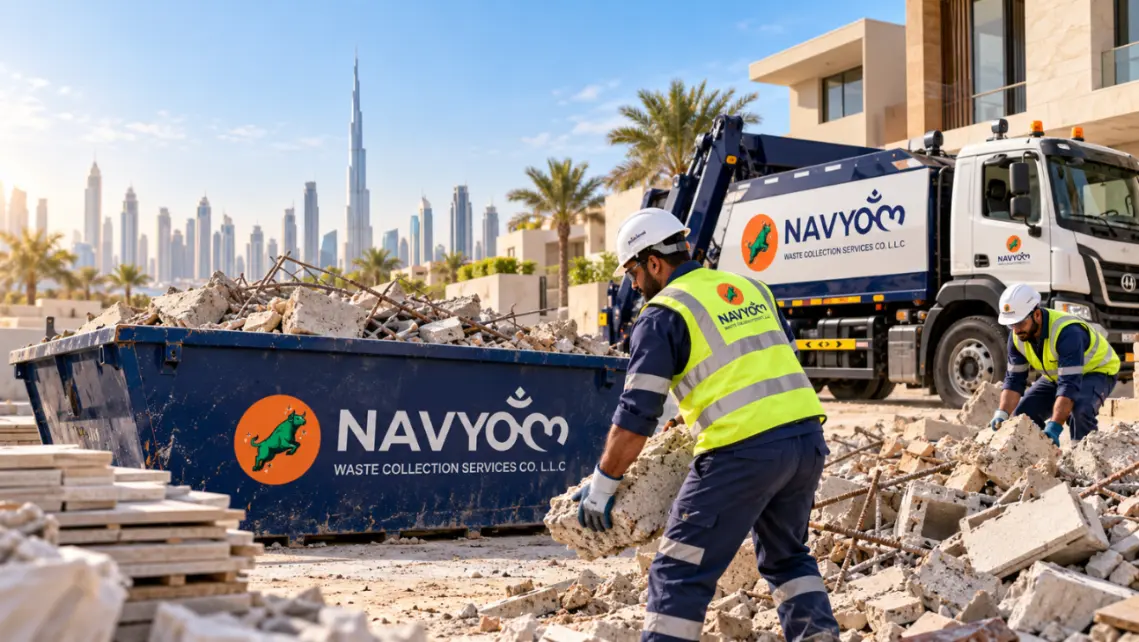
Concrete & Rubble Removal Dubai
Remove concrete, masonry, blocks, tiles and heavy construction debris with a collection plan built around weight, volume, access and the difference between clean inert waste and mixed C&D waste.
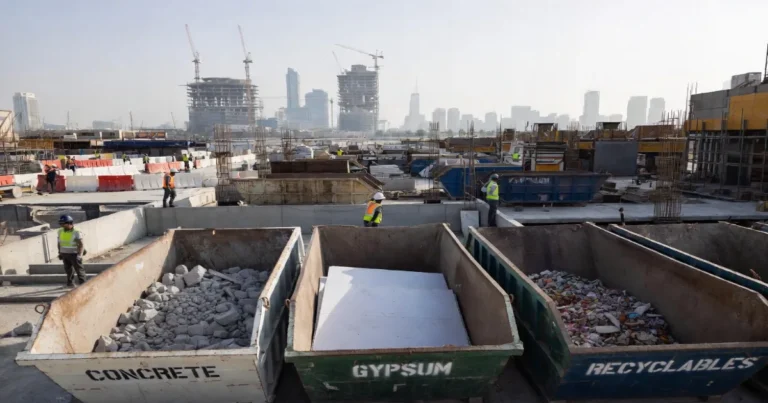
Concrete and rubble are heavy waste, so weight matters as much as container volume. Clean concrete, blocks, masonry and similar inert material should be kept separate from timber, gypsum, plastic and general mixed debris where practical. Dubai Municipality identifies construction and demolition waste as a regulated waste category, and its guidance requires construction waste to be separated and sorted before transport.
What counts as concrete and rubble waste?
The first pricing question is not “how big is the pile?” It is “what is actually in it?” Clean inert material and mixed construction waste should not be treated as the same load.
Broken slabs, screed, blocks, kerbs and concrete demolition debris.
Blocks, bricks and mineral-based construction waste.
Broken wall and floor tiles, ceramics and similar heavy finish waste.
Reinforced concrete can need a different loading and sorting plan.
Concrete mixed with gypsum, timber, plastic or packaging is a different waste profile.
Soil and sand should be identified separately because receiving routes can differ.
How much does concrete and rubble removal cost in Dubai?
There is no honest flat rate for every site. Cost depends on waste purity, load weight, container/vehicle access and how many collection movements are required.
| Planning item | DubaiWaste planning benchmark | Best use | Note |
|---|---|---|---|
| Small skip | AED 400–620 | Small renovation rubble | Planning range only; heavy-waste loading limits still apply. |
| Medium skip | AED 680–980 | Moderate renovation debris | Volume alone does not determine suitability for dense concrete. |
| Large skip | AED 1,050–1,500 | Larger construction jobs | May reach practical weight limit before appearing full. |
| RoRo | AED 1,700–3,700 | Large projects and bulk C&D | Best where access and project scale justify it. |
| Concrete / inert waste | AED 80–120 per ton | Clean inert material | Commercial planning benchmark, not a municipal tariff. |
Which skip size is best for concrete rubble?
The biggest container is not automatically the best. For dense concrete, a controlled load can be safer and more efficient.
Smaller / controlled loads
- Useful for bathroom, kitchen and villa rubble
- Better where truck access is limited
- Helps prevent overloading
- Easier for hand-loaded sites
Bulk / high-volume removal
- Better for demolition and structural works
- Needs suitable loading plant and vehicle access
- Works best when concrete and metal can be separated
- Should be planned by expected tonnage
Build a concrete & rubble collection brief
This tool does not invent a quote. It packages the information needed to recommend the right collection method.
Concrete is a weight problem disguised as a volume problem
This is why heavy-waste quotes need more detail than normal light-waste collections.
Useful for choosing the container footprint and collection frequency.
Concrete and tiles can reach safe transport limits before the container looks full.
Hand loading, wheelbarrows or excavator loading can change the setup.
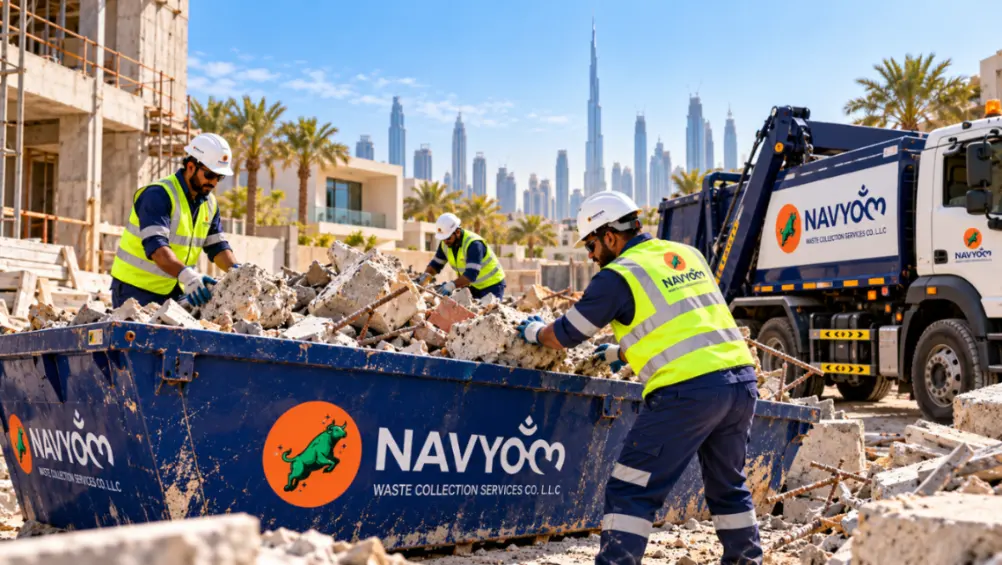
Keep concrete and rebar separate where practical
Dubai Municipality’s construction and demolition waste circular instructs contractors and consultants to separate and sort construction waste before transport. It explicitly gives examples such as concrete, rebar, wood, tiles and plastics.
Keep clean mineral waste away from gypsum, timber and packaging where site conditions allow.
Metal is easier to recover when it is not buried in mixed light waste.
If separation is impractical, tell the contractor the load is mixed so it can be planned correctly.
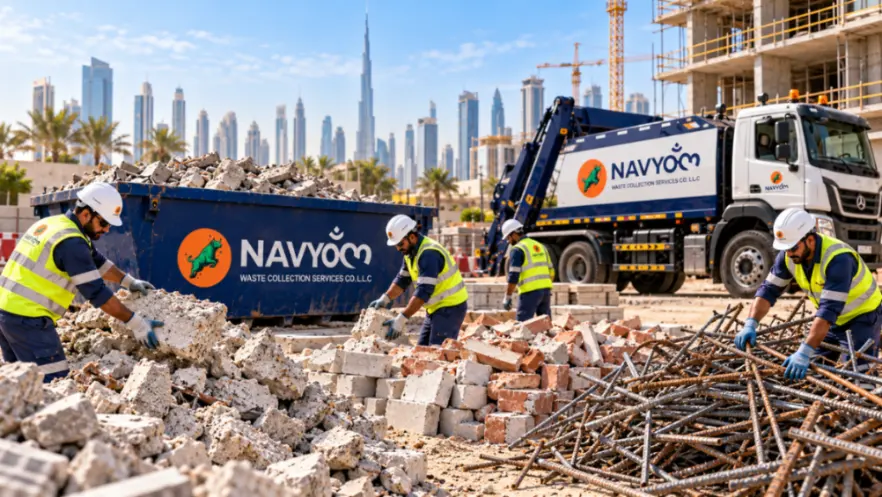
Site access can change the rubble-removal plan
Heavy waste needs a route from the pile to the truck. The fastest quote is the one that already includes that route.
Send with your enquiry
- Location and project type
- Wide photos and close-ups of the rubble
- Main material type
- Whether rebar/metal is mixed in
- Truck/container access photos
- Required collection date
Access points to confirm
- Road width and turning space
- Container placement area
- Basement height restrictions
- Tower loading-bay rules
- Whether mechanical loading is allowed
- Collection time restrictions
Dubai concrete waste disposal: compliance basics
The collection and transport side matters just as much as where the waste ultimately goes.
Dubai Municipality classifies construction and demolition waste as a distinct waste category.
RASID is used to regulate and monitor registered waste-management companies and waste transport activity.
Municipality guidance requires construction and demolition waste to be separated and sorted at site before transport.
Related Dubai construction waste guides
Use these when the next question is about total project cost, site clearance, demolition approvals or skip planning.
Need concrete or rubble removed in Dubai?
Send Navyom the location, project type, rubble photos, main material, approximate quantity, access details and required date.
Concrete & rubble removal Dubai FAQs
How much does concrete removal cost in Dubai?
Can I fill a large skip completely with concrete?
Should concrete and rebar be separated?
What photos should I send for a rubble quote?
Is clean concrete easier to handle than mixed construction waste?
Does RASID apply to construction waste transport?
- Dubai Municipality Circular No. 12-10-1 of 2023
- Dubai Municipality — About RASID
- Dubai Municipality — RASID GPS Tracking
- Dubai Municipality Circular No. 6/2015
- DubaiWaste construction-waste planning price benchmarks
Planning prices are commercial estimates, not Dubai Municipality tariffs.