Industrial Waste Management Dubai requires every facility to classify waste at source, segregate hazardous from non-hazardous streams, engage only Dubai Municipality-licensed contractors, and issue a Waste Transfer Note (WTN) for each collection. Fines for non-compliance range from AED 500 to AED 50,000, and rejected loads or operational suspensions follow repeat violations.
Dubai’s industrial zones — Jebel Ali Free Zone (JAFZA), Al Quoz, Dubai Industrial Park (DIP), and Dubai Investment Park — process hundreds of thousands of tonnes of industrial waste every year. The facilities responsible are as varied as the waste they produce: aluminium fabricators, food processors, chemical storage operators, automotive workshops, logistics hubs, and electronics assembly plants all face different waste profiles, different regulatory obligations, and very different cost exposures.
What they share is this: the UAE has moved decisively away from treating industrial waste as an operational afterthought. Dubai Municipality, the Environment and Protected Areas Authority (EPAA), and individual free zone authorities now enforce structured compliance frameworks — and they audit without warning. Businesses that understand the framework make money from their waste. Those that don’t pay twice: once for disposal, once for the fine.
This guide covers the complete industrial waste management picture for Dubai and the wider UAE — classification, on-site segregation, storage standards, licensed contractors, WTN obligations, facility-specific strategies, cost benchmarks, and the common mistakes that regularly cost facility managers their budgets and their compliance records.
📖 Reading Time
Approximately 12 minutes
🏭 Who This Is For
Facility managers, EHS officers, plant operators, sustainability leads, procurement teams, warehouse supervisors, and industrial site owners across the UAE
🗂️ Waste Streams Covered
Hazardous, non-hazardous, process scrap, packaging, metal offcuts, e-waste, chemical containers, oils, solvents, batteries, general industrial
⚙️ Complexity Level
Medium to high — requires contractor vetting, disciplined segregation, WTN documentation, and periodic waste audits
What Counts as Industrial Waste in Dubai?
The classification matters because it determines everything downstream: which contractor you’re legally permitted to use, how you must store waste on-site, what permits apply, and what disposal costs look like. A single misclassification — treating a chemical solvent as general industrial waste, for example — can contaminate an entire skip load, trigger a rejection at the transfer station, and draw an inspection to your facility.
Hazardous Industrial Waste
Under UAE regulations, waste is classified as hazardous if it exhibits one or more of the following properties: flammability, corrosivity, reactivity, or toxicity. In practice, Dubai’s industrial zones generate hazardous waste across six common categories:
- Oils and lubricants — used engine oil, hydraulic fluids, gear oil, cutting fluids from machining operations
- Solvents and chemical residues — thinners, acetone, industrial cleaning agents, paint stripper waste
- Batteries — automotive, industrial lead-acid, and lithium-ion batteries from forklifts, UPS systems, and EVs
- Paint and coating waste — liquid paint residues, contaminated spray equipment, empty aerosol cans with residue
- Contaminated absorbents — rags, spill kits, and PPE contaminated with hazardous substances
- Electronic waste (e-waste) — circuit boards, monitors, and industrial controllers containing lead, mercury, or cadmium
Non-Hazardous Industrial Waste
Non-hazardous industrial waste presents fewer safety risks but remains tightly regulated in terms of disposal routing and documentation. Common types include:
- Cardboard, corrugated packaging, and paper
- Plastic stretch wrap, shrink film, strapping, and rigid plastic containers (uncontaminated)
- Wood pallets, timber off-cuts, and wooden crates
- Metal scrap — steel, aluminium, copper, and stainless steel off-cuts
- Rubber scrap and foam materials
- Construction debris from fit-out or facility modifications
- General canteen and office waste generated within an industrial premises
The critical point: mixing hazardous and non-hazardous waste is illegal under Dubai Municipality regulations. It voids contractor liability, elevates disposal costs by up to 400%, and — if discovered during an inspection — triggers enforcement action against the waste generator, not the contractor.
The Four Pillars of Compliant Industrial Waste Management in Dubai
Pillar 1: At-Source Waste Segregation
Segregation must happen where waste is created — on the production floor, at the loading dock, in the workshop — not at a centralised bin area. By the time mixed waste reaches a communal collection point, contamination has already occurred. And contamination destroys value: a clean aluminium scrap stream worth AED 3/kg becomes a disposal liability the moment a contaminated oil rag enters the same bin.
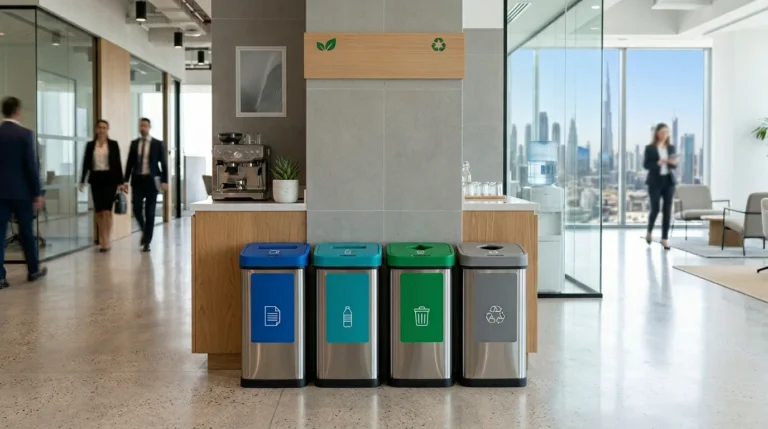
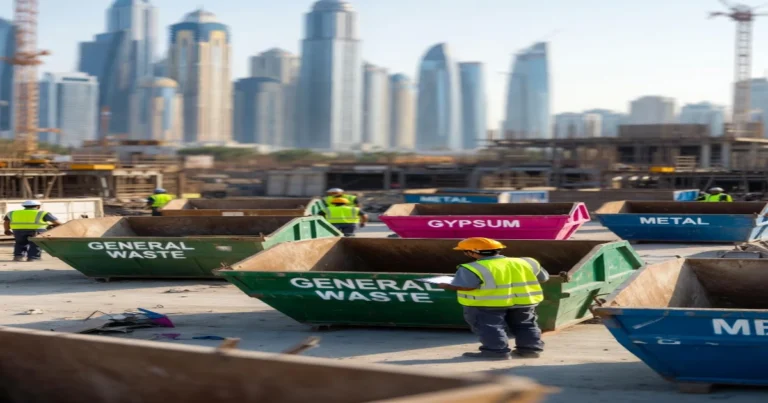
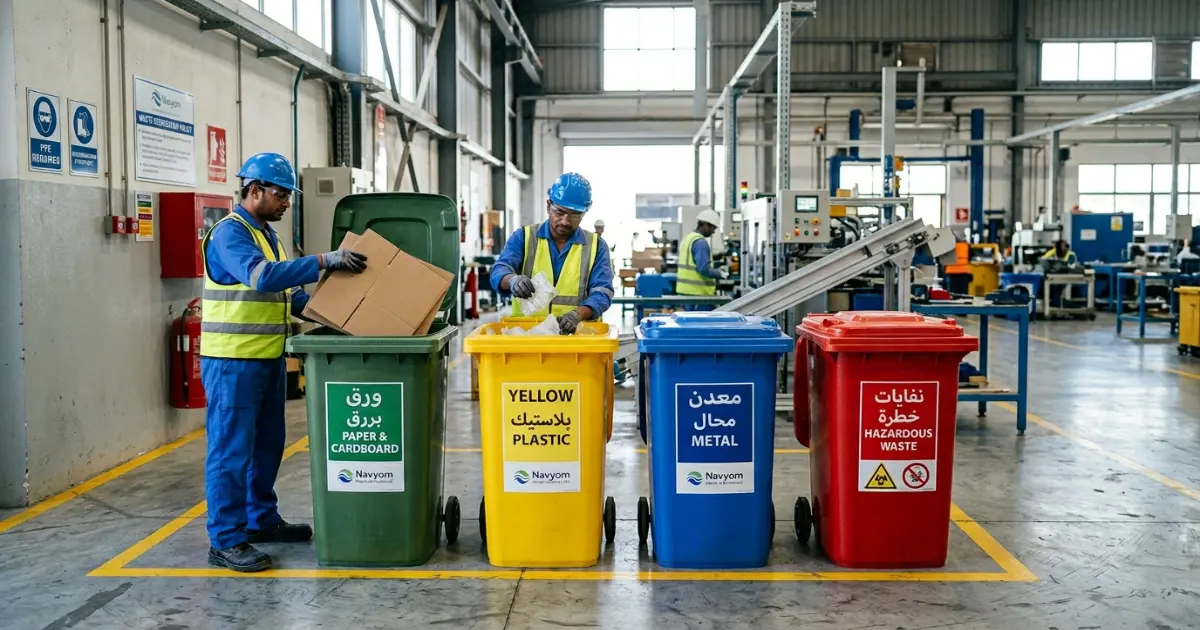
Set up colour-coded, clearly labelled collection points at each waste generation location. A practical starting framework for most Dubai industrial facilities:
- Green bins — clean cardboard and paper
- Yellow bins — clean rigid plastics (uncontaminated)
- Blue bins — metal scrap
- Brown bins — wood and timber
- Grey bins — general non-recyclable industrial waste
- Red bins with secondary containment — hazardous waste only
Staff training is not optional. Run induction-level waste training for all new hires and quarterly refreshers for existing teams. A single untrained worker can contaminate an entire month’s recyclable stream before anyone notices.
Pillar 2: Licensed Waste Contractors
Not every waste company operating in Dubai holds the permits required for industrial or hazardous waste. Using an unlicensed contractor — even inadvertently — transfers compliance liability to your business for any illegal dumping, missing chain-of-custody documentation, or environmental damage downstream. Before signing any waste contract, verify:
- Current Dubai Municipality waste collection licence (request the licence number and verify on the DM portal)
- Separate hazardous waste handling permit, if your facility generates hazardous streams
- Third-party liability insurance covering environmental incidents
- References from facilities with comparable waste profiles
- Ability to provide WTNs for every collection — this is a non-negotiable capability
The cheapest contractor quote is almost never the right choice for industrial waste. Underpriced industrial waste services routinely cut corners on disposal — and it’s the waste generator who bears the legal and financial consequences when those corners are cut.
Pillar 3: Waste Transfer Notes (WTNs)
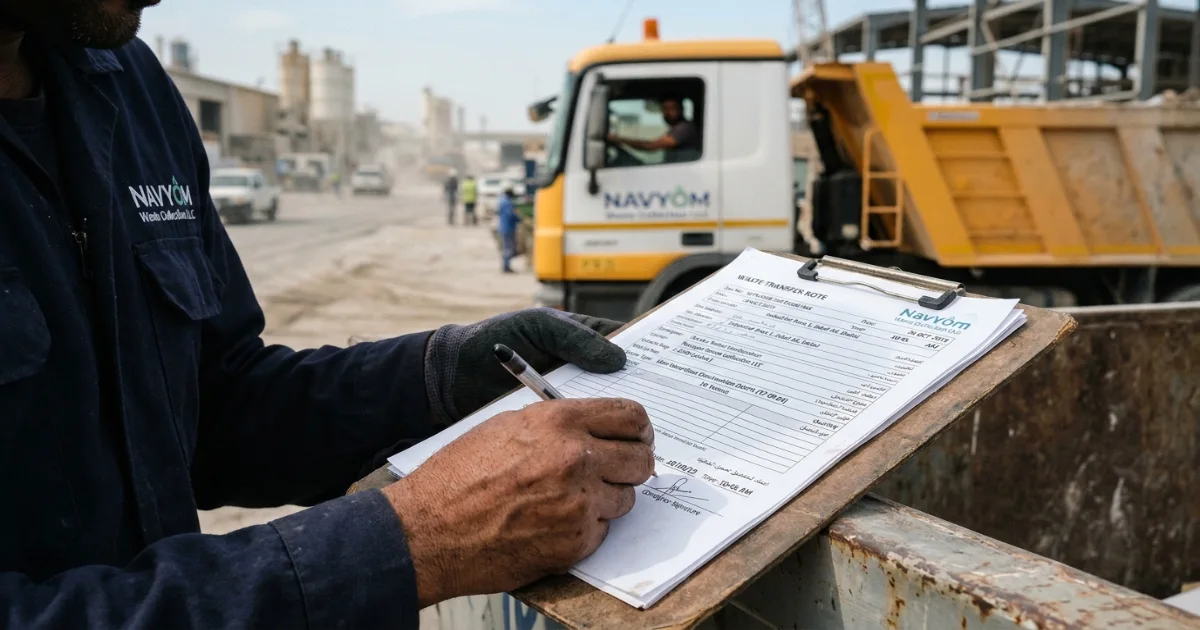
A Waste Transfer Note is the legal instrument proving your waste left site lawfully, travelled with a licensed carrier, and reached an authorised treatment or disposal facility. For industrial and hazardous waste in Dubai, WTNs are mandatory — not a courtesy. Each completed WTN must capture:
- Precise waste description and UAE classification code
- Measured volume or weight at collection
- Date, time, and collection vehicle registration
- Contractor name, licence number, and authorised signatory
- Destination facility name, address, and permit reference
- Generator-side authorised signature
Retain WTNs for a minimum of three years. During ESG audits, ISO 14001 assessments, free zone renewals, or Dubai Municipality inspections, your WTN archive is the primary evidence of compliant waste management. Verbal agreements, informal receipts, or photographs of a skip being loaded do not constitute compliant documentation.
Pillar 4: Climate-Appropriate On-Site Storage
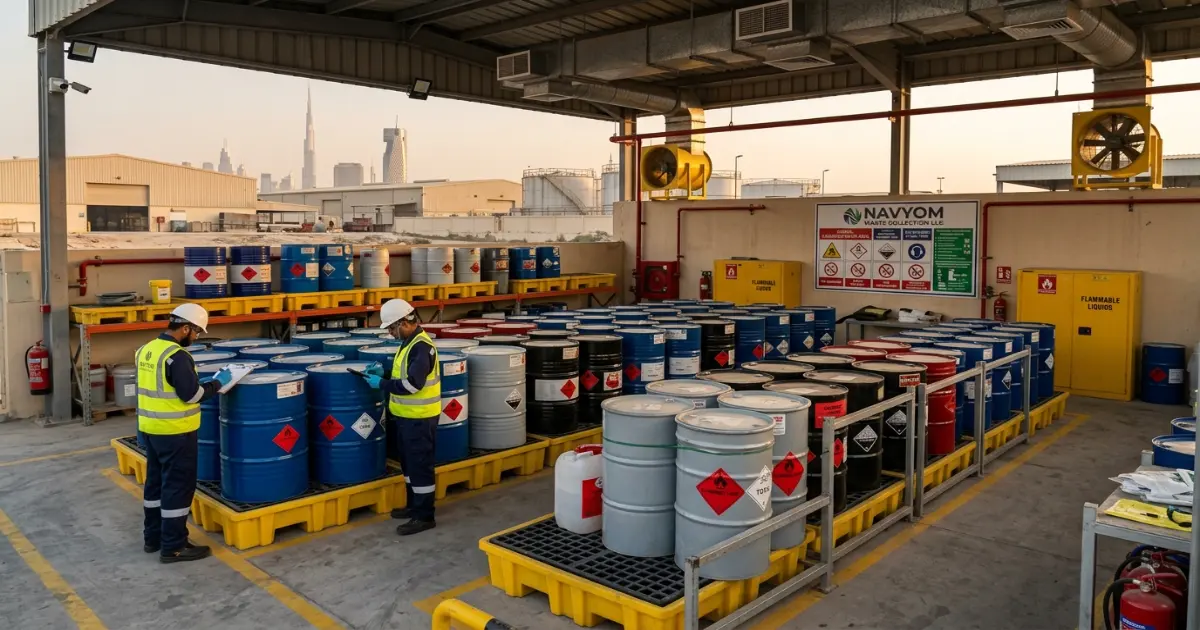
Dubai’s environmental conditions create hazardous waste storage risks that don’t apply in most other markets. Summer ambient temperatures regularly exceed 45°C, and the combination of heat, direct sunlight, and humidity accelerates the degradation of containment vessels, label adhesives, and bunded pallets. Minimum storage standards for UAE industrial facilities:
- Hazardous waste in designated, access-controlled areas — not co-located with general waste
- Secondary containment (bunded pallets or concrete bunds) for all liquid hazardous waste — sized to hold 110% of the largest container’s volume
- Fire-resistant cabinets for flammable materials, positioned away from heat sources and direct sun
- Ventilation for volatile organic compounds — sealed rooms without airflow are not compliant
- UN-rated containers for transport-ready hazardous waste
- Weekly visual inspections logged and signed — container integrity, label legibility, bund condition
📋 Inspection Reality Check
Dubai Municipality and free zone authority inspectors conduct unannounced waste compliance visits. Documented findings in 2024 included: missing WTNs (most common), mixed hazardous and general waste streams, unlicensed contractors in use, and inadequate secondary containment for liquid hazardous waste. Fines issued ranged from AED 2,000 for documentation gaps to AED 50,000 for mixed hazardous waste — with facility operations suspended pending corrective action in the most serious cases.
Industrial Waste Disposal vs Recycling Costs in Dubai: Stream-by-Stream Breakdown
| Waste Stream | Preferred Route | Typical Cost / Revenue | UAE-Specific Notes |
|---|---|---|---|
| Cardboard & Paper | Recycling (baled) | Revenue-neutral to revenue-positive (AED 0.10–0.30/kg for clean bales) | Contamination from oil, metal dust, or wet storage eliminates value; balers pay back within 6–12 months for high-volume sites |
| Metal Scrap — Aluminium | Scrap dealer / recycler | AED 2.50–4.00/kg (aluminium); AED 0.80–1.50/kg (steel) | UAE scrap metal market is mature; clean, sorted loads command best prices; contaminated mixed scrap is discounted or refused |
| Clean Industrial Plastics | Recycling (sorted by type) | Revenue-neutral; some streams earn AED 0.05–0.15/kg | PE, PP, and PET are most marketable; mixed or contaminated plastics default to landfill disposal costs |
| General Mixed Industrial Waste | Landfill (SWMD-approved sites) | AED 150–400/tonne disposal fee plus contractor collection charge | Dubai Municipality is progressively increasing landfill gate fees to drive diversion; costs trending upward through 2026 |
| Hazardous Waste (liquid) | Licensed hazardous waste treatment | AED 500–2,000+/tonne depending on classification and volume | Requires licensed contractor with hazardous manifest; improper disposal can result in fines exceeding the disposal cost by 10–20× |
| Wood Pallets | Repair/reuse or biomass | Revenue-neutral to low cost; contaminated pallets disposed as general waste | Pallet exchange schemes with suppliers eliminate disposal cost entirely for high-throughput warehouses |
| E-Waste (WEEE) | Authorised e-waste recycler | AED 0–400/tonne depending on content and volume | UAE WEEE compliance is accelerating; authorised recycler certification is required for audit-grade chain-of-custody documentation |
| Used Engine / Industrial Oil | Licensed oil waste contractor / re-refining | AED 200–800/tonne; some re-refiners pay for high-quality used oil | Pouring oil waste into drains is an environmental offence in Dubai carrying fines of up to AED 50,000; always document |
The pattern across all streams is consistent: clean, segregated waste costs less to dispose of and frequently generates revenue. Mixed, contaminated waste always costs more and yields nothing. Facilities that run waste programmes purely as a compliance function miss the substantial cost-reduction and revenue opportunity sitting in their skips.
Facility-Type Waste Strategies: Adjusted for Your Operation
Heavy Manufacturing and Fabrication Facilities
Sites generating multiple tonnes of waste daily — metal off-cuts, process scrap, packaging, cutting fluids — need infrastructure to match the volume:
- On-site balers or compactors to reduce cardboard and plastic volume by 70–80%, cutting collection frequency and transport costs
- Dedicated metal scrap bays with magnetic separators to keep ferrous and non-ferrous streams clean
- Daily or twice-daily collections for high-volume streams to prevent overflow, contamination, and HSE risks
- Real-time waste tracking — even a simple spreadsheet logging daily weights by stream — to identify process inefficiencies generating excess waste
- Monthly waste audits to quantify diversion rates and benchmark against UAE industry averages
Large fabrication facilities in Dubai Industrial Park (DIP) and Dubai Investment Park that consolidate waste streams and present clean, pre-sorted loads consistently negotiate 15–25% better contractor rates than sites presenting mixed loads.
Warehousing and Logistics Hubs
Logistics and warehousing operations generate high volumes of packaging waste — cardboard, stretch film, wooden pallets, plastic strapping. The good news: this is among the most recyclable waste profiles in Dubai’s industrial sector. The bad news: it’s also the most frequently mismanaged through contamination.
- A cardboard baler is the single highest-ROI investment for most warehouses — payback periods under 12 months are standard for sites processing 5+ tonnes of cardboard monthly
- Stretch film and strapping should be collected separately from cardboard; combined, they contaminate each other’s recyclability
- Pallet return or exchange programmes with major suppliers eliminate pallet disposal entirely
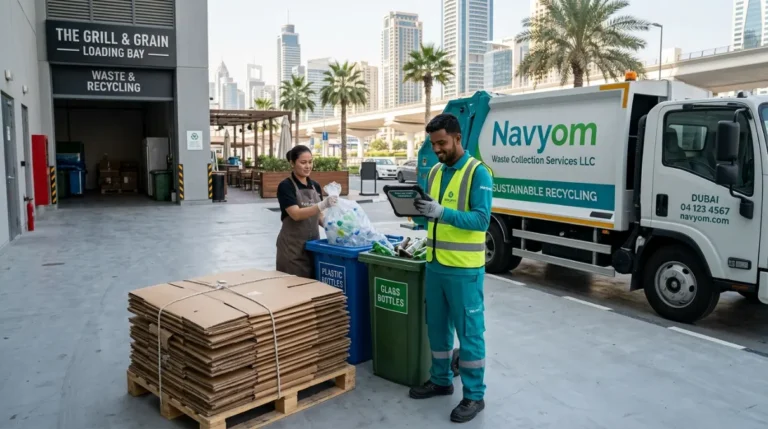
- Place segregation bins at receiving docks and despatch areas — where contamination originates — not just in a central waste area
- Align collection schedules with peak receiving days, not fixed weekly slots; overflow during busy periods is a leading cause of mixed-waste incidents in Al Quoz
Facilities Handling Hazardous Materials
Chemical storage, paint manufacturing, automotive servicing, and any operation using solvents, lubricants, or reactive compounds requires a formal hazardous waste management plan — not an informal arrangement. In practice, this means:
- A written hazardous waste management plan, reviewed annually and after any spillage incident
- Named personnel responsible for hazardous waste oversight — EHS Officer or equivalent designation
- Secondary containment for all liquid storage, inspected weekly and after heavy rain
- Licensed hazardous waste contractors only — with valid permits verified annually, not just at contract signing
- Hazardous waste manifests retained for five years (exceeding the standard three-year WTN requirement)
- Quarterly emergency response drills covering hazardous spill scenarios
Hazardous waste incidents in JAFZA and Dubai Industrial City have historically triggered immediate DM inspection of nearby facilities in the same industrial cluster. Your neighbours’ compliance failures become your inspection risk.
Small Industrial Units and Shared Facilities
Small operators in shared buildings or free zone clusters often assume that communal waste arrangements remove their compliance obligations. They don’t.
- Confirm in writing whether your landlord or free zone provides a compliant waste service — and what documentation they issue
- Request WTNs for all collections even within centrally managed schemes; you remain the legal waste generator
- Do not rely on communal bins to maintain segregation — contamination from neighbouring units regularly defeats the system
- Check your free zone authority’s specific requirements; JAFZA, DAFZA, Dubai Silicon Oasis, and Dubai CommerCity each operate distinct environmental protocols
♻️ UAE Operations Insight: Segregation Pays Within Six Months
Industrial facilities in Jebel Ali and Dubai Industrial Park that shifted from weekly mixed-waste collection to daily segregated streams with dedicated recycling contracts reported total waste management cost reductions of 30–55% within six months. The driver in every case was identical: eliminating contamination losses and capturing scrap metal and cardboard revenue that was previously buried in mixed landfill loads.
Seven Costly Mistakes in Industrial Waste Management Dubai — and How to Fix Them
Mistake 1: Verifying Contractor Licences Only at Contract Signing
Licences expire. A contractor that was fully permitted when you signed a two-year agreement may be operating on a lapsed permit by month eight. Build an annual licence verification step into your procurement calendar. Request updated licence copies and confirm their status on the Dubai Municipality portal — takes ten minutes, eliminates significant legal risk.
Mistake 2: Treating Waste Segregation as a Bin-Area Problem
Centralised waste areas don’t prevent contamination — they just collect it after it’s already happened. Move segregation upstream to production floors, loading docks, and service areas. The closer bins are to the point of waste generation, the better the segregation discipline and the cleaner the resulting streams.
Mistake 3: Open or Uncovered Storage of Hazardous Waste
Dubai’s climate is hostile to poorly stored hazardous materials. Plastic containers degrade under UV exposure. Label adhesives fail in high humidity. Bunds crack under temperature cycling. Use UV-resistant containers, weatherproof labels, shaded storage areas, and schedule container replacements before degradation creates a spill risk.
Mistake 4: Accepting Verbal WTN Equivalents
Some contractors offer “confirmation texts”, photos of loaded vehicles, or informal receipts instead of formal WTNs. None of these constitute compliant documentation. If a contractor can’t provide a correctly completed WTN for every collection within 24 hours of pickup, they are not fit-for-purpose for industrial waste management in Dubai.
Mistake 5: Ignoring Waste Volume Data
Facilities that don’t track waste by stream, weight, and cost cannot identify where money is being lost or where contamination is occurring. A monthly one-page waste log — streams, weights, contractor invoices, WTN references — is enough to spot 80% of inefficiency opportunities. Use it to benchmark against the calculators at DubaiWaste.com quarterly.
Mistake 6: Applying Generic Middle-East Waste Advice to Dubai Specifically
Regulations vary significantly across the UAE. Dubai Municipality’s standards — including WTN requirements, hazardous waste manifests, and licensed contractor obligations — are more rigorously enforced than in some other emirates. Be cautious of blanket UAE advice that doesn’t explicitly address Dubai Municipality’s framework and your free zone’s specific overlay requirements.
Mistake 7: Assuming Compliance During Free Zone Licence Renewals is Someone Else’s Job
Free zone authority licence renewals in JAFZA, DIP, and Dubai South increasingly require waste compliance documentation as part of the renewal pack — WTNs, contractor licences, and sometimes an environmental management statement. Facilities that haven’t maintained records face renewal delays and supplementary inspections. Start building your compliance file from day one, not three months before renewal.
Real-World Case Study: Al Quoz Aluminium Fabrication Facility
🏭 Al Quoz Aluminium Fabrication — 90-Day Waste Turnaround
Starting position: AED 18,000/month in mixed industrial waste disposal. Single weekly skip collection. No WTN records. One unlicensed contractor in use.
Waste audit findings:
- 60% of waste by weight — clean aluminium off-cuts — being landfilled as general waste
- 20% — cardboard packaging — contaminated with metal dust and oil; non-recyclable
- 15% — general non-recyclable waste — correctly disposed but expensive per tonne due to mixing
- 5% — hazardous waste (cutting fluids, contaminated rags) — going into general skip; compliance violation
Changes implemented over 90 days:
- On-floor aluminium scrap segregation station installed at each CNC machine station (AED 1,200 total investment)
- Licensed UAE scrap metal dealer engaged for weekly aluminium collection — now revenue-generating at AED 3.20/kg
- Separate cardboard skip with clear contamination protocol; no metal or oil contact permitted
- Licensed hazardous waste contractor engaged for monthly manifested collection of cutting fluids and contaminated rags
- WTN process established — all collections documented; archive created retrospectively from contractor records
Results at 90 days:
AED 8,500/month total waste cost AED 4,200/month aluminium scrap revenue Net saving: AED 13,700/month 76% cost reduction 100% WTN compliance from month 2 Zero rejected loads post-implementation
Payback on segregation infrastructure: Under five weeks.
This outcome isn’t unusual for Dubai industrial facilities with a mixed-waste baseline. The aluminium scrap sitting in landfill-bound skips across the UAE’s fabrication sector represents tens of millions of dirhams in lost recyclable value annually — value that belongs to the waste generator, not the disposal contractor.
How to Use DubaiWaste.com Tools to Optimise Your Waste Budget
Before changing contractors, adjusting collection schedules, or investing in on-site equipment, model the financials. Each tool serves a distinct decision point:
Industrial Waste Impact Calculator
Input monthly waste volumes by type, current disposal method, and collection frequency. The calculator outputs current costs, recyclable revenue potential left on the table, your estimated landfill diversion percentage, and an indicative carbon footprint from waste transport and disposal. Run this quarterly — waste profiles shift with production volumes and product mix.
Waste Management Cost Estimator
Compare collection scenarios side by side: weekly mixed waste versus daily segregated streams, open skip versus compactor-equipped skip, full-service contractor versus self-haul for high-value recyclables. The estimator reveals exactly how much each configuration costs per tonne across a 12-month horizon — the format most useful for budget approval submissions.
Landfill Savings Calculator
Quantifies the financial benefit of diverting specific waste streams away from landfill disposal. For a facility landfilling 20 tonnes of cardboard and 15 tonnes of clean aluminium scrap monthly, the potential diversion saving commonly exceeds AED 25,000 per month — far beyond any cost of segregation infrastructure.
Recycling Savings Calculator
Models revenue potential from selling clean recyclable streams at current UAE market rates. Uses live-updated pricing for aluminium, steel, copper, cardboard, and PE plastic to give projections grounded in actual buyer prices rather than theoretical benchmarks.
Frequently Asked Questions: Industrial Waste Management Dubai
Do all industrial facilities in Dubai need a licensed waste contractor?
Yes — without exception. Dubai Municipality requires all commercial and industrial facilities to use licensed waste contractors for collection, transport, and disposal of industrial waste. Using an unlicensed provider, even unknowingly, makes the waste generator legally responsible for any illegal dumping, missing documentation, or environmental damage that occurs downstream. Always request a contractor’s licence number and verify it on the Dubai Municipality portal before signing any agreement.
What is a Waste Transfer Note and is it legally required for industrial waste in Dubai?
A Waste Transfer Note (WTN) is a legal document that records the transfer of waste from a generator to a licensed contractor, confirming transport and delivery to an authorised disposal or treatment facility. For industrial and hazardous waste in Dubai, WTNs are a legal requirement — not optional documentation. Retain completed WTNs for a minimum of three years. During inspections by Dubai Municipality or free zone authorities, a complete WTN archive is the primary evidence of compliant waste management.
Can hazardous and non-hazardous industrial waste be mixed to reduce collection costs in the UAE?
No. Mixing hazardous and non-hazardous waste is prohibited under Dubai Municipality regulations and UAE Federal Law No. 24 of 1999. The practice contaminates recyclable streams, drives disposal costs up by 300–400%, and constitutes a compliance violation that can result in fines between AED 5,000 and AED 50,000 per incident. Mixed hazardous loads are routinely rejected at licensed disposal facilities, adding transport and re-collection costs on top of the fine.
How much does industrial waste disposal typically cost in Dubai?
General non-hazardous industrial waste disposal in Dubai costs approximately AED 150–400 per tonne at Dubai Municipality-approved landfill facilities, plus contractor collection charges. Hazardous waste disposal ranges from AED 500 to AED 2,000+ per tonne depending on waste classification, volume, and treatment method required. Clean, segregated recyclables — particularly aluminium scrap (AED 2.50–4.00/kg) and baled cardboard — can be revenue-neutral or revenue-positive. Use the Waste Management Cost Estimator to model your specific profile.
Do free zone industrial facilities in Dubai follow different waste regulations?
Free zones including JAFZA, DAFZA, Dubai Silicon Oasis, Dubai South, and Dubai CommerCity each maintain their own environmental management frameworks — but these align with and often extend Dubai Municipality standards rather than replacing them. Some free zones operate centralised waste collection services; others require individual facility contracts. Confirm your specific free zone’s requirements in writing, and verify all contractor licences regardless of whether the free zone endorses a preferred provider list.
What are the fines for industrial waste non-compliance in Dubai?
Fines for industrial waste non-compliance in Dubai range from AED 500 for minor documentation gaps to AED 50,000 for serious violations involving hazardous waste mixing, unlicensed contractors, or improper disposal. Repeat violations escalate rapidly in both fine value and enforcement severity — corrective action orders, temporary operational suspension, and referral for business licence review are all documented outcomes for persistent non-compliance in Dubai’s industrial zones.
How often should hazardous waste be collected from Dubai industrial facilities?
Hazardous waste collection frequency should be determined by volume generated, storage capacity, and container integrity under Dubai’s climate conditions — not by cost minimisation. Most Dubai industrial facilities benefit from monthly or bi-weekly hazardous waste collections. Extended storage of liquid hazardous waste beyond 90 days without a collection event is generally considered high-risk given container degradation rates in UAE temperatures. High-volume generators should schedule collections fortnightly as standard practice.
Can industrial facilities in Dubai set up on-site composting for organic waste?
On-site composting at industrial facilities in Dubai requires an environmental permit and must meet odour control, leachate management, and vector control standards set by Dubai Municipality. In practice, very few industrial sites meet the spatial, operational, and permit requirements for compliant on-site composting. Licensed organic waste collection through approved contractors is the standard route for canteen and food-related organic waste at industrial premises in Dubai.
What documentation is needed for industrial waste compliance during a free zone licence renewal in Dubai?
Free zone licence renewals increasingly require a waste compliance pack covering: copies of current waste contractor licences, a selection of WTNs from the previous 12 months, and in some cases an environmental management statement or EHS compliance declaration. Jebel Ali Free Zone (JAFZA) and Dubai Industrial Park (DIP) have been progressively strengthening waste documentation requirements at renewal. Facilities without organised WTN archives regularly face renewal delays and supplementary inspections. Build and maintain your compliance file continuously — not in the weeks before renewal.
Key Takeaways: Industrial Waste Management Dubai
- Segregate at the point of generation — colour-coded bins at production floors, loading docks, and service areas, not just in central waste areas. Contamination after the fact is non-recoverable.
- Verify contractor licences annually — not just at contract signing. Request Dubai Municipality licence numbers and confirm status on the DM portal every 12 months without exception.
- Issue and retain a WTN for every collection — complete, signed, filed. Three-year minimum retention. This is your primary compliance evidence in any inspection, audit, or renewal.
- Store hazardous waste to UAE climate standards — secondary containment, ventilation, UV-resistant containers, weekly inspection logs. Dubai’s 45°C+ summers are not compatible with standard UK or EU storage assumptions.
- Run the numbers before changing anything — use the Industrial Waste Impact Calculator to baseline costs, model segregation scenarios, and quantify recycling revenue potential before committing to contractors or equipment.
The Bottom Line for Dubai Industrial Facilities
Industrial waste management in Dubai is not primarily a regulatory burden — it’s a cost control and operational discipline problem with a measurable financial upside. Facilities running structured waste programmes consistently spend 30–55% less on waste management than those running ad-hoc arrangements, and most generate meaningful recyclable revenue on top. The framework is clear. The calculators are free. The only input required is the decision to treat waste as a managed business process rather than an afterthought billed at month-end.