The conversation around recycled concrete in the UAE used to be about sustainability optics. That era is over. In 2026, Recycled Concrete Aggregate (RCA) is a financial instrument, a certification lever, and — for developers chasing LEED or Pearl Rating approval — a documentation-driven compliance requirement. This guide explains how it actually works on the ground, what the numbers look like, and where most projects quietly lose points they should have earned.
Why the UAE Construction Sector Can No Longer Treat Concrete as Waste
Walk any major demolition site in Dubai or Abu Dhabi and the numbers become physical. Concrete — slabs, columns, beams, crushed rubble — accounts for somewhere between 70 and 80 percent of everything being carted away. For years, the default move was simple: load it, transport it, dump it. At AED 100 per tonne for mixed construction waste at Dubai landfills, that approach still works logistically. It just doesn’t work financially, regulatory-wise, or for certification purposes anymore.
The UAE’s construction sustainability landscape has shifted in ways that are worth being blunt about. Green building frameworks — LEED v4.1 and Abu Dhabi’s Pearl Rating System — have moved recycled material use from “nice to have” to “you’ll miss points you can’t afford to miss.” ESG-linked financing, increasingly common in UAE development deals, requires quantifiable data. And the era of unannounced waste management inspections is here: Waste Transfer Notes, manifest accuracy, and facility approval verification are now audit-sensitive.
Recycled Concrete Aggregate sits at the intersection of all of this. It is the single highest-volume lever available in UAE construction sustainability — and most projects are still underusing it.
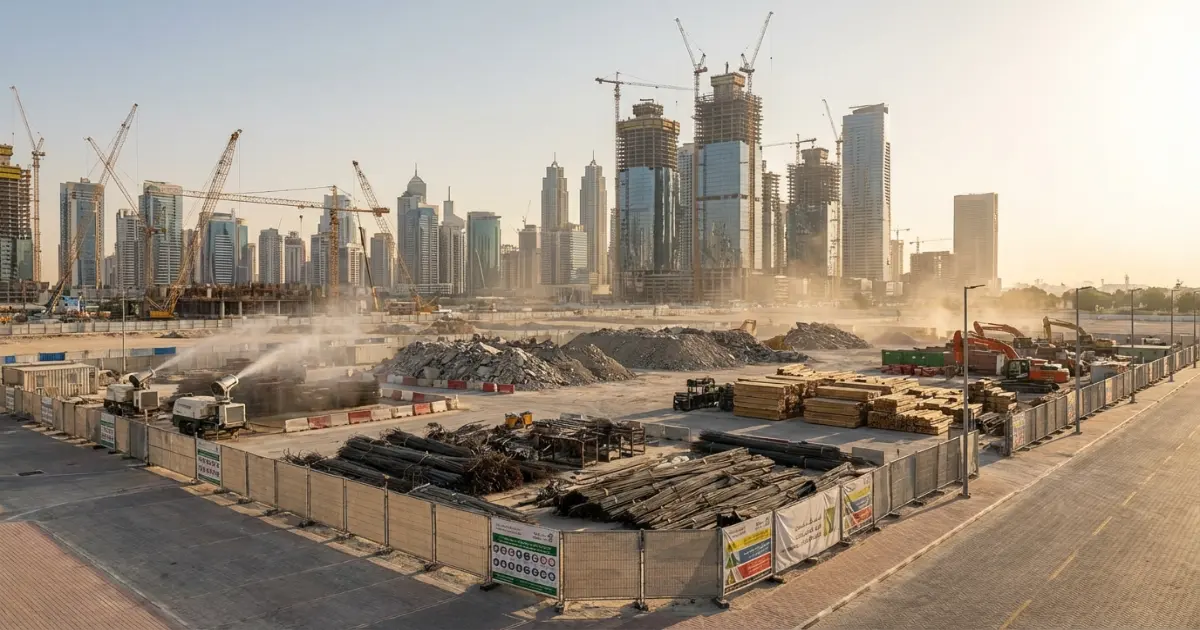
Dubai’s construction boom generates millions of tonnes of concrete waste annually — volume that circular economy strategies are now designed to recover and reuse.
What Is Recycled Concrete Aggregate — and What Can You Actually Do With It?
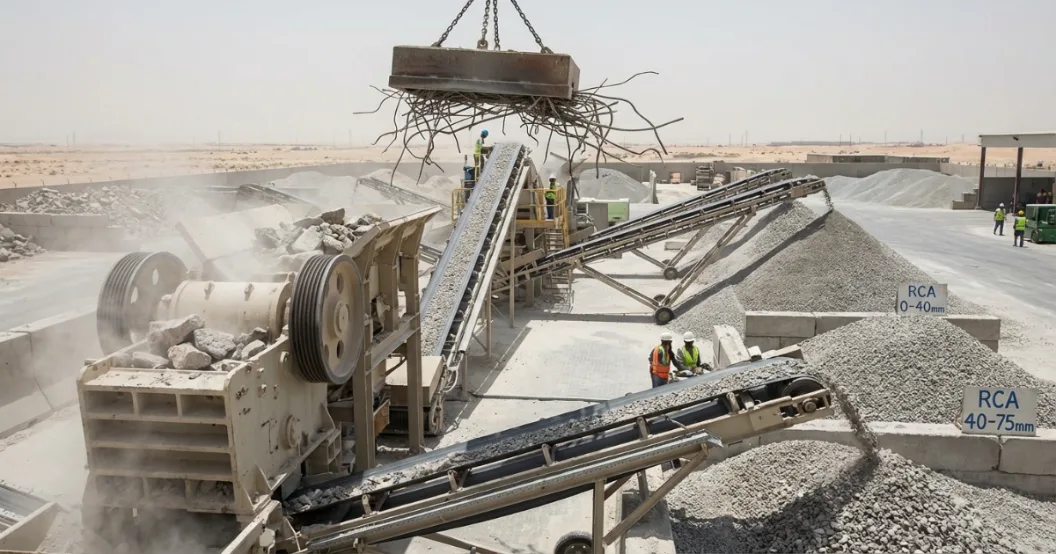
RCA is produced from controlled demolition followed by on-site segregation, mechanical crushing, screening, contaminant removal, and laboratory testing. The output is graded aggregate that can substitute for — or blend with — virgin material across a range of construction applications.
In the UAE context, approved uses include road base layers, sub-base foundations, backfilling, pavement works, and non-structural concrete applications. The question of structural use comes up constantly: the answer is nuanced. Pure RCA substitution in structural concrete is generally not approved under current UAE standards. Blended mixes — typically 20 to 40 percent RCA combined with virgin aggregate — are widely used and perform acceptably when tested to ASTM and relevant UAE municipal standards.
The technical caveats matter: recycled aggregate carries 10–20 percent potential strength variation depending on blend ratio, absorbs more water than virgin aggregate, and requires active contaminant control (gypsum, organics, metals from embedded fixtures are the usual offenders). None of these are insurmountable — they just require specification awareness before demolition begins, not after.
The Specification Gap That Costs Projects Points
The most preventable LEED and Pearl Rating failures happen because RCA percentage targets are never written into Bills of Quantities. When recycled aggregate isn’t specified at tender stage, contractors default to virgin material — and the diversion credit window closes before the project team notices. The fix is upstream: coordinate with your waste management partner before demolition begins, not during it.
How Recycled Concrete Earns LEED Credits in UAE Projects
LEED v4 and v4.1 — the versions most commonly used on UAE projects today — reward recycled concrete across the Materials and Resources (MR) category. Two credit areas are directly relevant.
Construction & Demolition Waste Management Credits
This is where concrete volume makes the biggest difference. Divert 50 percent of total construction and demolition waste from landfill and you earn one MR point. Hit 75 percent diversion and you earn two. Because concrete routinely represents the majority of C&D waste by weight, a solid recycled concrete strategy can shift project-wide diversion percentages dramatically — even if other waste streams are being handled less efficiently.
Sourcing of Raw Materials and Regional Material Credits
Recycled content in structural and non-structural materials contributes to threshold calculations under the Sourcing of Raw Materials credit. Locally processed RCA further reduces transportation-related embodied carbon, which feeds into the regional materials advantage under LEED’s framework. The more of your aggregate that is sourced and processed within the UAE, the stronger this credit becomes.
LEED reviewers do not award points based on what your waste contractor verbally confirmed. Every diversion claim requires Waste Transfer Notes with timestamps, weighbridge tickets, recycling facility approval documentation, and a structured diversion summary report. Projects that generate the waste but skip the paperwork — or use facilities that aren’t formally approved — lose credits they operationally earned. Don’t let documentation be your weakest link.
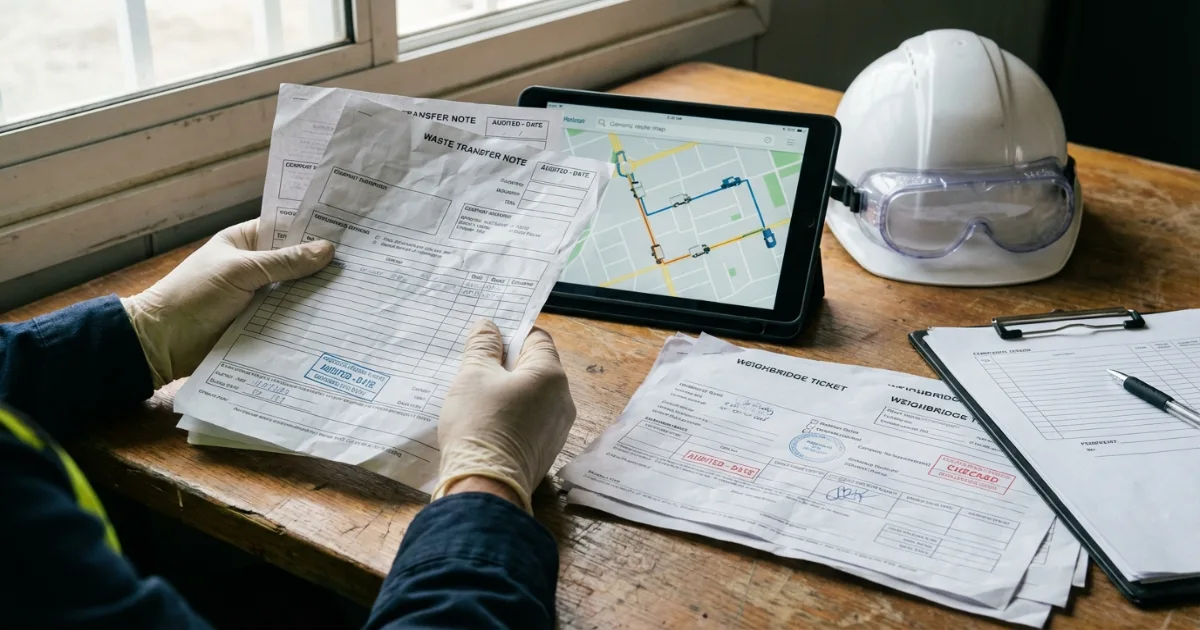
LEED Silver, Gold and Platinum certification in the UAE now depends heavily on documented waste diversion — recycled concrete aggregate is the fastest route to hitting 75% diversion thresholds.
Estidama Pearl Rating and the Concrete Diversion Mandate
Abu Dhabi’s Pearl Rating System operates under a different structure than LEED, but the logic for recycled concrete is similar — and in some ways more demanding. Pearl compliance evaluates construction waste management under both mandatory and optional credit categories, with a hard floor: a minimum 30 percent waste diversion under the Construction and Demolition Waste Management Plan (CDWMP) is required for project approval.
Pearl ratings are not optional for Abu Dhabi projects. Private developments require a minimum 1 Pearl rating. Government projects must hit 2 Pearls. Given that Pearl assessment directly influences occupancy permit issuance, a documentation failure isn’t just a certification problem — it can delay a project’s ability to hand over to occupants.
Projects targeting higher Pearl ratings (3, 4, or 5 Pearl) need to demonstrate diversion rates in the 50–70 percent range. On large demolition and new-build programs, getting from 30 percent to 70 percent diversion almost always runs through one material: concrete. The Pearl compliance pathway isn’t complex, but it is process-driven: on-site segregation with color-coded waste bins, weekly tracking updates, Pearl Quality Plan (PQP) oversight, and a structured final diversion report submitted before occupancy application.
The Pearl-Compliant Concrete Waste Process — Step by Step
- Pre-Demolition Planning
Establish diversion targets, identify an approved recycling facility, and write RCA specifications into the BOQ and waste management plan before any breaking ground.
- On-Site Segregation
Set up color-coded bins with clear labeling. Concrete waste must be separated from general C&D waste, gypsum, metals, and organics to avoid contamination that degrades RCA quality and complicates facility processing.
- Licensed Hauler Transport
Move concrete using licensed haulers whose vehicles carry GPS tracking logs. These logs form part of the audit trail and are checked during Pearl assessments and municipal inspections.
- Approved Facility Processing
Concrete arrives at an approved crushing and screening facility. Facility approval documentation must be kept on record — using a non-approved site is one of the most common compliance failures and can invalidate all diversion claims from that material stream.
- Diversion Reporting & Documentation
Generate monthly diversion summaries with WTNs, weighbridge tickets, and lab test reports. Compile into the final CDWMP diversion report for Pearl or LEED submission.
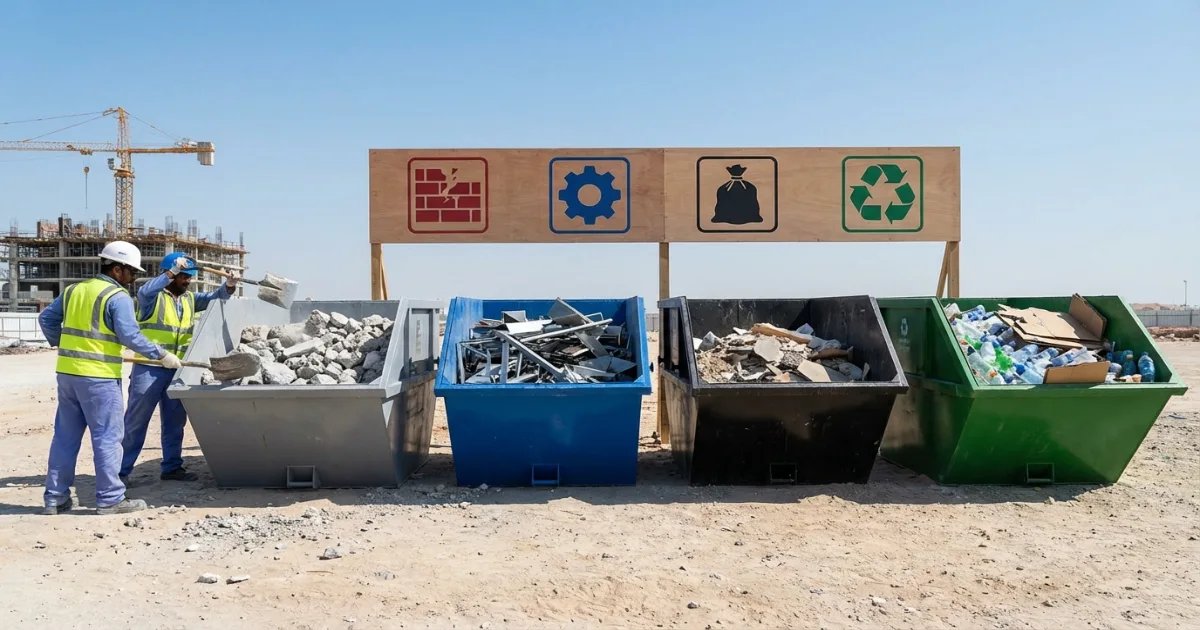
Effective on-site segregation is the foundation of Estidama Pearl compliance — without it, concrete gets contaminated, diversion rates drop, and documentation becomes impossible to reconstruct.
The Financial Case: Where Sustainability Strategy Protects Margin
The sustainability framing matters for certification. But for project directors managing construction budgets in a market where material costs and regulatory penalties are both moving upward, the financial argument for RCA is arguably more compelling than the certification one.
Start with the disposal side. At AED 100 per tonne for mixed waste at Dubai landfills, a 5,000-tonne demolition phase generates a potential AED 500,000 disposal cost. Divert 70 percent of that concrete — 3,500 tonnes — through an approved recycling facility, and the landfill exposure drops by AED 350,000. That’s not a sustainability initiative. That’s a budget line.
On the procurement side, recycled aggregate is typically 20–30 percent cheaper than virgin material. On a project using significant volumes of sub-base and backfill material, this compounds meaningfully — an estimated AED 100,000 saved on a 5,000-tonne project scenario, before accounting for any diversion fee reductions.
| Cost / Benefit Area | Traditional Disposal | With RCA Strategy |
|---|---|---|
| Landfill disposal fees | AED 100/tonne (full volume) | 40–70% cost reduction |
| Virgin aggregate cost | 100% purchase required | 20–30% savings on aggregate |
| LEED MR credits | Missed or partially secured | 2 credits at 75% diversion |
| Estidama diversion | Non-compliant (at risk) | Compliant + additional credits |
| ESG reporting data | Weak or absent | Quantifiable, audit-ready |
| Inspection risk | High (missing WTNs, unapproved sites) | Low (full documentation trail) |
There is also the certification premium itself. LEED Gold and Platinum buildings in the UAE command measurable advantages in bank lending rates, asset valuation, and institutional tenant attraction. Pearl-rated buildings carry equivalent advantages in Abu Dhabi’s government procurement and leasing markets. The return on a properly documented RCA strategy is not speculative — it is layered across multiple financial line items.
Recycled Concrete and the UAE’s Circular Economy Commitment
The UAE Circular Economy Policy (2021–2031) establishes concrete targets for diversion rates and localized material reuse across sectors. Construction — given its volume share of national GDP and waste generation — is one of the primary sectors where circular economy principles are expected to move from policy language into operational practice.
The linear model that has dominated UAE construction for decades — extract virgin aggregate, build, demolish, landfill — is being actively replaced. The circular alternative: design with reuse in mind, demolish with segregation protocols, recover and reprocess concrete into RCA, and reintroduce it as aggregate for the next project cycle. This closes a loop that currently produces significant embodied carbon through unnecessary cement production and virgin aggregate transportation.
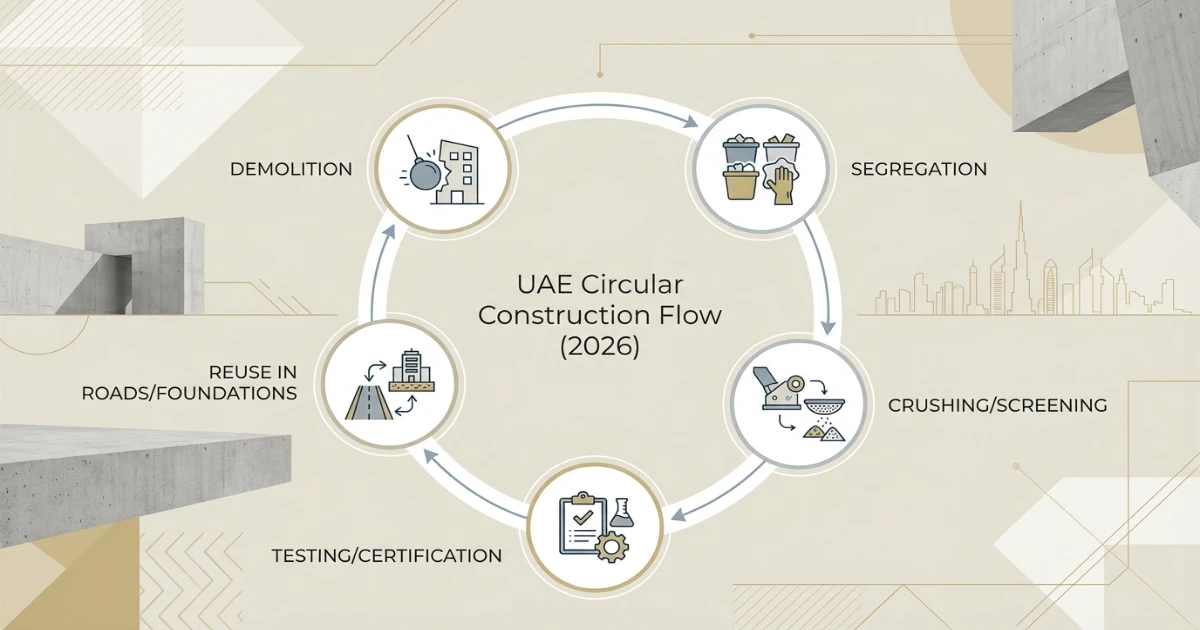
The UAE Circular Economy Policy (2021–2031) positions recycled concrete as the primary material recovery opportunity in construction — reducing virgin aggregate demand and cutting embodied carbon at scale.
Practically, this means BIM-integrated lifecycle impact modelling is becoming a best practice on projects targeting higher LEED or Pearl tiers. Architects and structural consultants who specify RCA percentage targets in early BOQs are increasingly the ones whose projects clear compliance thresholds without last-minute documentation scrambles.
Key Takeaways
- Concrete is 70–80% of UAE construction and demolition waste — making it the single biggest diversion opportunity available on any large project.
- LEED v4.1 awards up to 2 MR credits at 75% diversion; credits are documentation-dependent, not intent-dependent.
- Estidama mandates a minimum 30% diversion for Pearl Rating approval — failure delays occupancy permits.
- Landfill savings alone (AED 100/tonne avoided) can run to AED 350,000+ on a 5,000-tonne demolition phase at 70% diversion.
- The most common compliance failure: using non-approved recycling facilities or missing WTN timestamps — both invalidate otherwise compliant diversion claims.
- Specification-stage planning (RCA targets in BOQ, pre-demolition facility alignment) consistently outperforms reactive waste management.
Audit Readiness: What Inspectors and LEED Reviewers Are Actually Looking For
Unannounced municipal inspections in Dubai and Abu Dhabi are no longer a theoretical risk — they are routine on large construction and demolition sites. The documentation checklist that auditors work through has become relatively standardized, and the gaps are predictable.
Required documentation that must be on record: licensed hauler contracts, Waste Transfer Notes with complete timestamps, verified recycling facility approvals, laboratory test reports demonstrating aggregate quality and compliance with ASTM and UAE municipal standards, and monthly diversion calculation summaries. For LEED submissions, these need to be compiled into a formal diversion report with supporting calculations by material type and weight.
Inspection risk triggers — the things that cause inspectors to look harder — include: diversion rates below 30 percent (the Estidama floor), missing GPS tracking logs from haulers, waste manifests with inconsistencies between loaded weight and received weight, and any evidence that material was directed to non-verified recycling sites. Missing timestamps on WTNs is surprisingly common and is enough to invalidate an otherwise compliant manifest during audit.
Arrange compliant general waste collection alongside segregation →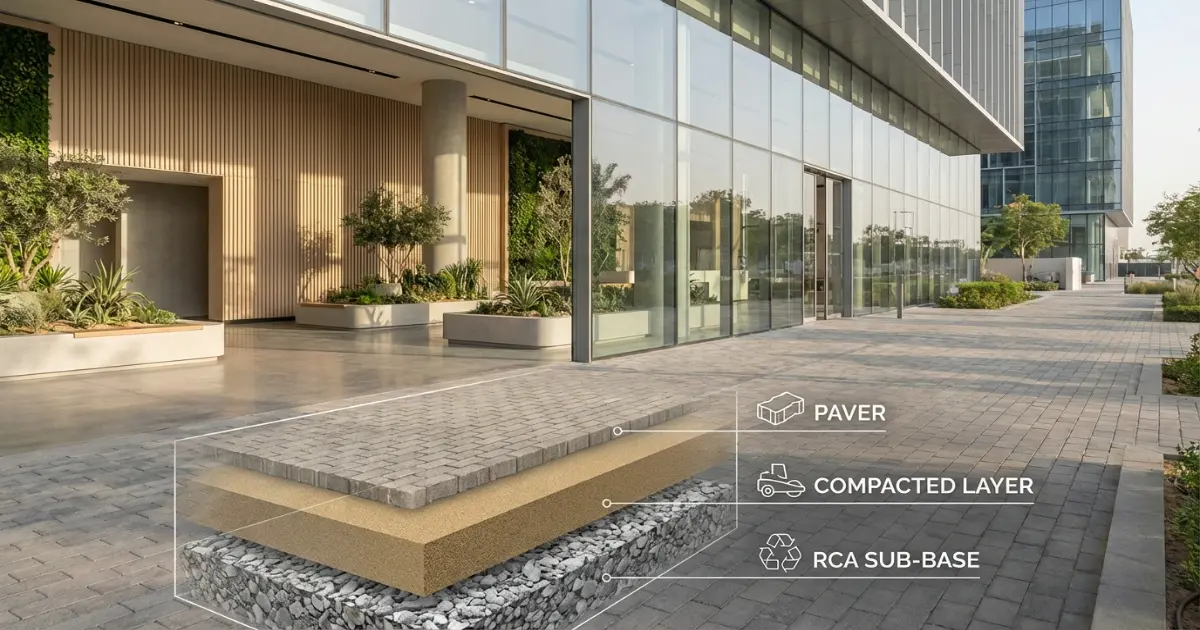
Documentation quality is the single biggest differentiator between projects that retain their LEED and Pearl credits through audit and those that don’t — WTNs, weighbridge tickets, and facility approvals must be complete and timestamped.
Frequently Asked Questions
Can recycled concrete be used structurally in UAE construction projects?
Generally, RCA in the UAE is limited to non-structural applications — road base layers, sub-base foundations, backfilling, and pavement works — unless blended and tested to approved ASTM and UAE municipal standards. Blended mixes of 20–40% RCA with virgin aggregate are common practice and perform well across most civil applications when properly tested and documented.
Does recycled concrete automatically earn LEED points in Dubai?
No. LEED Materials and Resources credits are awarded based on documented diversion percentages and verified recycled content — not on the fact that recycling occurred. You need Waste Transfer Notes, weighbridge tickets, approved facility documentation, and diversion summary calculations to qualify. Intent without paperwork earns nothing in a LEED review.
What waste diversion rate is required for Estidama Pearl Rating compliance?
A minimum 30% diversion is mandatory under the Construction and Demolition Waste Management Plan (CDWMP) for any Pearl Rating approval. Achieving 50–70% diversion unlocks additional sustainability credits. Private developments require 1 Pearl minimum; government projects require 2 Pearls minimum.
Is recycled aggregate actually cheaper than virgin aggregate in Dubai?
Typically yes — around 20–30% cheaper per tonne before landfill savings are factored in. On large projects, the combined effect of reduced virgin aggregate costs and avoided landfill fees (at AED 100/tonne for mixed waste) creates a significant cost advantage over conventional disposal approaches.
What documents prove recycled concrete compliance in a UAE audit?
The required documentation set includes: Waste Transfer Notes (WTNs) with complete timestamps, weighbridge tickets, recycling facility verification and approvals, lab test reports (ASTM and UAE municipal standards), monthly diversion summaries, and licensed hauler contracts. LEED submissions additionally require a structured diversion report with per-material calculations.
Ready to Build a Compliant RCA Strategy?
Whether you’re targeting LEED Silver, Gold or Platinum — or need to hit Estidama’s Pearl Rating thresholds — the planning starts before demolition. Our team specialises in certified waste diversion planning, audit-ready documentation, and construction waste compliance for UAE projects of all scales.
Talk to Our Construction Waste Team →