There’s a feeling most contractors in Dubai know too well — the one that hits your stomach like a brick.
It’s 10:40 a.m. Your team finally filled the skip, the driver is on the way, your project is tight on time, and then… you get that message:
“WTN Rejected. Correct and resubmit.”
You stare at the screen for a second, hoping it’s a mistake.
It’s not.
Your entire waste movement — frozen.
Your project — delayed.
Your skip — stuck.
And the landfill? Not accepting the load until you fix the problem.
I know this moment better than anyone.
Inside Navyom Waste Collection Services, I review more WTNs per day than most contractors see in a month. I’ve watched supervisors panic, project managers scramble, and even big-name contractors lose half a day’s work because of one incorrect Waste Transfer Note.
But here’s the truth nobody tells you:
WTN rejections are rarely random. They follow predictable patterns — and almost all are preventable.
In 2025, Dubai Municipality upgraded the entire WTN system with AI-powered validation, real-time landfill checks, and stricter classification rules. What used to slip through doesn’t slip anymore. Dubai’s waste system is now one of the most advanced (and unforgiving) in the world.
The good news?
If you understand why WTNs get rejected — the nine exact reasons — you can eliminate 99% of these delays forever.
This is the guide I wish every contractor had taped to their site office wall.
Table of Contents
Why WTN Rejections Are Exploding in 2025
If you worked in Dubai construction before 2024, you’ll remember a different world.
WTNs were simpler. More flexible. Less monitored.
Then Dubai Municipality tightened enforcement. Hard.
Now:
- Every WTN is digital
- Every load is photo-verified
- Every category is auto-checked for mismatches
- Every truck and driver is tracked
- Every gram of waste is scanned at the landfill

AI doesn’t blink. It doesn’t make exceptions.
If something doesn’t match, it’s rejected instantly.
From my vantage point inside Navyom Waste, I’ve watched rejection rates spike because contractors simply didn’t know the rules had changed — or how strict they’ve become.
So let’s break down the nine reasons WTNs get rejected… and how to fix them instantly.
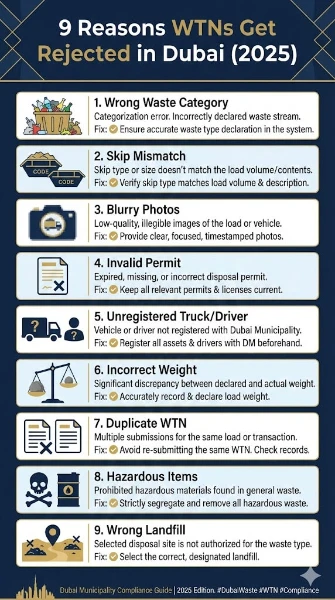
1. Wrong Waste Category Selected
This is the #1 cause of WTN rejection.
The most common mistakes?
- Marking mixed C&D waste as “general waste”
- Marking concrete as “inert waste” even when it contains tile or wood
- Marking gypsum as “recyclable”
- Marking excavation sand as “construction debris”
Dubai Municipality’s system now automatically checks the waste category against:
- Photo
- Weight
- Past records
- Expected density
If anything doesn’t line up?
Instant rejection.
✔ How to fix it
- Use the official 2025 DM waste classification before submitting
- Ask your hauler to confirm category (we do this for every WTN at Navyom)
- Avoid “guessing” categories — this creates 60% of rejections
Learn more: Construction Waste Disposal Dubai
2. Skip Contents Don’t Match the WTN
This one hurts because it’s usually avoidable.
Example I see every week:
A contractor orders a concrete-only skip.
The skip arrives.
Workers toss in:
- Cardboard
- Paint buckets
- Plastic
- Tiles
- A broken ladder
Suddenly the “concrete-only” skip is now mixed waste — but the WTN still says “concrete.”
Rejected.
Why it happens
Workers aren’t always trained.
Worksites get rushed.
Different subcontractors load different items.
One contaminated load = rejected WTN.
✔ How to fix
Before dispatch, have your supervisor take a quick top-angle photo and confirm:
- Waste type = WTN category
- No contamination
- No hazardous items
This one habit stops 80% of mismatch rejections.
3. Blurry, Dark, or Missing Photos
Dubai Municipality uses image recognition to validate waste types.
Night photos? Rejected.
Blurry photos? Rejected.
Shadow-heavy? Rejected.
Only one angle? Rejected.
✔ Required 4-photo rule
- Top view
- Left side
- Right side
- Front view
Preferably in daylight.
If the system can’t identify the waste clearly, it rejects automatically.
4. Permit or Project Number Not Validated
This is one of the “silent killers” of WTNs.
When your project permit is:
- Expired
- Mistyped
- Not linked in DM system
- Assigned to a different contractor
- Recently updated but not synced
Your WTN gets rejected even if everything else is perfect.
✔ How to fix
- Confirm permit validity before first skip
- Sync contractor & project IDs 24 hours before first load
- Have your hauler (Navyom) validate permit status before dispatch
We once had a contractor delayed 6 hours because one digit in the project code was wrong. That’s how sensitive the system is now.
5. Unregistered Truck or Driver
Dubai Municipality tracks every driver and every vehicle moving waste.
If your hauler isn’t registered, the system rejects instantly.
Common triggers:
- Plate number not found
- Driver ID unapproved
- Expired registration
- Truck belongs to an unlicensed hauler
At Navyom Waste, we do daily registration checks because DM audits are extremely strict now.
✔ How to fix
- Use only DM-approved haulers
- Confirm driver + plate before raising WTN
- Avoid last-minute driver swaps (big rejection source)
6. Weight Mismatch at the Weighbridge
Dubai landfills compare:
- Declared weight
- Expected density
- Load photos
- Past patterns
If something looks off?
Flagged → Rejected.
Examples
- Declared “3 tons” but weight = 6 tons
- Declared concrete but looks like mixed waste
- Declared sand but weight too heavy
✔ Fix
- Let your hauler estimate (don’t guess)
- Avoid overloading skips
- Know average waste densities
When we estimate weight at Navyom, WTN rejections for weight mismatch drop to nearly 0%.
7. Duplicate or Unclosed WTNs
This one frustrates contractors the most because it feels “bureaucratic.”
It happens when:
- You create a WTN
- Driver leaves
- Someone accidentally creates another one
- Or the previous WTN wasn’t closed
System thinks:
“Possible duplicate transport / data conflict.”
Rejected.
✔ Fix
- Close every WTN immediately after disposal
- Don’t reuse skip numbers
- Let your hauler confirm WTN status before generating a new one
8. Restricted or Hazardous Items in the Load
Dubai Municipality has a zero tolerance policy for hazardous waste being mixed with C&D waste.
Items that trigger instant rejection:
- Paint buckets (even empty)
- Fiberglass
- Batteries
- Aerosols
- Chemicals
- Gas cylinders
- Tyres
- Electronics
- Medical waste
Even a single hazardous item can cause rejection.
✔ Fix
- Keep a separate box for hazardous waste
- Add hazardous waste removal to your service
- Train workers on what cannot enter a C&D skip
- Keep MSDS sheets when disposing chemicals
Related: Hazardous Waste Removal Dubai
9. Wrong Disposal Facility Selected
Every waste type has a designated disposal or recycling location.
Pick the wrong one?
Rejected.
Examples:
- Concrete sent to mixed-waste facility
- Gypsum sent to construction debris landfill
- Metal directed to landfill (not allowed)
- Excavation sand sent to wrong pit
✔ Fix
- Use the 2025 landfill routing guide
- Allow your hauler to choose facility (recommended)
- Match waste type → approved facility
Zero-Rejection System Checklist for Contractors
This is the exact checklist we use inside Navyom to keep top contractors rejection-free.
Daily Checklist
- Label skips by waste type
- Verify contents before loading
- Take 4 photos in daylight
- Confirm driver & plate
- Remove hazardous items
- Double-check project permit
Weekly Checklist
- Train workers
- Audit 2–3 WTNs
- Validate skip segregation practices
Monthly Checklist
- Update teams on DM rule changes
- Sync project IDs
- Review landfill weight patterns
When contractors follow this system, their rejection rate goes below 1%.
What Navyom Waste Does Differently to Guarantee Approval
Most haulers do “transport and dump.”
We don’t.
We built what we call the Zero-Rejection Protocol — a compliance-first approach designed specifically to eliminate WTN rejection for contractors.
Our internal process:
1. Pre-dispatch verification
We inspect load photos before the truck leaves.
2. Driver & vehicle compliance check
We do daily DM registration checks.
3. Category verification
We match waste type → classification → landfill.
4. Automated mismatch alerts
If the load doesn’t match the category, we flag it immediately.
5. Real-time WTN submission
We handle the digital paperwork.
6. On-site support for complex waste
Hazardous, gypsum, concrete, mixed loads — we guide everything.
7. Instant correction
If something’s wrong, we fix it before the landfill sees it.
This is why our rejection rate is near zero.

🚨 WTN rejected again? Don’t lose another hour.
Navyom Waste Collection Services guarantees 100% DM-compliant WTN approvals and zero delays.
Frequently Asked Questions
1. Why was my WTN rejected in Dubai?
Most WTNs are rejected due to incorrect waste categories, contaminated loads, blurry photos, unregistered trucks, or invalid permits. Dubai’s 2025 system auto-detects mismatches and rejects instantly.
2. How do I fix a WTN rejection quickly?
Correct the waste category, re-upload clear photos, confirm permit validity, and ensure your truck/driver are DM-approved. A licensed hauler like Navyom can fix this in minutes.
3. How long does it take to resolve a rejected WTN?
Anywhere from 5 minutes to several hours depending on the issue. Incorrect photos → fast fix. Unregistered driver → long delay.
4. Will the landfill turn away my truck for a rejected WTN?
Yes. The landfill cannot accept any load without a validated WTN in 2025.
5. Does mixed waste cause WTN rejection?
Only when it’s incorrectly labeled. Mixed waste is acceptable — misclassified mixed waste is not.
6. Is Dubai Municipality stricter in 2025?
Extremely. AI verification, weight-density checks, and instant rejection filters make the system more accurate and less forgiving.
7. Do WTNs expire?
Yes — WTNs must be closed promptly. Unclosed or duplicate WTNs trigger auto-rejection.
8. Can I reuse a WTN?
No. Every load requires a new WTN. Reusing = immediate rejection.
Conclusion
WTN rejection in Dubai isn’t mysterious — it’s mathematical.
If the waste type doesn’t match the category, the photos aren’t clear, the truck isn’t registered, or the project permit doesn’t align, the system rejects instantly.
But once you understand these nine triggers, you can build a system that eliminates WTN rejection completely.
If you want a waste partner who handles all compliance, all permits, all WTN submissions, and ensures zero rejections:
📞 Call Navyom Waste Collection Service Today: 058 521 1155
🌐 Visit: www.dubaiwaste.com
Your projects deserve smooth approvals — every single time.