JAFZA Waste Management: Disposal Services, Compliance & Recycling in Dubai’s Largest Free Zone
JAFZA (Jebel Ali Free Zone Authority) operates within Dubai Municipality’s broader waste management framework but enforces its own zone-specific rules for waste collection, disposal, and hazardous material handling. Businesses in JAFZA must use licensed waste contractors, maintain mandatory segregation, and comply with both DM regulations and JAFZA Authority directives — failure to do so risks fines, licence complications, and rejected loads at designated facilities.
Jebel Ali Free Zone — home to over 9,600 companies from 100+ countries — is one of the busiest industrial and logistics hubs in the world. Every day, warehouses receive shipments, factories run production lines, packaging operations generate mountains of cardboard and plastic, and construction crews work on tenant fit-outs. All of that activity produces waste. A lot of it.
The challenge isn’t just volume — it’s complexity. JAFZA tenants operate across an enormous range of industries: food and beverage, pharmaceuticals, chemicals, electronics, automotive, textiles, and logistics. Each generates different waste streams. Each comes with different compliance requirements. And within the free zone, the rules aren’t always what businesses assume they are.
This guide breaks down how JAFZA waste management actually works — who controls collection, what the obligations are, which mistakes cost companies the most, and how to build a waste disposal system that passes inspection without creating operational headaches.
On This Page
How JAFZA Waste Management Is Actually Governed
Here’s where most businesses — particularly those new to the free zone — get confused. JAFZA is a semi-autonomous authority, but it does not operate outside Dubai’s environmental and waste management laws. Dubai Municipality sets the overarching regulatory framework for waste handling, classification, and disposal. JAFZA enforces this within its own boundaries while adding zone-specific operational requirements.
In practice, this means two layers of compliance:
- Dubai Municipality regulations — govern which waste types require licensed treatment, how hazardous materials must be classified and transferred, and which facilities can legally accept different waste streams.
- JAFZA Authority directives — cover on-site storage requirements, contractor approval status within the zone, collection scheduling, and how companies must maintain compliance records during licence renewal or DM inspections.
If your waste contractor is licensed by DM but hasn’t been approved to operate within JAFZA, you’re in a compliance gap that neither party will necessarily flag proactively — until there’s an inspection. Verify contractor status at both levels before signing any collection agreement.
JAFZA conducts periodic waste compliance checks as part of licence renewal and HSE inspections. Non-compliance findings — including improper segregation, unlicensed contractor use, or inadequate hazardous waste documentation — can affect licence renewal timelines and attract municipal penalties. Companies with multiple waste streams should maintain a waste management log as standard operational practice, not just for inspection readiness.
Operating in JAFZA? Navyom can help map your waste streams, collection frequency and documentation requirements before you request service.
Discuss Your JAFZA Site →Waste Streams in JAFZA: What You’re Actually Dealing With
Waste in JAFZA isn’t a single category. A pharmaceutical company in the zone generates entirely different waste compared to a textile logistics firm two blocks away. Getting this wrong at the classification stage creates downstream problems — rejected loads, compliance failures, and unnecessary cost.
The primary waste streams in JAFZA and their compliance implications:
1. General / Municipal Solid Waste (MSW)
Office paper, food waste from staff canteens, packaging that doesn’t qualify as recyclable in its current state, hygiene waste, and mixed light industrial debris. This is the simplest stream but often the most mismanaged — because companies throw regulated waste into general bins without realising it.
2. Recyclable Waste
Cardboard, clean plastic, metals, glass, aluminium, and paper. JAFZA’s industrial environment generates significant volumes of these materials — especially from packaging-heavy logistics and distribution operations. Segregated recyclables collected by an approved recycler not only divert waste from landfill but often reduce overall collection costs compared to mixed waste disposal. Check out the recycling savings calculator to quantify your potential savings before choosing a collection plan.
3. Hazardous Waste
Chemicals, solvents, oils, batteries, pharmaceuticals past their shelf life, aerosols, and contaminated materials. This is where JAFZA compliance becomes most demanding. Hazardous waste must be classified correctly — using the correct UN/DM codes — handled by a licensed hazardous waste contractor, transferred with proper documentation, and treated or disposed of at an approved facility. There is no shortcut here. Misclassification of hazardous waste as general waste is one of the most common and costly compliance failures in industrial zones across Dubai.
4. Industrial and Process Waste
Production-line debris, manufacturing scrap, contaminated packaging from industrial processes, and regulated by-products. The exact classification depends on the material and process — operators should confirm classification with their licensed contractor and, where necessary, with Dubai Municipality’s Environment Department before disposal.
5. Construction and Demolition (C&D) Waste
Any fit-out, renovation, or expansion project in JAFZA will generate C&D waste. This requires a separate collection arrangement from general waste, typically using dedicated skips, and must be directed to an approved C&D waste processing facility. The construction waste guide on DubaiWaste.com covers documentation requirements and common compliance gaps in detail.
6. E-Waste (Electrical and Electronic Equipment)
Electronics, batteries, computing equipment, and accessories. JAFZA has several electronics and technology firms generating significant e-waste. Standard disposal channels don’t apply — e-waste must go through an approved e-waste recycler registered with Dubai Municipality.
Segregation at Source: The Non-Negotiable Foundation
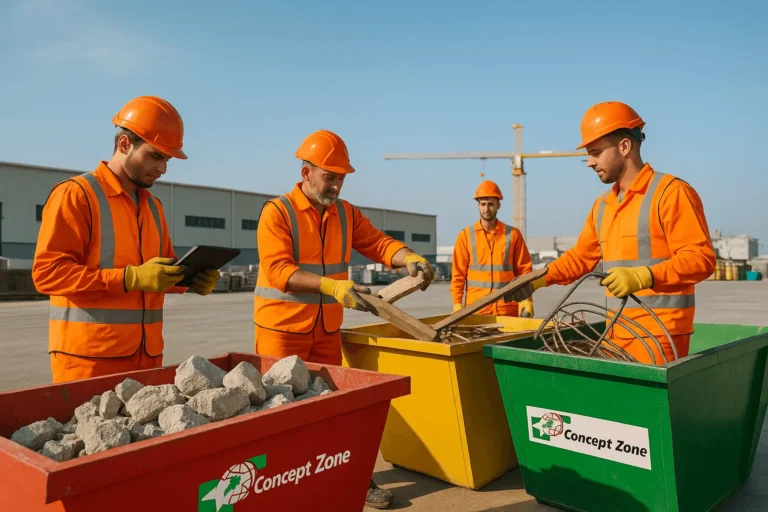
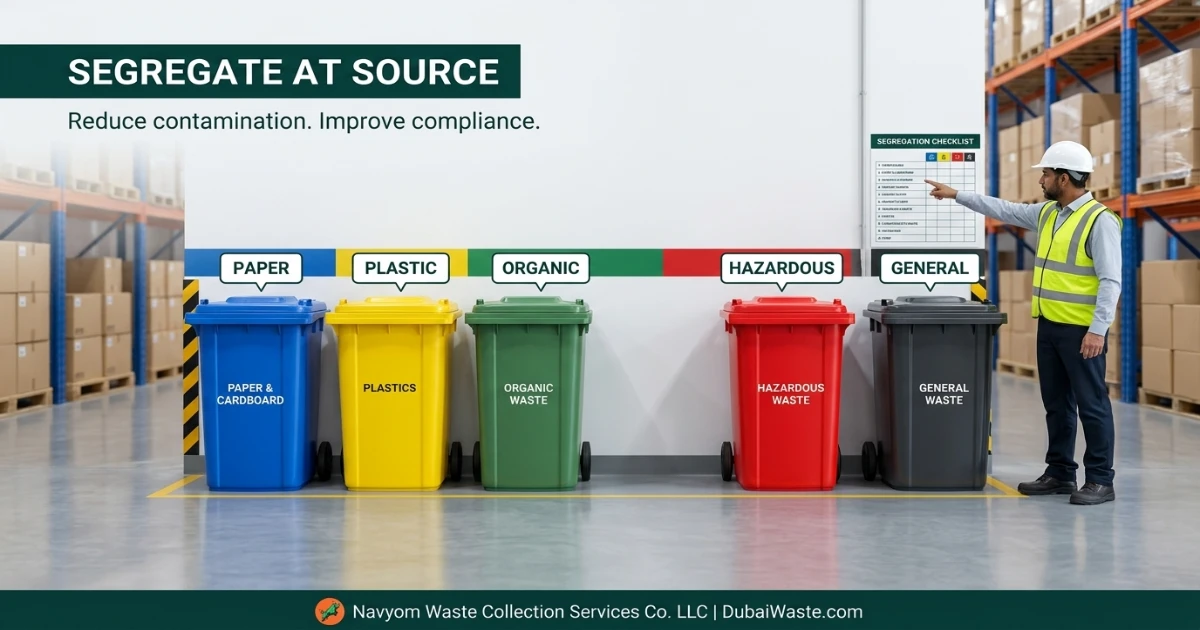
Every waste management process in JAFZA starts and ends with segregation. This isn’t an operational preference — it’s a compliance requirement. Mixing hazardous waste with general waste doesn’t just create a logistics problem; it makes the entire load hazardous by association, driving up disposal costs and creating documentation issues that follow you through the compliance chain.
The Dubai Municipality colour-coding system for waste bins applies within JAFZA:
| Bin Colour | Waste Type | JAFZA Relevance |
|---|---|---|
| Green | Organic / food waste | Staff canteens, food-handling operations |
| Blue | Paper and cardboard | High-volume in logistics / distribution |
| Yellow | Plastics | Packaging-intensive manufacturers and importers |
| Red | Hazardous waste | Chemicals, solvents, contaminated materials |
| Black / Grey | General mixed waste | Non-recyclable, non-hazardous MSW |
| White / Silver | Clinical / medical waste | Occupational health clinics on-site |
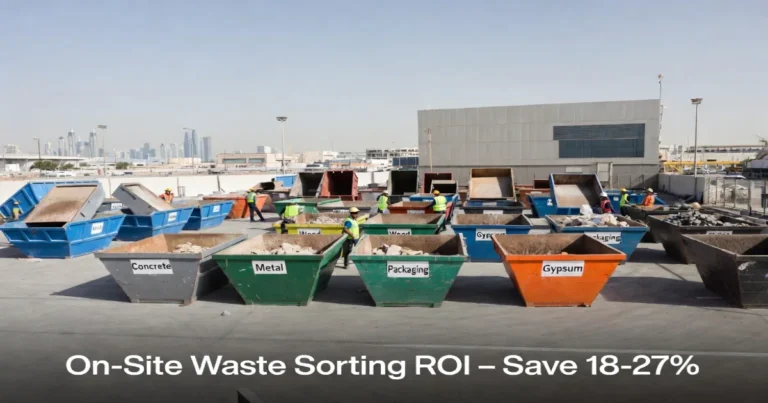
The most important thing to understand about segregation in JAFZA: the zone’s mix of industrial tenants means a single facility can legitimately need four or five separate bin streams running simultaneously. This is normal — and setting it up correctly from the start is far cheaper than the cost of a rejected load or a compliance fine.
Choosing a Licensed Waste Contractor for JAFZA
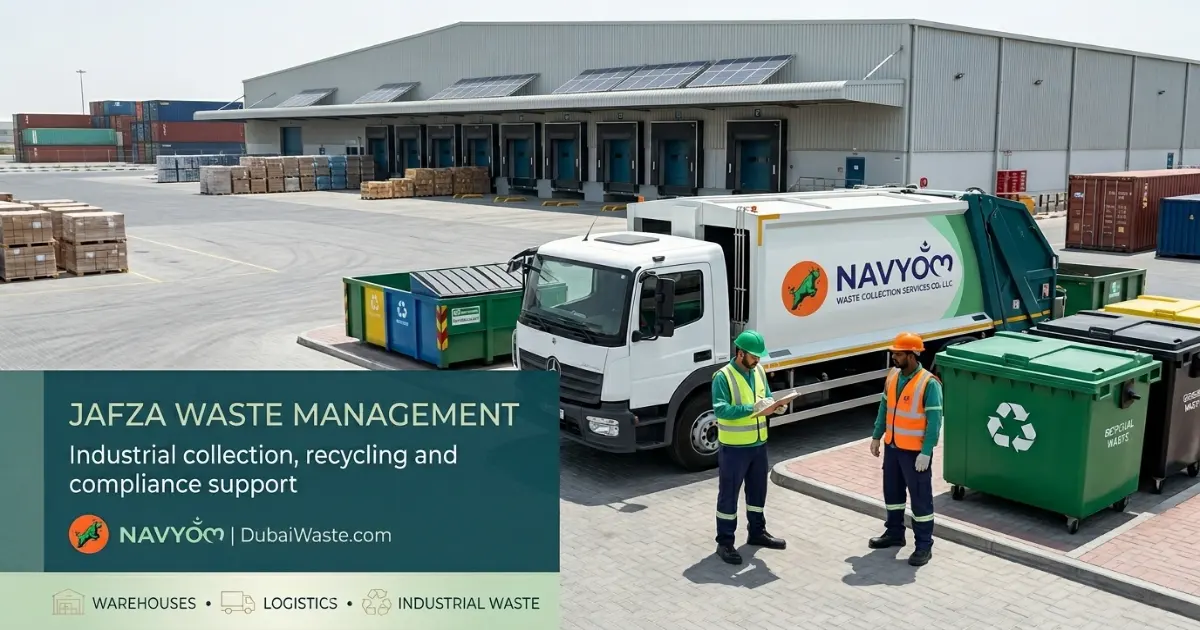
This is where many businesses make their first significant mistake. Not all waste contractors licensed by Dubai Municipality are approved to operate within JAFZA specifically. The free zone authority maintains its own list of approved service providers, and using a contractor who isn’t on that list — even if they’re fully DM-licensed — puts your compliance status at risk.
The right evaluation checklist when selecting a waste management partner for your JAFZA operation:
- ✅ Licensed by Dubai Municipality’s Waste Management Department
- ✅ Approved vendor or registered contractor within JAFZA
- ✅ Covers your specific waste streams (hazardous, medical, C&D, e-waste — as applicable)
- ✅ Can provide waste transfer documentation / manifests per collection
- ✅ Has confirmed disposal route to an approved DM facility for your waste type
- ✅ Offers collection frequency aligned to your operational volume (not just what’s cheapest)
- ✅ Has a clear process for emergency or overage collections
For multi-stream operations, many JAFZA tenants work with two or three contractors: one for general and recyclable waste, a specialist for hazardous streams, and a dedicated partner for C&D during fit-out or expansion phases. Managing multiple contractor relationships requires more coordination, but it generally produces better compliance outcomes and lower overall cost than forcing one contractor to cover streams they’re not specialists in.
One of the highest-ROI moves for any JAFZA tenant with significant cardboard and plastic packaging output: negotiate a separate recyclables collection contract at zero cost or revenue-share. Several licensed recyclers in Dubai will collect clean cardboard, plastic film, and aluminium at no charge — or even pay per tonne — because the material has resale value. This immediately reduces your general waste volume, lowering your overall disposal cost while improving your sustainability credentials for ESG reporting. Use the landfill savings calculator to quantify exactly how much you’re currently sending to landfill unnecessarily.
Hazardous Waste in JAFZA: Where Compliance Gets Serious
Jebel Ali is home to a significant cluster of chemical, pharmaceutical, petroleum, and specialty materials businesses. Hazardous waste management in this environment isn’t peripheral — it’s central to how these operations function. And it’s the area where the consequences of getting things wrong are most severe.
Key requirements for hazardous waste handling in JAFZA:
Classification and Labelling
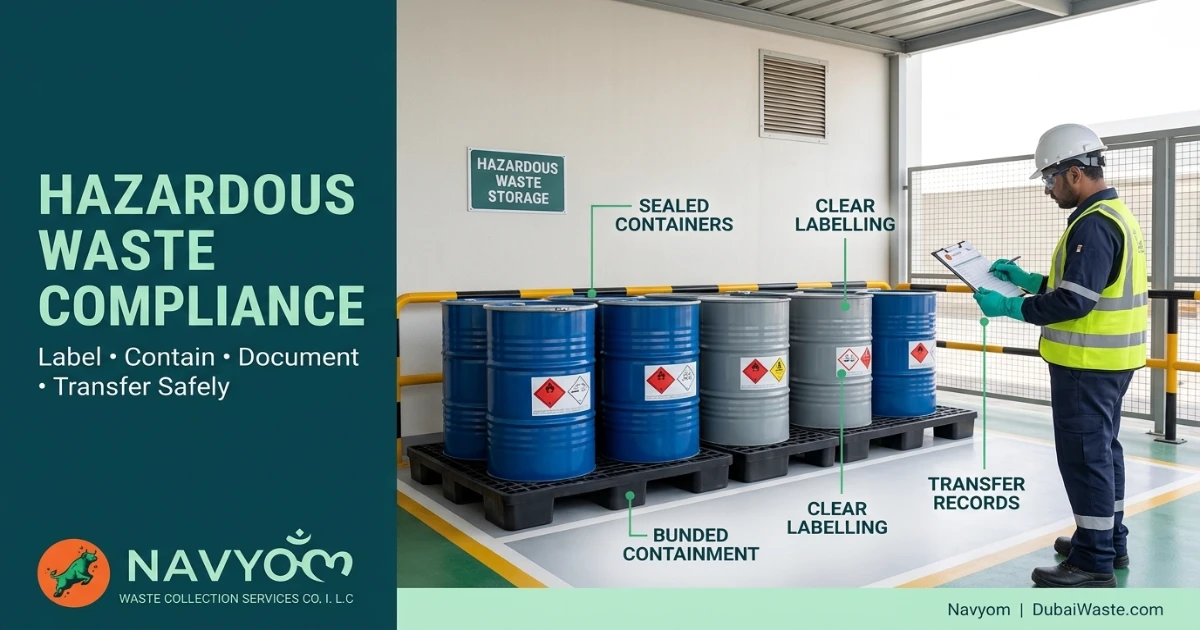
Every hazardous waste stream must be classified according to Dubai Municipality’s waste classification guidelines, which align with GHS (Globally Harmonized System) and UN hazardous materials codes. Drums, containers, and storage areas must be correctly labelled with hazard symbols, material content, and date of generation. Unlabelled hazardous waste containers are an immediate compliance finding.
Storage Standards
Hazardous waste cannot be stored indefinitely. Storage areas must meet specific standards for containment (bunded areas to catch spills), ventilation, temperature, incompatibility segregation (keeping oxidisers away from flammables, for example), and access control. JAFZA HSE inspections include physical checks of hazardous waste storage areas.
Transfer Documentation
Every movement of hazardous waste off-site requires a completed waste transfer manifest. This document identifies the generator (your company), the type and quantity of waste, the transporter, and the receiving facility. Keep copies of all manifests — they form the audit trail that demonstrates compliant disposal if your operation is ever scrutinised.
Approved Disposal Routes
Hazardous waste in Dubai must go to a DM-approved treatment, storage, or disposal facility. The specific facility depends on the waste type — not all facilities accept all hazardous streams. Confirm the disposal route with your contractor before the first collection, not after.
JAFZA Waste Management vs Other Dubai Industrial Zones: Key Differences
| Factor | JAFZA | DIP (Dubai Industrial Park) | Al Quoz Industrial |
|---|---|---|---|
| Governing Body | JAFZA Authority + DM | Dubai Industrial City + DM | Dubai Municipality (direct) |
| Contractor Approval | Zone-specific approval required | DM-licensed typically sufficient | DM-licensed sufficient |
| Hazardous Waste Complexity | Very High (port adjacency, chemicals) | High (manufacturing zone) | Moderate to High |
| Port / Export Waste | Yes — maritime waste rules apply | No | No |
| Customs-Regulated Waste | Yes — bonded zone rules apply | No | No |
| C&D Waste During Fit-Out | JAFZA approval + DM licensed skip | DM licensed skip | DM licensed skip |
| HSE Inspection Frequency | High — part of licence process | Moderate | Moderate |
One important JAFZA-specific dimension that doesn’t apply elsewhere in Dubai’s industrial landscape: the zone’s proximity to Jebel Ali Port introduces maritime waste handling considerations for any business that receives or dispatches cargo directly from the port. Ship-generated waste has its own classification and handling requirements under international maritime regulations, which intersect with JAFZA’s on-shore waste management framework.
Situation-Based Guidance: Advice That Changes by Operation Type
There’s no universal JAFZA waste management playbook — the right approach depends heavily on what your operation actually does.
Logistics and Distribution Warehouses
High-volume packaging waste (cardboard, plastic wrap, wooden pallets) dominates. Priority: get a dedicated recyclables collection agreement in place. Mixed-waste disposal costs per tonne are significantly higher than recycling rates for clean separated materials. Focus on staff training at dock and unpacking stations — that’s where contamination enters the recyclable stream.
Manufacturing and Assembly Operations
Multiple waste streams running simultaneously. Need a waste audit before setting up collection — process waste classification often requires specialist input. Prioritise documenting your waste classification rationale so that if DM or JAFZA inspects, you can demonstrate the basis for your segregation decisions.
Chemical and Pharmaceutical Companies
Hazardous waste management must be the centrepiece of your entire waste system. Invest in proper containment, staff training, and a licensed hazardous contractor with a strong track record in the pharmaceutical or chemical sector specifically. Generalist collectors with hazardous licences aren’t always equipped to handle regulated pharmaceutical waste correctly.
Retail and Food Businesses in JAFZA
Organic waste is the primary concern — food waste volumes can be high, and the UAE has specific targets around food waste reduction. Consider food waste segregation for composting or biogas routes if your volume warrants it. Grease trap waste from commercial kitchens also requires a specialist collection contractor — it cannot go into standard general waste.
Technology and Electronics Firms
E-waste accumulates fast — outdated equipment, failed components, batteries, screens. Most tech firms underestimate their e-waste volume until it’s audited. Set up a quarterly e-waste collection schedule through an approved recycler. Check DM’s e-waste drop-off points as a complement to scheduled pickups for smaller volumes.
Not sure how much your current waste setup is actually costing? Estimate your disposal, recycling, and landfill costs before choosing a collection plan.
Try the Waste Management Cost Estimator Check Your Fine Risk Level →Common Pitfalls — and When to Ignore Generic Advice
Most waste management guidance written for Dubai businesses is too generic to be useful in a free zone context. Here’s what companies in JAFZA routinely get wrong:
Pitfall 1: Assuming DM Licensing Equals JAFZA Approval
A contractor can be fully DM-licensed and still not be approved to operate within JAFZA. This is a zone-specific gate that DM licensing doesn’t automatically clear. Always verify directly with JAFZA Authority that your chosen contractor is an approved vendor within the zone.
Pitfall 2: Treating Hazardous Waste as a One-Off Problem
Companies that generate hazardous waste consistently — even in small volumes — need a scheduled collection arrangement, not an ad hoc call when storage gets full. Storing hazardous waste beyond recommended periods or capacity limits is a compliance violation in itself.
Pitfall 3: Underestimating C&D Waste Volume During Fit-Out
JAFZA fit-out projects routinely generate far more construction and demolition waste than initial estimates suggest. Budget for additional skip hires and don’t assume the volumes your contractor quoted pre-project will hold through completion.
Pitfall 4: Relying on Contractor Verbal Assurances
If your contractor tells you “we’ll handle the documentation,” make sure you receive copies of every transfer manifest. The documentation is your compliance evidence — not the contractor’s assurance that they filed it correctly.
Pitfall 5: Not Updating Waste Arrangements After Operational Changes
Companies that expand their product range, add a new production line, or change their import/export volumes often forget to revisit their waste classification and collection contracts. A new product category can introduce an entirely new hazardous waste stream that your existing contractor isn’t licensed to handle.
When to deviate from standard advice: If you operate a bonded warehouse receiving goods directly from the port, your waste situation may involve customs-controlled materials — consult JAFZA Authority before disposing of any goods-related waste. Similarly, if you’re handling goods under a specific regulatory framework (pharmaceuticals, controlled substances, dual-use items), standard waste guidance doesn’t fully apply — seek specialist advice for those specific streams.
How to Set Up Your JAFZA Waste Management System: Step by Step
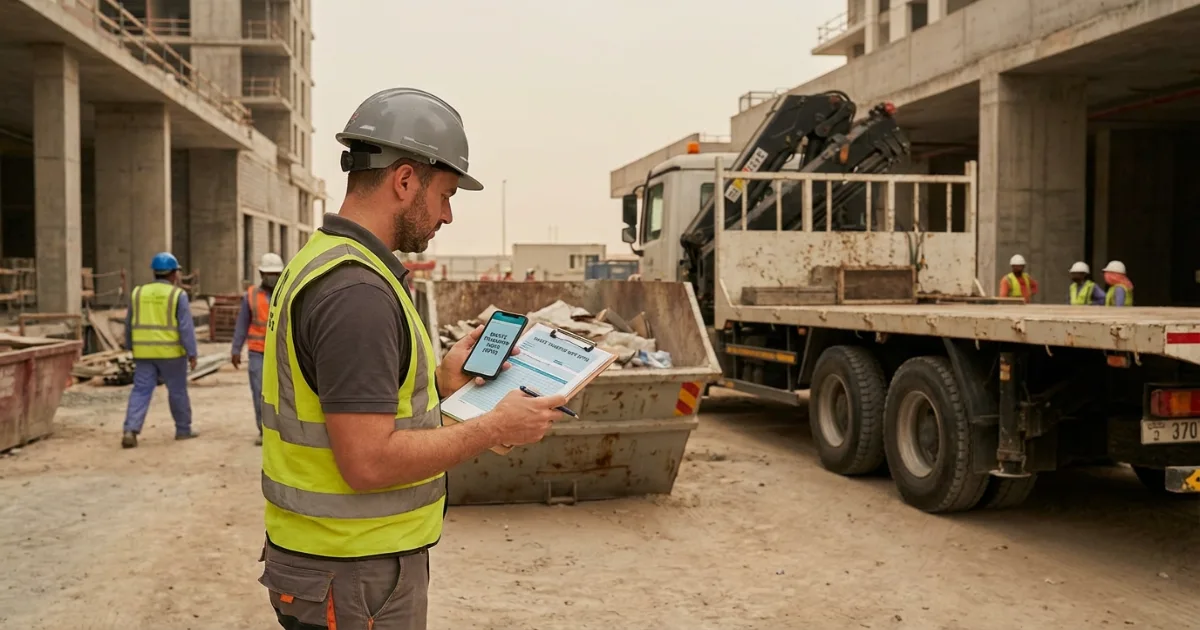
- Conduct a waste stream audit — Identify every waste type generated by your operation. Don’t guess. Walk the facility and document what leaves every work area, production zone, canteen, maintenance area, and office.
- Classify each stream — Determine whether each waste type is general, recyclable, hazardous, or regulated. For hazardous streams, confirm the correct DM classification code with your contractor or consult DM’s Environment Department.
- Verify contractor credentials — Confirm DM licensing and JAFZA vendor approval status for every contractor you plan to use. If a contractor cannot provide both, keep looking.
- Set up segregation infrastructure — Install the correct bin types and colours in the right locations. Staff at point-of-generation — not the cleaning crew — are responsible for initial segregation. Train accordingly.
- Establish collection frequency — Based on your actual generation rate, not a minimum-cost default. Under-serviced bins overflow; overflow waste is a compliance risk and an operational problem.
- Implement documentation protocols — Every hazardous waste collection should produce a manifest. File these centrally. Review quarterly. Keep a minimum 12-month archive at all times.
- Build a review cycle — Waste streams change as operations evolve. Review your classification, contractor arrangements, and infrastructure at least once per year — or whenever there’s a significant operational change.
Need a waste collection plan for your JAFZA facility?
Navyom Waste Collection Services Co. LLC supports commercial, industrial and construction waste requirements across Jebel Ali and JAFZA. Share your waste streams, site location and collection needs to receive a practical service recommendation.
Frequently Asked Questions About JAFZA Waste Management
No — JAFZA tenants don’t obtain a personal waste licence, but they must use a contractor that holds a valid Dubai Municipality waste management licence AND is approved to operate within JAFZA. The compliance obligation sits with your choice of contractor. Verify both credentials before signing any collection contract.
Only approved ones. JAFZA Authority maintains a list of contractors approved to operate within the zone. Using a DM-licensed contractor who isn’t on JAFZA’s approved vendor list is a compliance gap — even if the contractor is fully legitimate for other Dubai operations. Always confirm both levels of approval before proceeding.
Hazardous waste in JAFZA must be classified per Dubai Municipality guidelines, stored in compliant containment areas, collected by a licensed hazardous waste contractor, and transferred with a formal waste manifest to a DM-approved treatment or disposal facility. Documentation must be retained on-site. Misclassification as general waste is a serious compliance violation with potential fines and licence implications.
Findings can range from formal warnings and required corrective action plans to financial penalties and, in serious cases, implications for licence renewal. The most common findings are improper segregation, missing hazardous waste documentation, unapproved contractor use, and inadequate storage conditions. Having a current waste management log significantly reduces inspection risk.
Yes. C&D waste from fit-outs or renovations is a separate waste stream requiring a separate collection arrangement — typically a licensed skip hire directed to an approved C&D processing facility. It cannot be mixed with general operational waste. JAFZA Authority may also need to be notified for larger fit-out projects generating significant waste volumes.
Yes — and this is one of the most overlooked cost-saving opportunities in the zone. Clean cardboard, plastic film, aluminium, and paper have commercial value to approved recyclers in Dubai. Several will collect these materials at no charge or on a revenue-share basis. Separating recyclables from general waste immediately reduces your general waste disposal volume and cost.
Maintain copies of waste transfer manifests for every hazardous waste collection, contractor licences and JAFZA approval documentation, waste classification records, and any inspection reports or corrective action responses. A 12-month archive is the practical minimum. For companies with active ESG reporting requirements, a full waste data log — volumes, streams, destinations — is essential.
Costs vary significantly by waste volume, stream complexity, and collection frequency. A small logistics operation with primarily recyclable packaging waste may pay very little for collection — or nothing, with a recyclables agreement. A chemical manufacturer handling multiple hazardous streams will pay considerably more. Use the DubaiWaste cost estimator to build a baseline before approaching contractors.
Ready to tighten up your JAFZA waste setup? Start with a site audit or get a tailored quote for your specific waste streams.
Get a Waste Cost Estimate Check Your Compliance Risk →⚡ Your Fast-Track Cheat Sheet: Top 3 Actions
- Verify your contractor at both levels. DM licensing alone doesn’t equal JAFZA compliance. Confirm your waste contractor is on JAFZA Authority’s approved vendor list — not just DM-registered — before your next collection cycle.
- Separate your recyclables immediately. Clean cardboard, plastic, metal, and paper from your operations can be collected by approved recyclers at low or zero cost — reducing your general waste volume and disposal spend. This is the fastest ROI move for most JAFZA warehouses and logistics operations.
- Build your documentation system now, not at inspection time. Keep waste transfer manifests for every hazardous collection, maintain your contractor approval records, and run a waste stream log. When JAFZA or DM inspects, your paper trail is your compliance evidence.