Site Waste Management Plan (SWMP) Dubai — How to Write & Submit a Compliant Plan
A Site Waste Management Plan (SWMP) Dubai is not just a paperwork exercise. It is the working document that shows how a construction, renovation, demolition, fit-out, warehouse, or industrial project will identify waste, reduce avoidable disposal, segregate recyclable materials, use compliant collection routes, and keep records that can stand up to review.
For Dubai sites, the strongest SWMPs are practical. They match the actual site layout, skip access, contractor responsibilities, expected waste streams, collection frequency, recycling options, Waste Transfer Note records where required, and the correct approval route. A generic template may look complete, but it often fails once the first mixed skip leaves the site.
The Short Answer
To write and submit a Site Waste Management Plan in Dubai, list every expected waste stream, estimate quantities, define segregation and storage methods, name responsible people, confirm the licensed collection route, attach supporting records, and submit the plan through the project’s required approval channel — typically via the consultant, main contractor, developer, free-zone authority, or Dubai Municipality process depending on the site.
Built for decision-makers who need the full process, not a thin definition.
Useful for villas, towers, warehouses, malls, hotels, clinics, schools, and industrial zones.
Higher when the project involves demolition, hazardous materials, medical waste, or heavy C&D volumes.
Waste forecast, site layout, contractor details, collection schedule, transfer notes, and inspection log.
Estimate skip size, landfill savings, recycling value, and fine-risk exposure before submission.
The plan must reflect how waste will actually move from workface to container to approved destination.
Why a Site Waste Management Plan Matters in Dubai
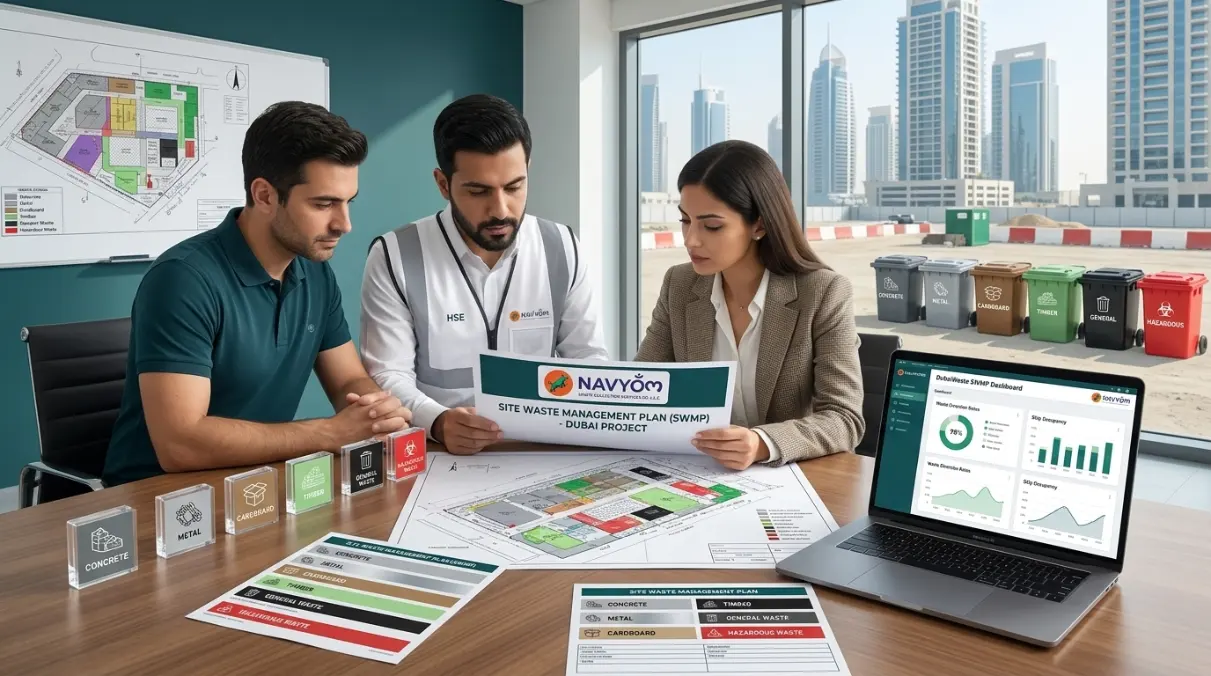
Dubai’s construction and commercial property cycle moves fast. A villa renovation may generate concrete, tiles, timber, packaging, metals, paint tins, gypsum, cardboard, plastics, and general waste within the same week. A tower or mall fit-out can produce the same mix at a much larger scale, with limited loading access and several subcontractors creating waste at once.
That is where many sites lose control. Waste becomes “someone else’s problem” until containers overflow, recyclable materials are contaminated, collection costs rise, or the project team cannot prove where the waste went. A proper SWMP prevents that by assigning ownership before work begins.
Dubai’s current waste-management direction is moving toward stronger reduction, recycling, treatment, circular economy, private-sector participation, and diversion away from landfill. Law No. (18) of 2024 on the Regulation of Waste Management in Dubai reinforces that wider direction. For site teams, the practical message is simple: waste planning needs to be deliberate, documented, and specific to the project.
Compliance Snapshot
A SWMP should separate three things clearly: legal and authority requirements, operational best practice, and cost-saving recommendations. Do not claim that a step is legally mandatory unless your project authority, permit condition, circular, consultant, or waste contractor has confirmed it. But do treat licensed collection, traceable records, controlled storage, and proper classification as non-negotiable project discipline.
Regulatory Context: What Dubai Reviewers Expect to See
A strong SWMP does not need to quote every law line by line, but it should show that the site understands Dubai’s waste-control expectations. Dubai Municipality’s waste-related service and guidance ecosystem covers collection, transport, disposal-site access, hazardous waste transport, waste department circulars, hygiene expectations for vehicles and bins, approved hazardous waste transporters, and processing or recycling premises.
For construction and demolition waste, the plan should make it obvious that the project will not rely on informal removal, unverified trucks, uncontrolled dumping, or mixed disposal without review. Where Waste Transfer Notes, collection tickets, weighbridge slips, disposal certificates, recycling certificates, NAFITH access evidence, or hazardous-waste permits are required by the project route, keep them load by load and file them against the SWMP.
For larger projects, the SWMP may be requested before work starts or as part of the pre-commencement, building permit, NOC, consultant submission, HSE plan, environmental management plan, developer approval, or free-zone approval package. For smaller works, the requirement may appear through the main contractor, building management, mall management, community rules, or waste contractor process. The safest method is to prepare the SWMP early, then confirm the exact submission channel before waste generation begins.
⚠️ Hazardous & Special Waste Callout
Do not place asbestos-suspect materials, chemicals, oils, solvents, batteries, contaminated containers, medical waste, laboratory waste, or unknown residues into normal construction skips. Isolate them, label them, restrict access, photograph the condition, and involve a specialist licensed handler where required. Small quantity does not mean low risk.
What a Dubai-Ready SWMP Should Include
A strong SWMP should be short enough to use on site but detailed enough to defend your process. The best plans normally include the following sections.
1. Project and site details
Start with the basics: project name, location, plot or unit details, client, consultant, main contractor, waste coordinator, expected start and completion dates, working hours, and access constraints. If the site is in a free zone, industrial area, mall, master community, or logistics park, mention that because the waste approval process may involve additional rules.
2. Waste stream forecast
List the waste types expected during each phase. For example, demolition may produce concrete, blocks, rebar, wiring, timber, glass, old fixtures, insulation, gypsum, and possible hazardous items. Fit-out may create packaging, board offcuts, metal channels, tiles, sanitaryware, adhesives, paint containers, pallets, and general waste. Do not hide small streams. Small hazardous or contaminated streams are often the ones that create the biggest compliance problem.
3. Waste reduction method
Before recycling, explain how waste will be prevented. This can include accurate procurement, returnable pallets, supplier take-back, prefabrication, careful material storage, cut-list planning, reusable formwork, on-site reuse of clean rubble where approved, and better coordination between civil, MEP, and finishing teams.
4. Segregation and storage layout
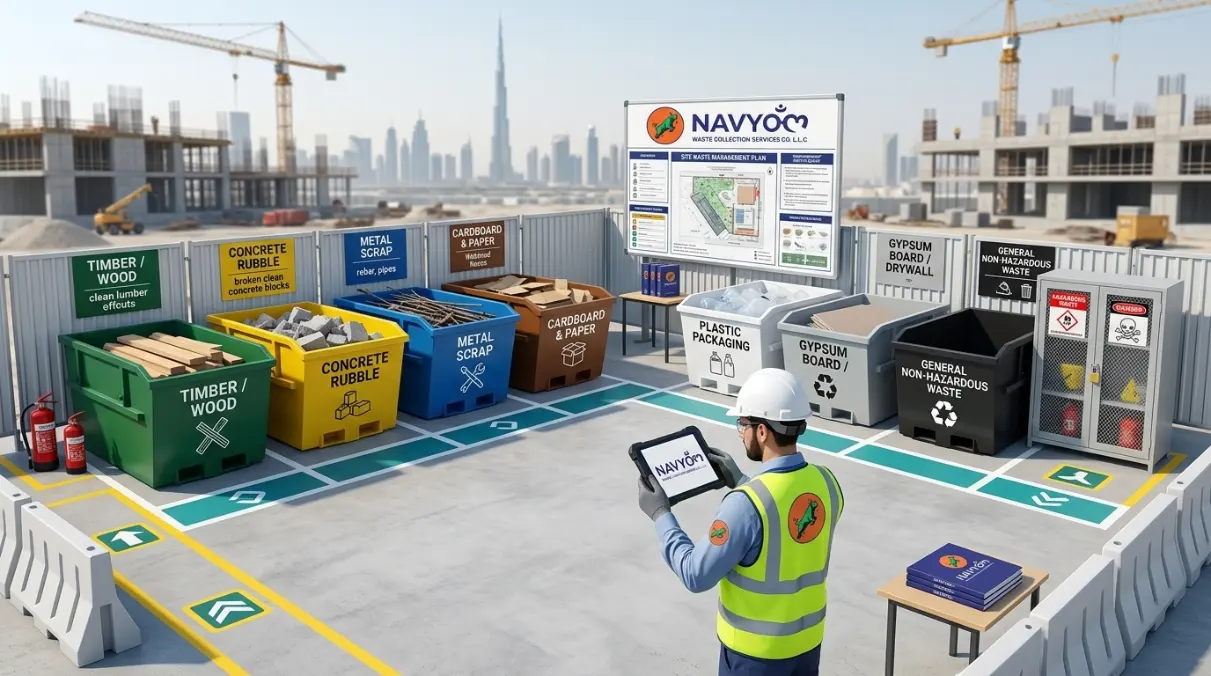
Show where waste will be placed, how containers will be labelled, who checks contamination, and how waste will move from floors, work zones, basements, loading bays, or roof areas to collection points. On tight Dubai sites, the best SWMP is often the one that solves the logistics before the first delivery truck blocks the access road.
5. Licensed collection and disposal route
Name the waste contractor or define the selection requirement if procurement is still open. The SWMP should state that waste must be collected by a suitably licensed provider and moved only through approved routes and disposal or recycling facilities. Include expected collection frequency, container type, skip size, NAFITH or disposal-site access requirements where applicable, and escalation steps for overflow.
6. Documentation and records
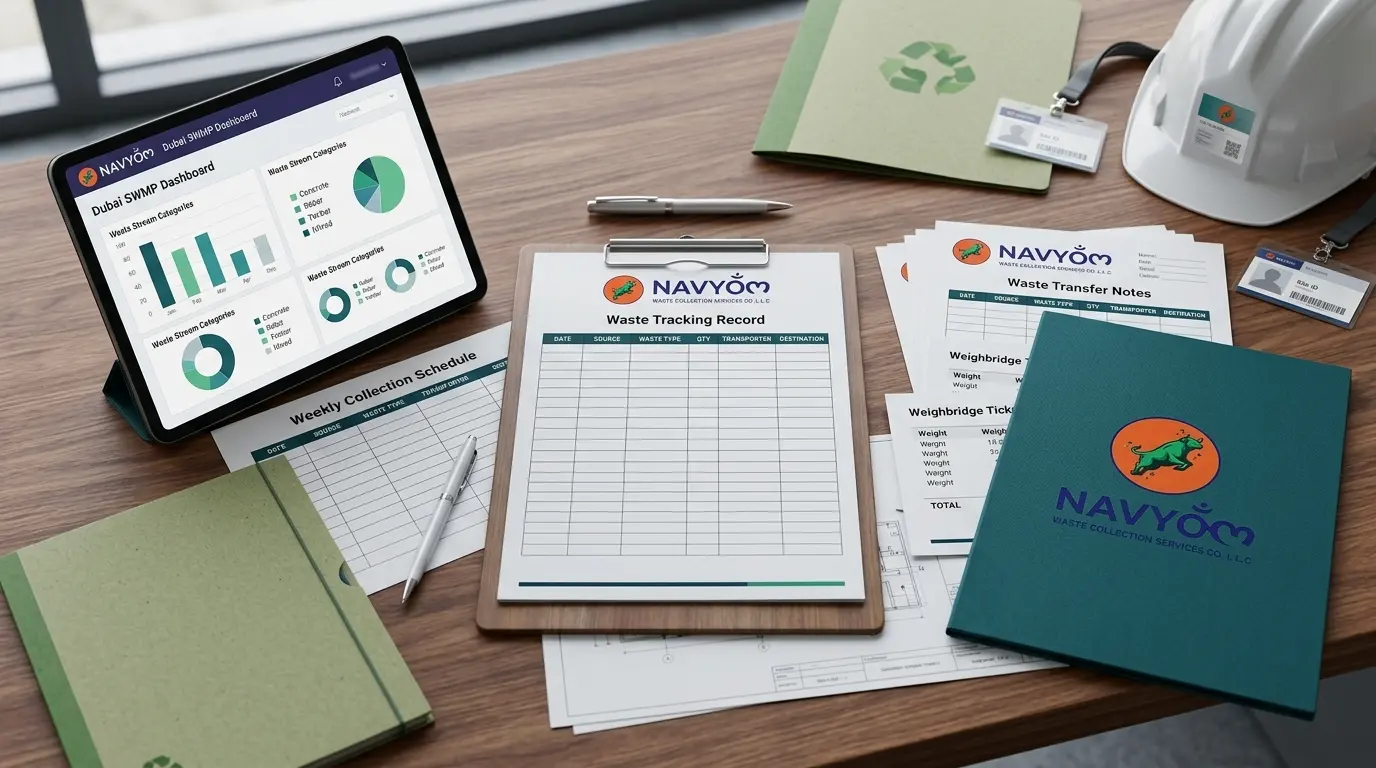
A SWMP becomes credible when records support it. Keep collection receipts, weighbridge tickets, Waste Transfer Notes where applicable, recycling certificates, hazardous waste documentation, contractor permits, toolbox-talk attendance, inspection logs, photos of segregation areas, and monthly waste summaries. Records should match the waste categories shown in the plan.
7. Responsibilities and training
Assign named responsibilities. A project manager may own compliance, the HSE officer may monitor daily storage, the logistics supervisor may control collection booking, and subcontractors may be responsible for removing or segregating their own packaging and offcuts. Add a simple toolbox-talk schedule so labourers and subcontractors understand the system before contamination begins.
Generic SWMP Template vs Dubai-Ready SWMP
| SWMP Element | Generic Template | Dubai-Ready Plan | Why It Matters |
|---|---|---|---|
| Waste classification | Broad terms such as “construction waste” or “general waste”. | Separate streams such as concrete, metals, timber, gypsum, packaging, hazardous items, organic, and general waste. | Better classification improves recycling options, cost control, and compliance clarity. |
| Site logistics | Mentions bins or skips without a practical layout. | Shows container locations, loading access, floor-to-skip movement, labels, and overflow controls. | Dubai sites often have limited access, shared roads, basement loading, and strict building management rules. |
| Contractor control | Says “licensed contractor” without verification detail. | Includes contractor licence checks, collection schedule, disposal route, and required records. | The waste producer still needs evidence that the waste was handled properly. |
| Recycling target | Uses a generic target with no calculation method. | Sets realistic diversion targets by waste stream and tracks actual tonnage or container volume. | Unrealistic targets look good on paper but collapse during implementation. |
| Submission readiness | Standalone document with no approval context. | Prepared for consultant, developer, free-zone, or municipal review with attachments and update process. | Submission route varies, so the plan must be easy for reviewers to check quickly. |
How to Write and Submit a Site Waste Management Plan (SWMP) Dubai
The process below works as a practical sequence for Dubai projects. Adjust it for your authority, site type, and waste stream complexity.
Step 1: Confirm the approval route
Before writing the final version, confirm who will review or request the SWMP. For some projects, the route is through the main consultant or contractor’s HSE submission. For others, it may involve a master developer, mall management, free-zone authority, industrial-zone operator, or Dubai Municipality-linked process. Do not assume the route is the same across Dubai.
Step 2: Walk the site and map the waste points
Do not prepare the plan from a desk only. Walk the site and identify work areas, loading access, hoist routes, storage zones, pedestrian paths, fire routes, and places where waste may accumulate. In busy areas such as Al Quoz, Jebel Ali, Business Bay, Dubai Marina, DIP, and mall environments, logistics can be more important than the template wording.
Step 3: Forecast waste by phase
Break waste down by phase: site preparation, demolition, shell works, MEP, fit-out, finishing, commissioning, and handover. Then estimate quantities using project drawings, bill of quantities, historical data, supplier packaging information, or skip-volume assumptions. If you cannot calculate tonnage precisely, start with a reasoned estimate and update it during the project.
Step 4: Choose segregation streams
Do not create ten skips if the site can only manage two. Select streams that are realistic and valuable: clean inert waste, metals, timber, cardboard, plastics, gypsum, general waste, and hazardous or special waste where relevant. Segregation must balance recycling ambition with space, collection frequency, labour control, and contamination risk.
Step 5: Confirm collection, transport, and records
Identify the collection provider, required permits, vehicle access, disposal or recycling destination, pickup frequency, and records to be returned after each collection. The SWMP should make it clear that no subcontractor can remove waste informally without approval and documentation.
Step 6: Add monitoring and update rules
Set a review frequency. For small fit-outs, weekly checks may be enough. For demolition or major construction, daily checks and monthly waste summaries may be more appropriate. Update the SWMP if the scope changes, a new waste type appears, containers overflow, contamination increases, or the contractor changes.
Step 7: Submit the plan with useful attachments
Submit the SWMP through the required project channel with supporting attachments. Include the site layout, waste stream table, contractor details, collection schedule, emergency handling procedure, inspection checklist, and record template. A reviewer should be able to understand the plan in minutes without asking basic follow-up questions.
♻️ Dubai Waste Pro Insight
The best time to prepare a SWMP is before procurement is locked. Once suppliers, subcontractors, and skip arrangements are already chosen, the plan becomes damage control. Early planning lets you reduce waste at source, specify packaging take-back, separate high-value recyclables, and avoid paying mixed-waste rates for materials that could have been diverted.
Realistic Diversion Targets: What to Set Without Overpromising
A SWMP becomes stronger when it includes measurable targets, but weak targets are worse than no targets. Do not write “90% recycling” unless your waste streams, contractor capability, site space, and records can support that number. Instead, set targets by material type and revise them after the first month of site data.
Clean metals, cardboard, pallets, and certain inert materials are often easier to divert than contaminated mixed fit-out waste. Gypsum, plastics, glass, packaging films, and timber depend heavily on cleanliness, volume, storage conditions, and recycler acceptance. Hazardous and regulated waste should not be counted as normal recycling just to improve a percentage.
| Waste Stream | Typical SWMP Target Style | Risk to Watch |
|---|---|---|
| Metals | High diversion where separated cleanly and stored securely. | Theft, mixed debris, or informal removal without records. |
| Cardboard & packaging | Good diversion if kept dry and separated from food/general waste. | Moisture, tape-heavy contamination, and poor floor-level collection. |
| Concrete, block, rubble | Possible diversion if clean and accepted by approved routes. | Mixed gypsum, timber, plastics, soil, or hazardous contamination. |
| Fit-out mixed waste | Moderate target after practical segregation. | Overclaiming recycling where materials are too mixed to recover. |
| Hazardous or special waste | Separate compliant handling, not normal diversion. | Incorrect storage, unlicensed handling, or missing disposal evidence. |
How Advice Changes by Site Type
A SWMP should never be copied unchanged from one project to another. The right approach depends on the site, waste mix, authority, and operational pressure.
Small villa renovation or residential fit-out
Keep the plan simple but specific. Focus on skip placement, neighbour impact, safe loading, concrete and tile waste, timber, packaging, paint containers, and collection timing. A small project may not need a complex reporting dashboard, but it still needs a clear route for waste leaving the property.
Commercial fit-out in a mall, hotel, or office tower
Access rules usually matter more than skip size. The SWMP should reflect loading-bay booking, night work, building management approvals, lift protection, cardboard and packaging volumes, waste movement from upper floors, and separation of general waste from recyclable packaging.
High-rise tower project
Waste movement is the main challenge. The plan should cover hoist scheduling, floor-by-floor waste cages, chute restrictions, temporary holding areas, fire-route protection, housekeeping checks, and collection timing. Without this, recyclable streams become mixed before they ever reach the ground-level skip.
Demolition or strip-out project
Use a more detailed plan. Add a pre-demolition waste audit, salvage opportunities, heavy debris handling, dust and safety controls, hazardous material checks, segregated metal recovery, and disposal records. Do not treat demolition as normal construction waste with bigger skips.
Warehouse or industrial operation
Expect mixed operational waste: pallets, stretch film, cardboard, damaged stock, packaging, metal, oils, chemicals, e-waste, and general waste. The SWMP should separate construction or maintenance waste from ongoing business waste so records do not become confused.
Clinic, laboratory, food, or hospitality facility
Do not combine regulated waste with general construction waste. Medical, chemical, food, grease, organic, and hazardous streams may require specialist handling, separate storage, and different documentation. Your SWMP should clearly mark which streams are outside the normal skip process.
Common Pitfalls & When to Ignore This Advice
Most weak SWMPs fail for predictable reasons. The wording looks professional, but the system cannot survive real site behaviour.
A UK-style SWMP may be useful as a structure, but Dubai sites need local authority routing, contractor verification, access constraints, and Dubai waste disposal realities.
Mixed waste may be convenient, but it usually reduces recycling value, increases contamination, and makes your diversion claim weaker.
Paints, solvents, adhesives, batteries, contaminated containers, and asbestos-suspect materials need careful handling. Small volume does not mean low risk.
If nobody owns the WTN file, collection receipts, photos, and monthly summary, the project may only discover missing evidence at closeout.
Do not promise high diversion if the site has no space, no training, no contractor capacity, or high contamination risk. Set targets by stream, not wishful thinking.
A SWMP written once and forgotten is not a management plan. It should change when scope, waste type, contractor, or collection frequency changes.
There are also times to simplify the advice. A minor maintenance job may not need a 30-page plan. A tiny waste stream may not justify a separate container if it creates more handling risk than benefit. And not every material can be recycled economically in every situation. The goal is not to produce a perfect-looking document; the goal is to create a waste process that is legal, practical, trackable, and cost-aware.
How DubaiWaste.com Tools Can Help
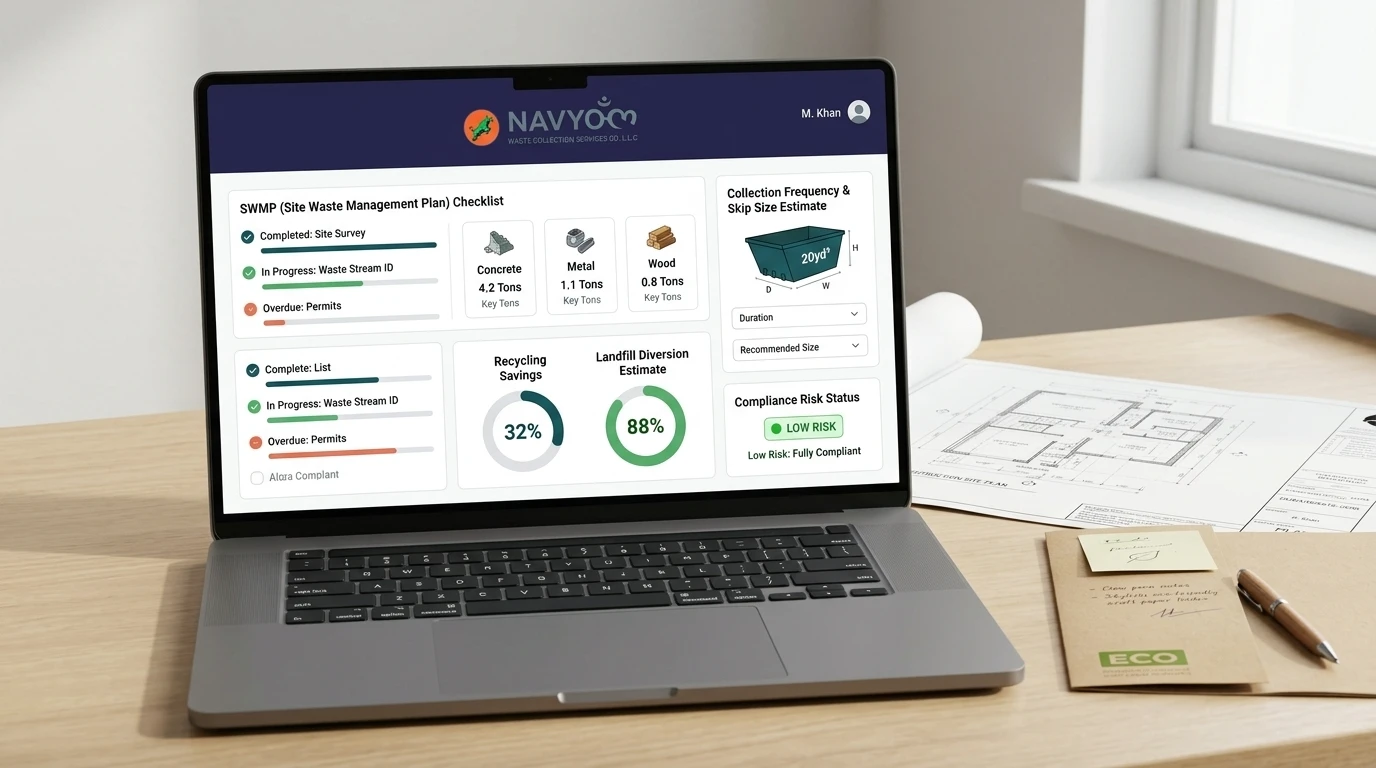
Before you submit a SWMP, use data to test whether the plan makes sense. Guessing container sizes, collection frequency, or diversion value can make the plan look weak. DubaiWaste.com tools help turn rough assumptions into practical planning numbers.
- Waste Management Cost Estimator — estimate likely waste collection cost based on waste type, volume, frequency, and site needs.
- Recycling Savings Calculator — compare mixed disposal against separate recycling streams where segregation is practical.
- Landfill Savings Calculator — show how diversion can reduce landfill dependency and support ESG reporting.
- Construction Waste Fine Risk Guide — review common compliance mistakes before they become site issues.
Real-World Example: Al Quoz Warehouse Renovation
Imagine a warehouse renovation in Al Quoz. The contractor expects metal racking removal, damaged pallets, cardboard, old lighting, tiles, gypsum partitions, general labour waste, plastic packaging, and a small quantity of paint and adhesive containers. A generic SWMP would simply say “construction waste will be collected by approved contractor.” That is not enough.
A better SWMP separates the project into phases. During strip-out, metals are stored in a clearly labelled area for scrap recovery. Timber pallets are stacked separately if clean. Cardboard is baled or kept dry for recycling. Gypsum and mixed finishing waste are kept away from clean inert material. Paint and adhesive containers are isolated and reviewed before disposal. The plan includes a collection schedule that avoids blocking shared industrial access roads, and the site supervisor photographs each waste area twice weekly.
By the end of the project, the contractor can show what was generated, what was diverted, who collected it, where it went, and what was changed when the waste mix shifted. That is the difference between a document and a working SWMP.
Put This Into Practice Before Your First Collection
If your site is already generating waste, do not wait until closeout to organize the records. Start with a waste stream review, confirm the collection route, and fix segregation gaps while the project is still active.
Try the Waste Management Cost Estimator or request a free site waste audit if your project has multiple waste streams, unclear documentation, or rising mixed-waste costs.
Site Waste Management Plan Dubai FAQs
What is a Site Waste Management Plan (SWMP) Dubai?
A Site Waste Management Plan Dubai is a project-specific document explaining how waste will be reduced, sorted, stored, collected, transported, recycled, or disposed of during site work. It should include waste types, estimated quantities, responsibilities, approved collection routes, records, and review steps.
Is a SWMP required for construction projects in Dubai?
It depends on the project type, authority, permit route, developer requirement, and waste stream. Many construction, demolition, fit-out, and regulated sites are expected to show a clear waste management process. Always confirm the exact requirement with the consultant, free-zone authority, master developer, or relevant Dubai authority.
Who should prepare the SWMP?
Usually the main contractor, HSE officer, environmental consultant, or project consultant prepares it with input from procurement, logistics, subcontractors, and the waste contractor. The person writing it must understand the real site layout and collection process, not just the template language.
How do I submit a Site Waste Management Plan in Dubai?
Submit it through the approval route required for your project. This may be via the lead consultant, main contractor’s HSE file, master developer portal, free-zone process, mall management, or municipal permit documentation. Attach the site layout, waste forecast, contractor details, collection schedule, and record templates.
Do waste vehicles need NAFITH access for Dubai Municipality disposal sites?
Often, access to Dubai Municipality waste disposal sites is linked to vehicle permit requirements such as NAFITH. The exact need depends on the waste type, vehicle, contractor, and disposal route. Your SWMP should confirm who is responsible for access permits and disposal-site entry evidence.
Can mixed construction waste be collected in Dubai?
Mixed construction waste may be collected in some situations, but it is usually less efficient and can reduce recycling value. A SWMP should explain when mixed waste is unavoidable and which streams can still be separated, such as metals, clean concrete, timber, cardboard, or hazardous materials.
What records should I keep with a SWMP?
Keep contractor licence evidence, collection receipts, Waste Transfer Notes where applicable, weighbridge tickets, recycling certificates, hazardous waste records, site inspection photos, toolbox-talk attendance, and monthly waste summaries. The records should match the waste streams and responsibilities listed in the plan.
Do small fit-out projects need a full SWMP?
Small fit-outs may not need a long document, but they still benefit from a simple SWMP. At minimum, identify waste types, skip or bin location, collection contractor, building access rules, packaging segregation, regulated waste handling, and who keeps disposal records.
Your Fast-Track Cheat Sheet: Top 3 Actions to Take
1. Build the plan around real site movement. Map how waste travels from work area to container to collection vehicle to approved destination.
2. Separate what is practical, not imaginary. Prioritize clean inert waste, metals, cardboard, timber, plastics, gypsum, hazardous items, and general waste based on volume, access, and contractor capability.
3. Keep records from day one. A SWMP without collection evidence, contractor details, inspection photos, and transfer records is difficult to defend during review or project closeout.
General guidance note: This article is for practical waste-planning education. Waste rules, permit routes, approval requirements, fees, and documentation expectations can change by authority, site, free zone, developer, waste type, and contractor. Always verify your project’s requirements with Dubai Municipality, the relevant free-zone or master developer authority, your consultant, and your licensed waste contractor before submission.