Mixed construction waste is no longer a housekeeping issue in Dubai.
In 2026, it is one of the fastest ways to trigger Waste Transfer Note (WTN) rejection, disposal delays, reclassification charges, repeated inspections, and escalating project costs.
Yet most contractors still approach the problem the same way:
- More induction slides
- More warning signs
- More toolbox talks
And the problem keeps returning.
That’s because waste mixing is not a training failure.
It is a systems failure under site pressure.
This playbook explains why workers mix waste, why training alone fails, and the 7 site-level systems Dubai contractors are using right now to stop contamination at the source — even on fast-moving construction and fit-out projects.
This is not theory.
It is designed for real sites, real crews, and real enforcement conditions in 2026.
1. Why Workers Mix Waste (It’s Not Laziness)
Blaming workers is convenient.
It is also inaccurate.
Across rejected WTNs, inspection reports, and site audits in Dubai, the same pattern appears again and again:
Workers mix waste because the site environment makes correct behavior difficult or unrewarded.
Here are the real reasons.
Time Pressure Overrides Sorting
When deadlines tighten, workers prioritize task completion.
Waste sorting feels optional when:
- Supervisors push for speed
- Materials are moving quickly
- Skips are far from work zones
Sorting loses every time.
Signage Fails in Multilingual Crews
Most sites rely on English-only signs with long text.
But Dubai construction crews are multilingual:
- Urdu
- Hindi
- Bengali
- Arabic
If instructions require reading and interpretation, compliance drops.
No Feedback Loop Exists
On many sites:
- Waste is mixed
- The skip leaves
- The WTN is rejected days later
The worker who caused the contamination never sees the result.
No feedback = no learning.
The “Sort It Later” Mentality
Early in a project, skips look empty.
That creates a dangerous assumption:
“We’ll separate it later.”
Later never comes.
By the time the skip fills, contamination is already embedded.
Key insight:
Workers respond to friction, not instructions.
When sorting slows work or carries no immediate consequence, it disappears.
2. Why Training Alone Fails on Construction Sites
Most contractors already provide training.
Yet waste mixing continues.
That’s because training is not reinforcement.
One-Time Induction Does Not Change Behavior
Induction training happens once.
Site pressure happens every day.
Slides do not override habits formed under heat, noise, and urgency.
Language Barriers Dilute the Message
Training may be delivered in English.
Daily work happens in multiple languages.
What is understood during induction is often lost on the ground.
Subcontractor Turnover Is Constant
In 2026, subcontractor churn is faster than ever.
- New crews join weekly
- Old crews leave without notice
Training never reaches everyone at the same level.
No Enforcement = Optional Rules
If nothing happens when waste is mixed:
- No correction
- No accountability
- No visible cost
Then sorting becomes a suggestion, not a requirement.
This is the turning point:
High-performing Dubai sites do not “train harder.”
They install systems that make the right behavior unavoidable.
3. The 7-System Playbook That Actually Works
These are not tips.
They are behavior-control systems.
Each system removes friction, assigns accountability, and aligns with how Dubai sites actually operate in 2026.
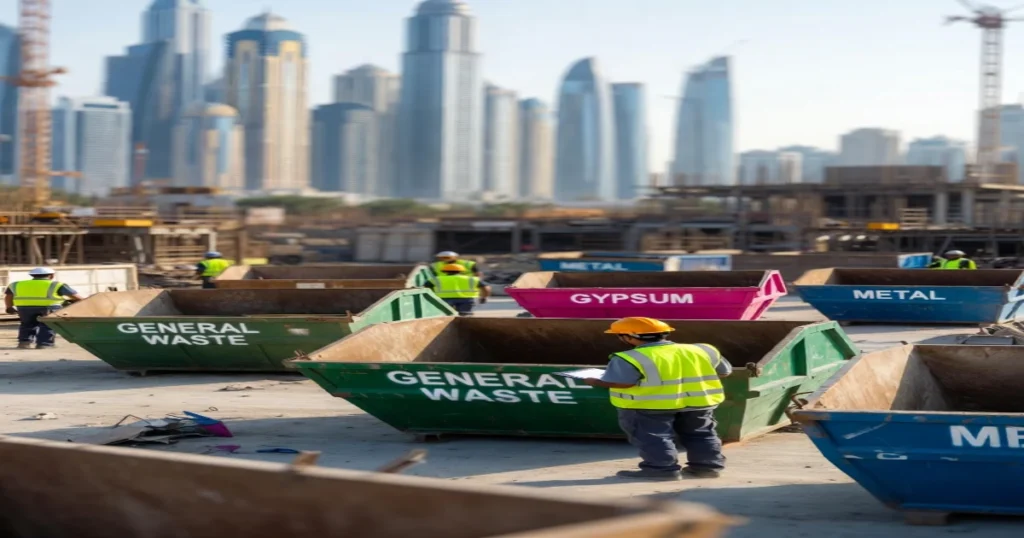
System 1: Color-Coded Skip Ownership
Each skip has:
- One color
- One waste stream
- One responsible supervisor
Not a list of rules.
Ownership.
When responsibility is shared, accountability disappears.
When ownership is clear, behavior improves immediately.
Why it works:
Workers don’t need to remember categories.
They just follow color and supervisor direction.
System 2: Photo-Before-Pickup Rule
No photo.
No pickup.
Before a skip leaves site:
- A clear photo is taken
- The contents are verified
- Contamination is corrected immediately
This aligns perfectly with Dubai’s digital WTN and photo-verification systems.
Why it works:
It forces correction before the waste leaves site — not after rejection.
System 3: The 2-Minute Daily Waste Briefing
This is not training.
It is a reminder loop.
Delivered during morning lineup:
- One rule only
- One message
- Two minutes maximum
Example:
“No gypsum in general waste today.”
Repetition beats presentations.
Why it works:
It keeps waste rules present in workers’ short-term memory — where decisions actually happen.
System 4: Contamination Correction Loop
When waste is mixed:
- It is corrected immediately
- The worker sees the correction
- The supervisor signs off
No shouting.
No blame.
Just correction and reinforcement.
Why it works:
Learning happens at the moment of error — not days later through paperwork.

System 5: Reward-Based Compliance
Punishment creates hiding.
Rewards create habits.
Sites that reduce contamination fastest:
- Publicly recognize clean skips
- Offer small incentives
- Acknowledge compliant crews
Why it works:
Workers repeat behaviors that earn recognition.
System 6: Supervisor Accountability
If a skip is rejected:
- It is not “site fault”
- It is not “waste company fault”
Responsibility is assigned to a named supervisor.
Why it works:
Accountability accelerates behavior change faster than any training session.
System 7: Visible Cost Feedback
Most workers have no idea what contamination costs.
High-performing sites post:
- Reclassification charges
- Delay costs
- Extra haulage fees
Publicly.
Why it works:
Cost visibility turns abstract rules into real consequences.
4. What NOT to Do (Common Mistakes)
Even well-intentioned sites fail when they:
- Create too many waste categories
- Overload workers with rules
- Rely on English-only signage
- Ignore violations
- Assume workers will “remember”
One truth stands out:
Complexity kills compliance.
5. Real Site Scenario: Before vs After
Before systems
- Mixed waste daily
- Frequent WTN clarifications
- Rising disposal costs
- Frustrated supervisors
After 30–45 days
- Mixing reduced significantly
- Fewer WTN rejections
- Predictable disposal costs
- Supervisors engaged in prevention
No extra manpower.
No longer training sessions.
Just better systems.
Stop Fixing Waste Problems After Rejection
Install site systems that prevent waste mixing before it reaches the skip. Download the same 10-minute toolbox talk Dubai supervisors use to reduce contamination, WTN delays, and disposal overruns.

6. Toolbox Talk That Actually Works
Most toolbox talks fail because they are:
- Too long
- Too theoretical
- Too generic
A high-performing waste toolbox talk in Dubai must be:
- 10 minutes or less
- Visual-first
- Supervisor-led
- Focused on one behavior
That’s why many sites now use a single-page Waste Segregation Toolbox Talk, designed specifically for Dubai construction conditions.
It includes:
- Visual sorting rules
- Supervisor checklist
- Common contamination examples
- Immediate correction steps
This format consistently outperforms traditional training decks.
For contractors managing active sites across Dubai, waste segregation should not be treated as an isolated task. It directly affects construction waste collection workflows, the accuracy of Waste Transfer Notes (WTNs), and overall compliance with Dubai Municipality waste regulations. Sites that integrate segregation systems with pickup scheduling, photo verification, and supervisor accountability consistently experience fewer rejections, lower disposal costs, and smoother inspections throughout the project lifecycle.
7. How Navyom Supports On-Site Compliance
Systems only work when supported consistently.
Navyom Waste Collection Services Co. LLC works with contractors to align waste collection operations with on-site segregation systems.
Support typically includes:
- Skip placement and labeling guidance
- Pickup workflows aligned with photo verification
- WTN compliance support
- Contamination prevention coordination
The objective is not enforcement.
It is predictability and zero surprises.
8. Frequently Asked Questions
Why does waste mixing continue even after training?
Because training without reinforcement collapses under site pressure.
Who is responsible for mixed waste on site?
Responsibility should be assigned to a specific supervisor, not shared.
Can one contaminated skip affect the whole project?
Yes. Repeated contamination increases inspection frequency and risk exposure.
How does Dubai Municipality detect mixed waste?
Through photo verification, WTN audits, and site inspections.
How quickly can these systems reduce rejections?
Most sites see measurable improvement within 30–45 days.
When Waste Mixing Persists, Training Is No Longer the Problem
Sites facing repeated WTN rejections usually need system alignment — not more rules. Navyom supports contractors by aligning skip placement, pickup workflows, and WTN verification with site-level segregation controls.
Talk to a Compliance-Focused Waste PartnerFinal Takeaway
This is not about teaching workers to care more.
It is about designing site systems that do not allow waste mixing to happen.
In 2026, Dubai contractors who engineer behavior — instead of blaming it — are the ones avoiding:
- WTN rejections
- Disposal delays
- Reclassification charges
- Cost overruns
Training informs.
Systems transform.