Waste Types in Dubai: Every Category, Rule & Colour-Coded Bin Explained (2026)
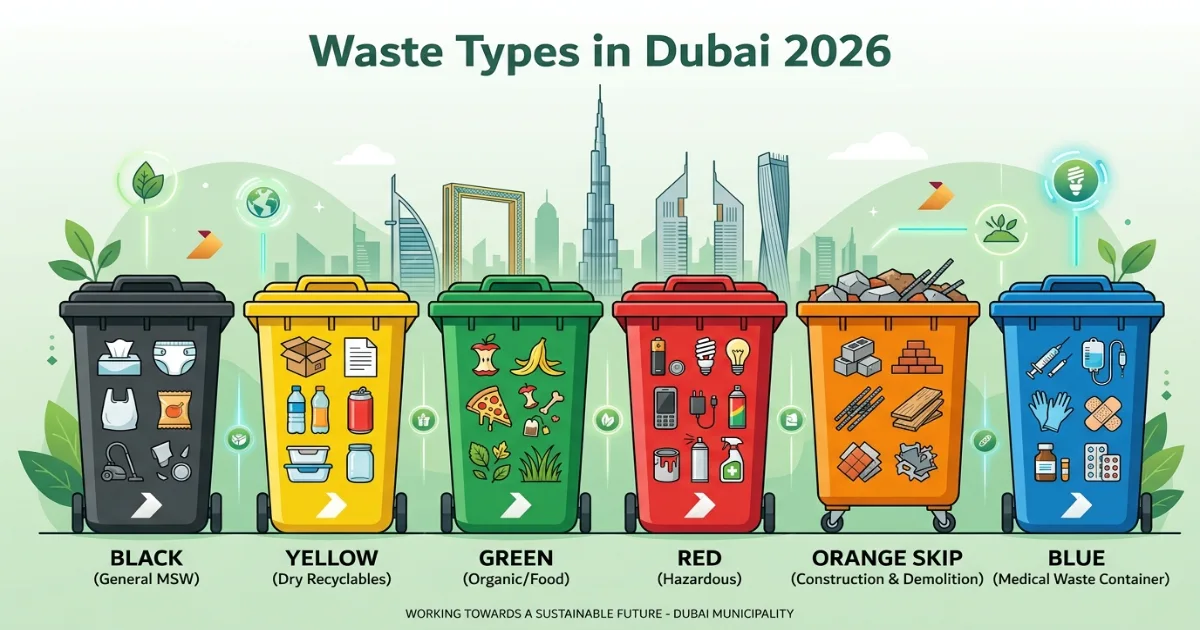
Dubai Municipality classifies waste into six regulated streams: general municipal solid waste, recyclables, organic/food waste, hazardous waste, construction & demolition (C&D) waste, and medical/clinical waste. Each type has its own colour-coded bin, licensed contractor requirement, Waste Transfer Note (WTN) obligation, and fine schedule under Law No. 18 of 2024. Mixing streams or using an unlicensed hauler can trigger fines from AED 1,000 to AED 100,000 per violation. This guide maps every type, explains the rules, and shows you exactly how to stay compliant.
Dubai generates more than 6,000 tonnes of waste every single day. That figure includes everything from a café’s coffee grounds in Jumeirah to reinforced concrete rubble coming off a 50-floor tower in Business Bay, to expired pharmaceuticals leaving a hospital in Healthcare City. These materials don’t go to the same place. They’re not handled by the same people. And they’re absolutely not subject to the same rules.
Yet one of the most common compliance failures we see — across restaurants, developers, and factories alike — is exactly that mistake: treating all waste as one problem. The consequences are immediate. Contaminated loads get rejected at transfer stations. Fines arrive from Dubai Municipality. WTNs are flagged on Montaji. Projects stall.
This guide is the companion article to our Dubai Waste Management Guide 2026 — the complete compliance and cost resource for every business in the emirate. Here, we go deeper on classification: what each waste type is, why it’s regulated separately, what bin it goes into, and what happens if you get it wrong.
Why Waste Classification Matters in Dubai
Dubai’s Integrated Waste Management Strategy 2021–2041 targets a 75% landfill diversion rate. That’s an ambitious goal — and it’s impossible to achieve without accurate waste classification at the source. When businesses mix streams, recyclables get contaminated, organic waste can’t be composted, and hazardous materials create safety risks at sorting facilities.
Law No. 18 of 2024 codified mandatory source segregation for all commercial, industrial, and multi-residential premises in Dubai. It’s no longer a guideline. It’s enforced — and enforcement has intensified since 2024 with AI-assisted inspections at transfer stations and surprise site visits from Dubai Municipality inspectors.
Getting classification right isn’t just about avoiding fines. It’s a genuine cost lever. Businesses that segregate correctly typically reduce disposal spend by 20–45%, because clean, single-stream materials are charged at much lower per-tonne rates than contaminated mixed loads. Clean recyclables can even carry zero or negative collection costs when volumes are sufficient.
The Six Waste Types in Dubai: A Complete Classification
Dubai Municipality’s regulatory framework recognises six primary waste streams. Here’s how each one is defined, regulated, and collected.
1. General Municipal Solid Waste (MSW)
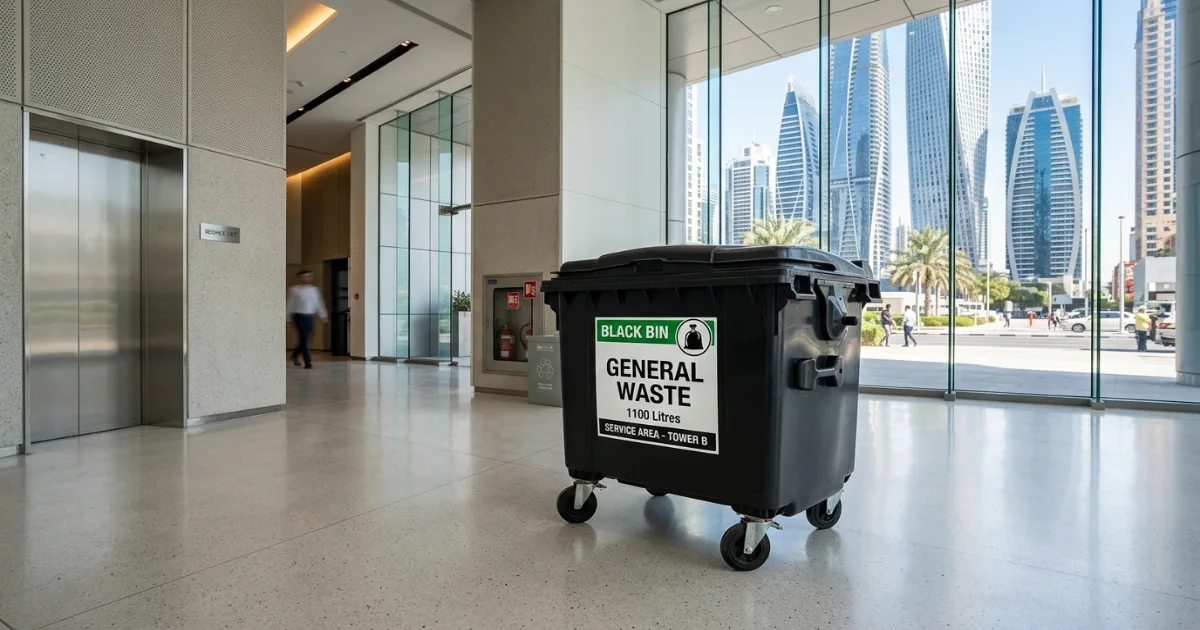
General municipal solid waste is the catch-all stream: non-hazardous, non-recyclable material from households, offices, retail, and food service businesses. Think food-soaked packaging, disposable cups, contaminated paper, non-recyclable plastics, and mixed domestic rubbish.
It’s the most common stream by unit volume, but it should also be the smallest once proper segregation is in place. The Warsan Waste-to-Energy plant — operating at 1.8 million tonnes per year capacity — is the primary destination for Dubai’s general waste, converting it into electricity for around 120,000 homes.
Who generates it: Households, offices, retail outlets, hotels, restaurants
Collection: Building/community operators for residential; licensed contractor for commercial
WTN required: Yes, for all commercial collections
DM disposal rate: AED 100/tonne (2026)
See our General Waste Collection Dubai guide for detailed commercial collection schedules, bin sizing, and cost benchmarks.
2. Dry Recyclables
The yellow bin stream includes clean, dry materials that can be sorted and reprocessed: paper, cardboard, PET and HDPE plastics, aluminium cans, steel tins, and glass. The operative word is clean — food-contaminated recyclables revert to general waste classification and are charged accordingly.
Dubai’s Material Recovery Facilities (MRFs) use optical sorters, near-infrared scanners, and AI-guided robotic arms to process these streams at speed. Purity of input material directly affects market value. A business sending in clean bales can often negotiate zero-cost or rebate collection for high-volume materials like aluminium — which Dubai Municipality prices at approximately AED 1/kg for verified diversion.
Who generates it: All businesses and households
Key rule: Must be clean and dry; no food residue; no black bin contamination
WTN required: Yes, for commercial bulk volumes
3. Organic and Food Waste
Organic waste covers food scraps, vegetable peelings, coffee grounds, garden trimmings, and biodegradable packaging. It’s a growing focus for Dubai Municipality because food waste is both high in volume — restaurants and hotels are significant generators — and high in landfill methane potential.
Separated organic waste is directed to composting facilities and anaerobic digestion plants, where it produces compost and biogas rather than greenhouse gas emissions. Biogas from organics complements the Warsan incineration output and reduces carbon intensity across the city’s energy mix.
Hotels and restaurants in particular should note that DM routinely audits these premises for food waste separation compliance. The Dubai Food Bank partnership route — where edible surplus is redirected before it becomes waste — also counts toward your landfill diversion metrics.
Who generates it: Restaurants, hotels, malls, hospitals, households
Key rule: No mixed packaging; organic only
DM disposal rate: AED 100/tonne
4. Hazardous Waste
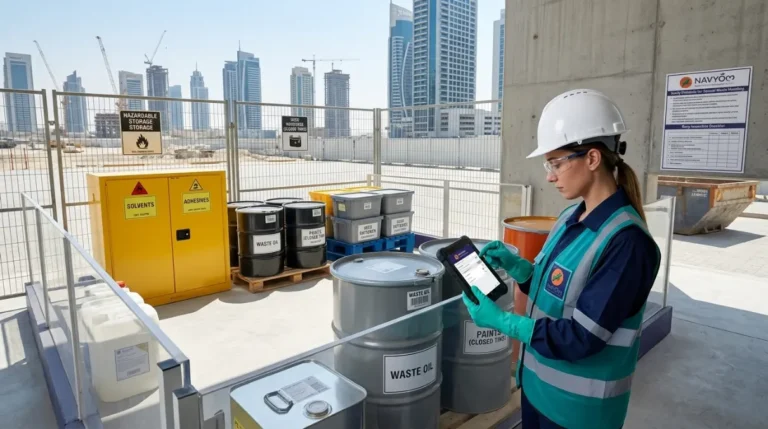
Hazardous waste is any material that poses a risk to human health or the environment due to its chemical, physical, or biological properties. In Dubai’s commercial landscape, this includes paints, solvents, oils, batteries, fluorescent lamps, cleaning chemicals, pesticides, and asbestos-containing materials.
This is where classification errors become dangerous — not just expensive. Mixing hazardous waste with general waste creates contamination at sorting facilities, puts workers at risk, and carries the highest DM fine thresholds. Asbestos, in particular, requires specialist licensed contractors with additional DHA-level approvals.
Every hazardous waste collection must be accompanied by a Safety Data Sheet (SDS), a valid DM contractor licence, and a Waste Transfer Note on Montaji capturing the waste code, quantity, and treatment destination. Storage on-site must be in UN-approved containers, labelled, and segregated from other waste streams.
Treatment routes: High-temperature incineration, chemical neutralisation, secure landfill cells
DM disposal rate: AED 550/tonne
5. Medical and Clinical Waste
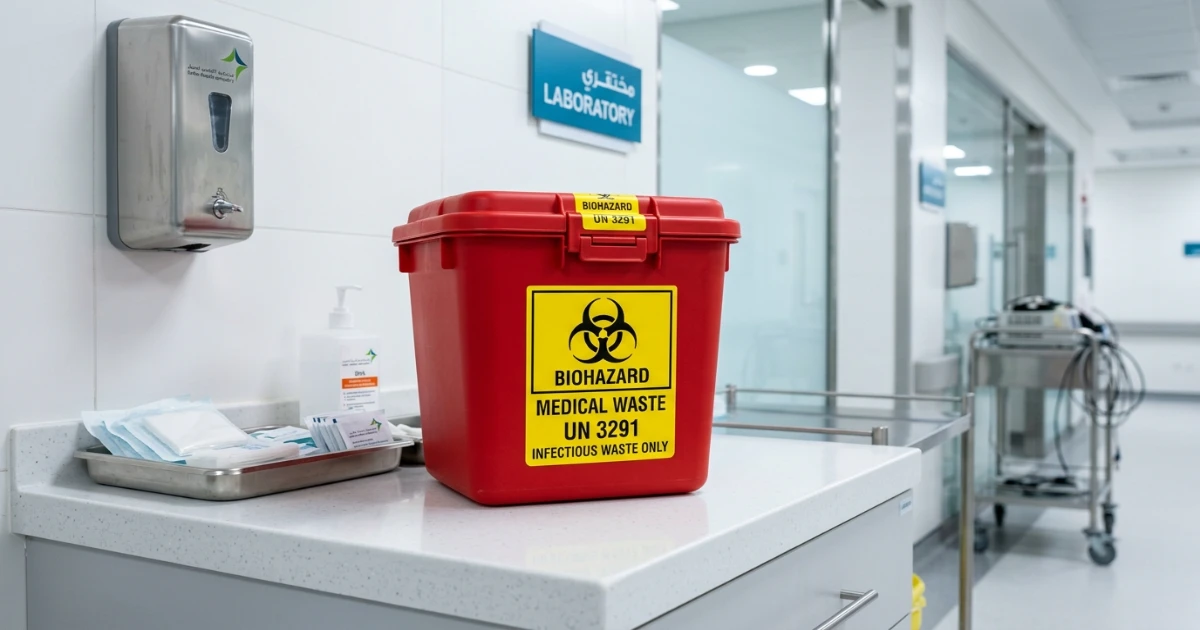
Medical waste is a sub-category of hazardous waste with additional regulatory oversight. It encompasses sharps (needles, scalpels), infectious materials, anatomical waste, pathological samples, expired pharmaceuticals, and contaminated single-use equipment from hospitals, clinics, dental practices, laboratories, and veterinary facilities.
Unlike other waste streams, medical waste disposal in Dubai requires approval from both Dubai Municipality and the Dubai Health Authority (DHA). Storage must use colour-coded, UN-approved containers with biohazard labelling. Treatment is exclusively via high-temperature incineration or autoclave sterilisation at licensed facilities.
Mishandling medical waste carries criminal liability under UAE Federal Law No. 24 of 1999 on Environmental Protection. There are no warnings — the first offence can result in both facility closure and criminal prosecution of responsible management personnel.
Who generates it: Hospitals, clinics, dental practices, labs, veterinary centres, home healthcare providers
Key requirement: DM + DHA licensed contractor; UN-approved containers mandatory
6. Construction and Demolition (C&D) Waste
C&D waste is Dubai’s largest waste stream by volume — accounting for approximately 76% of the emirate’s total waste output. It includes concrete, rubble, steel, timber, plasterboard, ceramic tiles, gypsum board, and excavated soil generated from construction, renovation, and demolition activities.
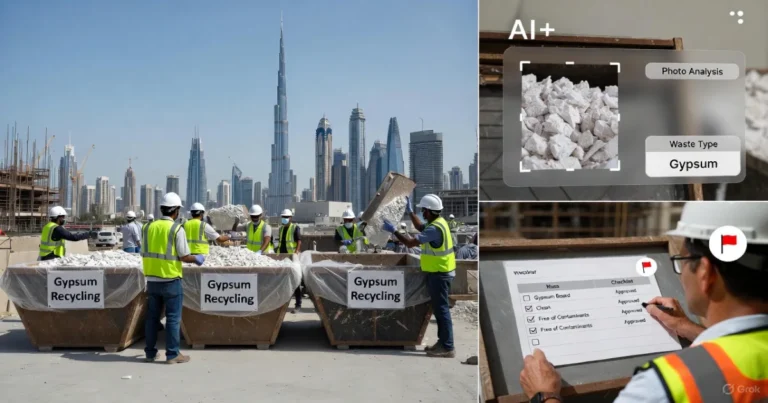
Every construction site operating in Dubai must have a Site Waste Management Plan (SWMP) and a licensed contractor issuing WTNs for every skip that leaves the site. Separate labelled skips are required for different material types — mixing concrete with gypsum, for example, can cost a contractor AED 1,200+ in reclassification fees on a single load.
Dubai Municipality Technical Guideline No. 21 and the Integrated Waste Management Strategy 2021–2041 both place heavy compliance obligations on this stream. AI vision systems at Warsan’s Material Recovery Facility now actively scan and reject mixed or contaminated construction loads at arrival.
DM disposal rate: AED 2–100/tonne (varies by contamination and routing)
Segregation saving: 30–45% off disposal costs through on-site separation
For a full breakdown of skips, WTNs, SWMPs, and approved routes, see our dedicated Construction Waste Disposal in Dubai guide and our practical Construction Waste Control Stack framework.
Bonus Stream: Electronic Waste (E-Waste)
E-waste — old phones, laptops, servers, cables, batteries, and industrial electronics — doesn’t fit neatly into the standard bin system. It’s classified as a special waste under Dubai Municipality rules and cannot go into general or recyclables bins. Businesses and households must use designated Recycling Points or a licensed e-waste contractor.
Enviroserve, located in Dubai Industrial Park (DIP), operates one of the world’s largest certified e-waste recycling facilities and works with both corporate and residential generators. With Dubai’s 5G infrastructure rollout accelerating device replacement cycles, corporate e-waste volumes are growing fast — making contractor relationships and documentation increasingly important for compliance.
See the Dubai Waste Management Guide for the full list of DM-approved e-waste drop points across the emirate.
Dubai Waste Colour-Coded Bin Reference Table (2026)
| Bin Colour | Waste Type | Accepts | Does NOT Accept | DM Rate/Tonne |
|---|---|---|---|---|
| ⚫ Black | General MSW | Non-recyclable, non-hazardous mixed waste | Hazardous, recyclables, organics, C&D | AED 100 |
| 🟡 Yellow | Dry Recyclables | Clean paper, cardboard, plastic, metal, glass | Food-contaminated items, general waste, hazardous | AED 0–rebate |
| 🟢 Green | Organic / Food | Food scraps, garden waste, biodegradable material | Packaging (non-biodegradable), plastics, general waste | AED 100 |
| 🔴 Red | Hazardous + Medical | Chemicals, batteries, pharmaceuticals, sharps, infectious waste | General waste, C&D waste, organics | AED 550 |
| 🟠 Labelled Skips | C&D Waste | Concrete, steel, timber, gypsum, tiles, soil (segregated by type) | General waste, hazardous materials, mixed loads | AED 2–100 |
| 🔵 Designated Points | E-Waste | Electronics, batteries, cables, devices | General waste bins — never | Contractor-specific |
How to Identify and Segregate Your Waste Type in Dubai (Step-by-Step)
Correct waste identification takes about 15 minutes to set up as a system — and it saves hours of administrative headache and thousands of dirhams in avoided fines. Here’s the process we walk every new client through.
For a full walkthrough of the WTN process, Montaji registration, and DM fine check tools, visit our Dubai Waste Management Guide. You can also use our Landfill Savings Calculator to model the cost impact of correct segregation for your specific business type.
Which Waste Types Does Your Industry Generate?
Most Dubai businesses generate more than one waste stream. Here’s a fast-reference matrix by industry:
| Industry | Primary Streams | Key Compliance Risk |
|---|---|---|
| Restaurants & Cafés | Organic, General, Recyclables | Food waste mixing with general; grease trap overflow |
| Hotels | Organic, General, Recyclables, Hazardous (chemicals) | Multi-stream segregation at scale; DM audit risk is high |
| Hospitals & Clinics | Medical, Hazardous, General | Medical + general mixing; DHA + DM dual licence requirement |
| Construction Sites | C&D (concrete, timber, metal, gypsum) | Mixed skips; missing WTNs; no SWMP on site |
| Factories & Warehouses | Industrial, Hazardous, General, E-Waste | Hazardous misclassification; SDS non-compliance |
| Offices & Retail | General, Recyclables | Recyclable contamination; unlicensed hauler use |
For a detailed compliance check by sector, visit our Dubai Municipality Waste Management Systems overview or consult our list of approved waste management companies in Dubai.
Frequently Asked Questions: Waste Types in Dubai
What are the main types of waste in Dubai?
Dubai Municipality classifies waste into six primary streams: general municipal solid waste (black bin), dry recyclables (yellow bin), organic/food waste (green bin), hazardous waste (red bin), construction and demolition (C&D) waste, and medical/clinical waste. E-waste is managed as a special stream via designated Recycling Points and licensed contractors. Each stream has distinct collection, documentation, and treatment requirements under Law No. 18 of 2024.
What colour bins are used for waste segregation in Dubai?
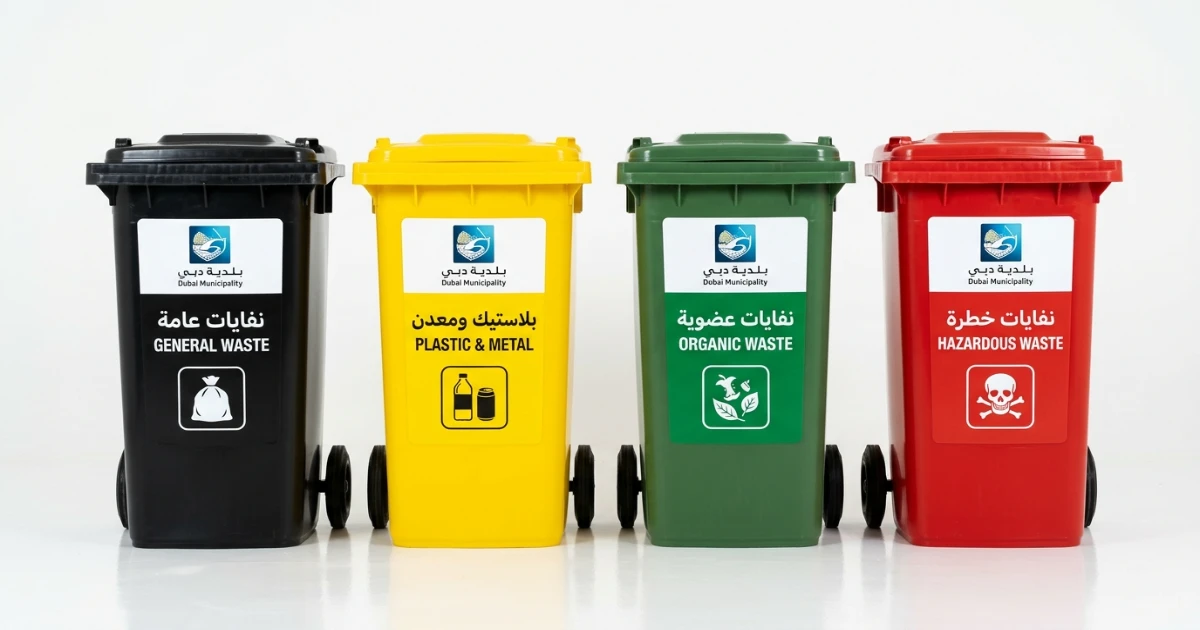
Dubai Municipality uses four colour-coded bins: black for general waste, yellow for dry recyclables (paper, plastic, metal, cardboard), green for organic and food waste, and red for hazardous waste. Construction sites use separate labelled skips for concrete, wood, metal, and mixed debris rather than standard colour-coded bins.
Is waste segregation mandatory in Dubai?
Yes — waste segregation is legally mandatory for all commercial, industrial, and multi-unit residential premises in Dubai under Law No. 18 of 2024. Businesses that fail to segregate at source face fines starting from AED 1,000 up to AED 50,000 per violation. Residential compliance is strongly encouraged and enforced at a community level by building operators.
How is hazardous waste disposed of in Dubai?
Hazardous waste must be collected by a DM-licensed contractor, stored in UN-approved containers, and transported under a Waste Transfer Note (WTN) recorded on Montaji. Treatment options include high-temperature incineration, chemical neutralisation, and secure landfill. The disposal rate is AED 550/tonne — significantly higher than general waste — making correct identification and segregation financially important as well as legally necessary.
Who handles medical waste disposal in Dubai?
Medical waste requires contractors holding dual approval from both Dubai Municipality (DM) and the Dubai Health Authority (DHA). Waste must be stored in colour-coded, UN-approved containers with biohazard labelling and disposed of exclusively via high-temperature incineration or autoclave sterilisation. Mishandling carries criminal liability — facility closures and personal prosecution of management personnel are both documented outcomes.
Where can businesses recycle e-waste in Dubai?
Businesses can use DM-designated Recycling Points, retailer take-back schemes, or licensed e-waste contractors. Enviroserve in Dubai Industrial Park (DIP) is the largest certified e-waste facility in the region and accepts both commercial and residential device volumes. Bulk commercial generators must document collections under Law No. 18 of 2024.
What is a Waste Transfer Note (WTN) in Dubai?
A Waste Transfer Note is a mandatory digital record on Dubai Municipality’s Montaji platform documenting every regulated waste collection. It captures waste type, weight, generator details, contractor licence number, and treatment destination. Operating without WTNs is a standalone violation — fines reach AED 50,000. Always request a WTN copy from your contractor before collection.
What percentage of Dubai’s waste is construction and demolition waste?
C&D waste accounts for approximately 76% of Dubai’s total waste volume — the single largest stream in the emirate. Dubai’s 18,000+ active construction sites produce thousands of tonnes of concrete, steel, timber, and gypsum board daily. Every skip leaving a construction site requires a Waste Transfer Note, and every project needs a Site Waste Management Plan (SWMP).
The Bottom Line on Waste Types in Dubai
Dubai’s waste framework is one of the most structured — and most enforced — in the Middle East. The six regulated waste streams each carry their own rules, their own costs, and their own fine schedules. Get classification right, and you cut costs by up to 45% while staying fully compliant. Get it wrong, and the first unannounced DM inspection will make the price of correct segregation look very small indeed.
The starting point for every business is simple: know which streams you generate, match them to the correct bin or skip, use only licensed contractors, and always demand WTNs. That’s compliance in five steps.
If you’re not yet sure where your business sits — or you want an expert eye on your current waste setup before an inspector arrives — the fastest next step is a free waste audit. Our DM-licensed team has audited hundreds of businesses across Jebel Ali, Al Quoz, DIP, DIC, Business Bay, and beyond. We’ll map your streams, flag your risk, and fix your documentation in one visit.
Know Your Waste Type. Know Your Risk.
Book a free site audit with our Dubai Municipality-licensed team. We’ll map every stream, fix your WTN setup, and put a segregation system in place — before the next inspection.
Read the Full DM Compliance Guide → Calculate Your Disposal Savings → Book Waste Collection in Dubai →Related Guides on dubaiwaste.com
- Dubai Waste Management Guide 2026 — Full Compliance & Cost Resource
- Construction Waste Disposal in Dubai: Complete 2026 Guide
- Construction Waste Control Stack — 5-Layer Framework
- General Waste Collection Dubai — Services, Costs & DM Rules
- Dubai Municipality Waste Management Systems Explained
- Best Waste Management Companies in Dubai (2026 Comparison)
- Landfill Savings Calculator — Estimate Your 2026 Cost Savings
- Garbage Disposal and Junk Removal in Dubai — Full Guide