Dental Clinic Waste Management Dubai: DHA Compliance & Sharps Disposal
Dental Clinic Waste Management Dubai is not only about removing bags at the end of the day. A safe dental waste system protects patients, nurses, dentists, cleaners, transport teams and the wider community by separating sharps, contaminated clinical waste, amalgam waste, pharmaceuticals, chemicals, recyclables and general waste before they become a compliance problem.
📅 Last reviewed: 2026 · Aligned with DHA Standard for Outpatient Facilities (DHA/HRS/HPSD/ST-45), effective 19 January 2025 · Reading time: 13–15 minutes
Dubai dental clinics must segregate waste at source using DHA’s colour-coded bin system — yellow bins for medical and sharps waste, black bins for general waste — with foot-operated bins in every treatment room and rigid sharps containers replaced once they reach three-quarters full. Medical waste must never enter general waste, must be collected under contract by a company approved by Dubai Municipality’s Public Health Department, and every clinic must keep records of waste type and quantity for inspection.
Dental practices generate a small volume of waste compared with hospitals, but the risk profile isn’t small at all. A single endodontic file, a used needle, an extracted tooth with amalgam, blood-soaked gauze, or an expired anaesthetic cartridge changes how that waste has to be stored, collected and documented. That’s why dental clinic waste management in Dubai needs an actual system — not a verbal instruction to “bag it and bin it” at closing time.
Dubai’s healthcare sector is tightly regulated, and dental clinics sit right at the intersection of healthcare licensing, infection prevention, hazardous waste handling and environmental responsibility. The Dubai Health Authority (DHA) licenses and inspects every outpatient facility in the emirate, including general dental clinics, polyclinics and dental units inside hospitals, and its current Standards for Outpatient Facilities set out exactly how medical waste has to be segregated, stored and collected — down to the colour of the bin.
For a clinic owner, the practical question is simple: can your staff identify the correct bin every single time, even mid-way through a fully booked Saturday? If the honest answer is “not always,” the clinic is exposed to avoidable injury, rejected collections, cross-contamination, inspection findings and cost that didn’t need to happen.
Why Dental Clinic Waste Management in Dubai Needs a Different System
Dental waste behaves differently from ordinary office waste because a compact treatment room generates several risk categories at once. Reception produces paper and packaging. The sterilization room handles contaminated instruments, enzymatic detergents and used packaging. The surgery produces sharps, blood-stained material, suction waste, disposable barriers and extracted teeth — sometimes with amalgam still in them. A radiology area may still produce chemical waste, depending on whether the clinic has gone fully digital.
Dubai Municipality classifies waste in the emirate under broad categories that include general waste, construction and demolition waste, liquid waste and hazardous waste, and medical waste sits inside the hazardous category because poor storage, transport or disposal can genuinely harm people and the environment. For a dental clinic, this means the waste plan has to separate low-risk general waste from regulated medical and hazardous streams before the first bag ever leaves the treatment room.
The most common operational mistake is treating “small quantity” as “low importance.” A boutique two-chair clinic in Jumeirah, Business Bay or Al Barsha might fill only a couple of sharps containers a month — but those containers still require the same handling discipline as a hospital’s. A busy multi-chair clinic in Deira or JLT, meanwhile, produces enough medical waste for scheduled or even daily collection, and poor segregation there gets expensive fast because contaminated recyclables can’t be diverted and end up billed as medical waste.
Dubai’s medical waste framework, rooted in Local Order No. 115 of 1997, defines medical waste broadly to include anything generated by medical, therapeutic, nursing or diagnostic procedures that carries a risk of harm or infection — syringes, needles and other sharp instruments included. It applies to any person or facility whose activity generates that waste, which covers dental clinics as directly as it covers hospitals. On top of this, DHA’s current Standards for Outpatient Facilities (Code DHA/HRS/HPSD/ST-45, effective 19 January 2025) require every licensed outpatient facility — general dental clinics included — to hold a waste collection contract with a company approved under Dubai Municipality’s Public Health Department conditions, and to use a specific colour-coded bin system covered in detail below.
DHA’s Colour-Coded Bin System: What Dubai Dental Clinics Are Actually Required to Use
This is the part most generic waste guides get vague about, and it’s worth being precise. Under DHA’s current outpatient facility standard, colour coding isn’t a best-practice suggestion — it’s a stated requirement, and inspectors check for it.
| Bin colour | Required use | Where it must be placed |
|---|---|---|
| Yellow | Medical waste — sharps, blood-contaminated material, pathological waste, biohazard items | Every treatment, procedure and examination room; foot-operated, not hand-operated |
| Black | General, non-contaminated waste — clean packaging, office paper, pantry waste | Reception, admin areas, staff rooms; kept clear of clinical zones |
Two details in the standard are easy to miss but matter operationally. First, medical waste bins in treatment, procedure and examination rooms must be foot-operated — hands-free operation reduces cross-contamination at the exact moment a clinician’s hands are least clean. Second, sharps containers have a defined replacement trigger: DHA’s standard says a sharps box should be discarded once it reaches three-quarters full, not when it’s overflowing. That single rule, if enforced, eliminates most of the “someone tried to force one more item in” injuries clinics report.
The standard also specifies a dedicated medical waste room for facilities generating enough volume to need one: a ventilated, lockable space stocked with yellow-bagged bins for sharps and pathological waste, marked with biohazard signage. Even clinics too small to need a full room should treat their interim storage area the same way in miniature — locked, ventilated, signed, and off-limits to anyone who isn’t handling waste.
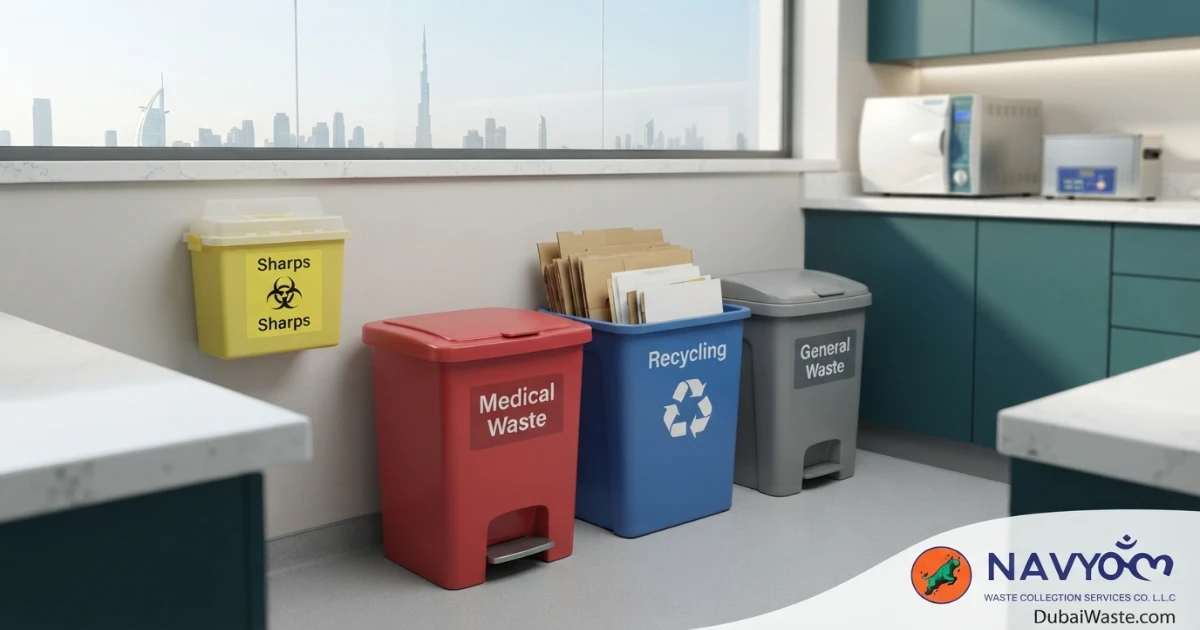
The Core Dental Waste Streams Every Dubai Clinic Should Separate
A dental clinic doesn’t need a dozen bins in every room. It needs a clear, repeatable setup mapped to the procedures actually performed. Start by mapping waste by room: reception, consultation, treatment room, surgical room, sterilization area, radiology area, storage room and housekeeping area.
1. Sharps waste
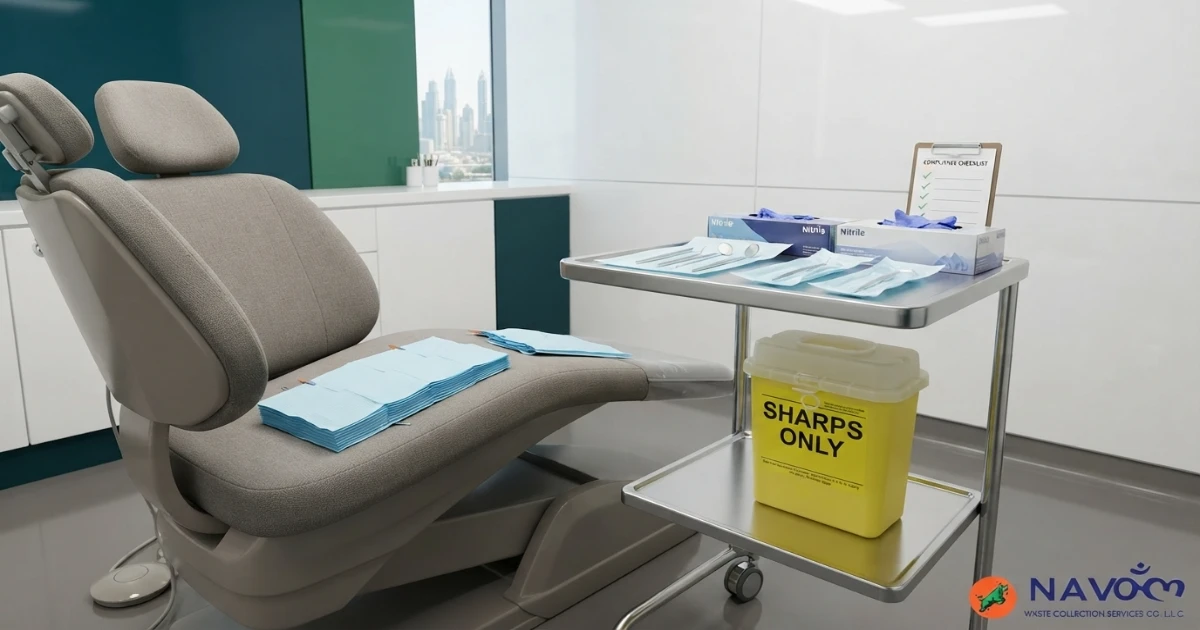
Sharps include needles, syringes with needles, scalpels, blades, burs, endodontic files, orthodontic wires, and any broken contaminated glass or instrument capable of puncturing skin. DHA’s infection control guidance for dentistry classifies these as medical waste requiring disposal in puncture-resistant sharps containers — never in a bag, never in general waste.
The rule in practice: if it can puncture skin and has touched a patient, it doesn’t go in a bag. Bags tear. Staff get injured. Housekeeping teams get exposed. Sharps belong in a rigid, closable, wall-mounted sharps container at the point of use, replaced at three-quarters full.
2. Blood-contaminated and infectious clinical waste
Gauze, cotton rolls, suction tips, disposable barriers, gloves and any material visibly contaminated with blood or saliva-borne infectious matter go into the yellow medical waste stream — regardless of how small the volume looks at the end of a routine filling.
3. Pharmaceutical and anaesthetic waste
Expired medicines, partially used local anaesthetic cartridges, rejected stock and any controlled or semi-controlled medication waste need their own process. DHA’s Medications Disposal and Waste Management policy governs this, and controlled or semi-controlled drug disposal specifically requires contacting DHA’s Drug Control Section rather than discarding it through the general medical waste route.
4. Dental amalgam waste
Amalgam deserves special handling because mercury content changes its risk profile entirely. Contact amalgam (capsules, scrap, extracted teeth with fillings) and non-contact amalgam (empty capsules, chairside traps) should both go into airtight, labelled containers — never down the sink, never into a standard sharps box. Clinics running restorative or endodontic caseloads with amalgam should also check whether an ISO 11143-compliant amalgam separator is fitted to the suction line; many jurisdictions now expect this as standard equipment, and it prevents mercury-bearing particulate from ever reaching the wastewater system in the first place.
5. Chemical and radiology-related waste
Clinics still using wet-film radiography handle fixer and developer chemicals that carry hazard labels of their own; clinics that have gone fully digital sidestep this stream entirely. If a chemical carries a hazard label, it doesn’t go down a drain or into clinical waste unless your approved contractor confirms that specific route in writing.
6. General waste and recyclable waste
Office paper, clean packaging, cardboard, uncontaminated plastic bottles and pantry waste stay in the black general waste stream and can be handled through normal Dubai waste collection routes — but only while genuinely clean. A cardboard carton from dental supplies is recyclable. The same carton once it’s carried contaminated instruments across the room is not.
Dental Clinic Waste Management Dubai: Step-by-Step Process
A compliant-looking bin layout isn’t the whole job. What actually matters is the full chain: waste generated, identified, contained, stored, collected, documented, and reviewed. Use this sequence as a practical clinic audit.
Step 1: Classify the waste before choosing containers
Start with procedure types. A clinic focused on hygiene and whitening has a very different waste profile from one doing implants, oral surgery, endodontics and sedation. List what each procedure produces, then assign every item to sharps, clinical, pharmaceutical, chemical, amalgam, general or recyclable.
Step 2: Place the right container at the point of generation
Sharps containers sit within safe reach of the procedure area. Foot-operated yellow bins go in every treatment, procedure and examination room per DHA’s standard. Black general waste bins stay clear of clinical zones entirely, so a clean-zone item never accidentally lands in a contaminated bin or vice versa.
Step 3: Train staff in real clinic language
Don’t train from a policy PDF alone. Train with the items your team actually touches: “Where does a used endo file go?” “What about an empty local anaesthetic cartridge?” “What about clean cardboard from an implant kit?” DHA’s dental infection-control guidance calls for both initial orientation and regular refresher training precisely because compliance improves when staff understand the reasoning, not just the rule.
Step 4: Store waste securely before collection
Waste stays sealed, labelled and kept in a secure, ventilated, ideally locked area away from patients, visitors, food zones and public access. Sharps containers are never forced shut, emptied, reopened or topped up past three-quarters. A low-volume clinic isn’t automatically low-risk — containers left too long or handled casually turn a small clinic into a high-risk one.
Step 5: Use an approved contractor and keep records
DHA’s outpatient standard requires every facility to hold a contract with a specialized company that regularly collects, transports and destroys medical waste according to the conditions set by Dubai Municipality’s Public Health Department. Separately, Dubai’s medical waste framework requires a register recording the nature and quantity of medical waste generated, and inspectors are authorized to request that register on demand. Keep collection receipts and the register together — they’re usually the first two documents asked for during an inspection.
Step 6: Review the system monthly
Check container fill rates, missed collections, staff confusion, contaminated recycling and any incident reports. Clinics that track these details often cut cost without touching safety — a common finding is that clean packaging has been quietly inflating the medical waste bill for months.
| Waste stream | Typical dental examples | Correct handling principle | Common mistake |
|---|---|---|---|
| Sharps waste | Needles, burs, blades, endodontic files, orthodontic wire | Rigid, wall-mounted, puncture-resistant sharps container; replace at ¾ full | Dropping small sharps into clinical waste bags or tray liners |
| Clinical/infectious waste | Blood-stained gauze, suction tips, contaminated disposables | Yellow, foot-operated bin; sealed and stored for approved collection | Mixing with pantry or office waste because the volume looks small |
| Amalgam waste | Contact and non-contact amalgam, capsules, extracted teeth with fillings | Airtight, labelled container; amalgam separator on suction line | Placing amalgam with ordinary clinical waste or rinsing into the sink |
| Pharmaceutical waste | Expired medicines, anaesthetic cartridges, rejected stock | Separate log; controlled drugs routed through Drug Control Section | Discarding expired controlled items without notifying Drug Control |
| Clean recyclables | Uncontaminated cardboard, clean packaging, office paper | Kept clean and separate; black bin, non-clinical zones only | Letting clean recyclables touch clinical waste, killing diversion |
Sharps Disposal in Dubai Dental Clinics: What Good Practice Looks Like
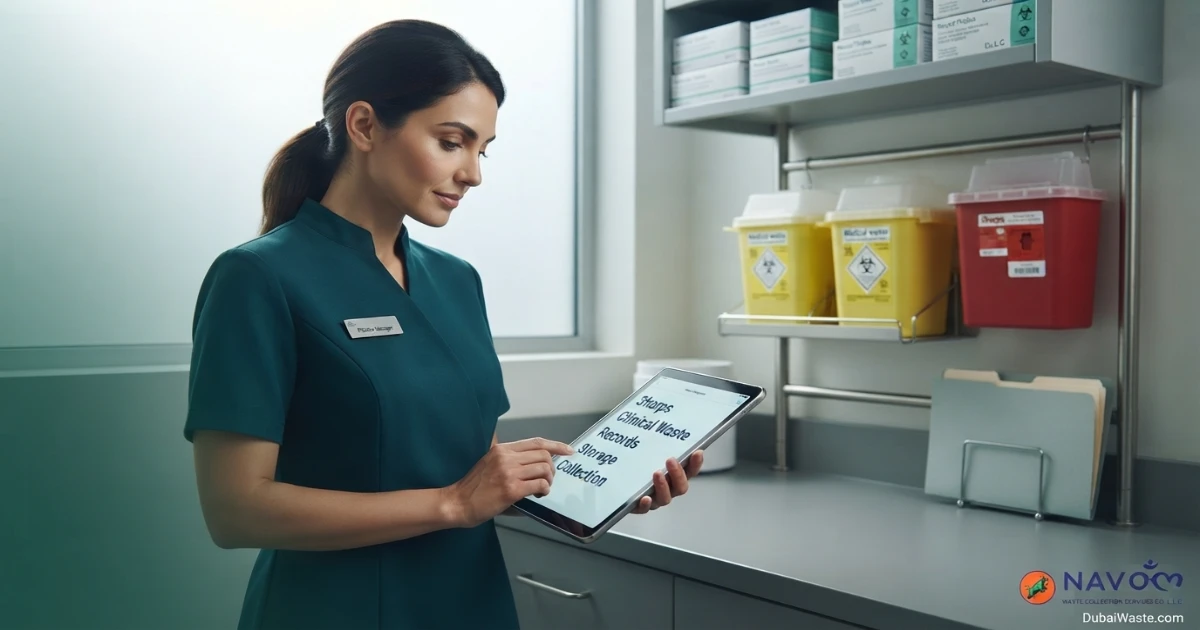
Sharps disposal earns its own section because the smallest item causes the biggest injury. A needle-stick isn’t just a reporting event — it can trigger anxiety, baseline testing, a physician risk assessment, staff absence and real reputational concern. DHA’s dental infection-control guidance calls for written protocols covering immediate action, cleaning, baseline testing, physician assessment and full incident documentation for exactly this reason.
Good sharps control starts before disposal. Avoid unnecessary recapping. Use safety-engineered devices where they exist. Never pass sharps hand-to-hand between team members. Dispose immediately after use, not at the end of the procedure. Keep the container close to the treatment area — not behind a cabinet, not in a storage room down the hall — and swap it out at three-quarters full, every time, without exception.
The best sharps system is boring. Staff shouldn’t have to think, search, improvise or ask. In well-run clinics, the container’s location, the replacement trigger, the pickup schedule and the incident-response steps are so unambiguous that a new nurse can follow the whole process correctly after a single practical orientation — no policy re-read required.
Situation-Based Adjustments: What Changes by Dental Clinic Type?
Collection frequency and container layout aren’t one-size-fits-all. The right setup depends on volume, procedure mix, staff count and building access.
Small general dental clinic
A one- or two-chair clinic needs simple but strict segregation: sharps at chairside, yellow clinical waste bins in treatment rooms, controlled medicine tracking, and clean recycling confined to admin areas. The risk here isn’t complexity — it’s complacency. Low volume tempts staff to delay container swaps or store waste casually.
High-volume multi-specialty clinic
A busy practice running implants, oral surgery, orthodontics and endodontics should review collection frequency, keep backup sharps containers on hand, and tighten sterilization-room workflow. More chairs mean more handovers, and handovers are where segregation breaks down.
Clinic inside a tower, mall or medical centre
Building logistics matter here. Service lifts, loading bay access, collection time windows and landlord rules all affect how medical waste physically moves from the clinic to the pickup point. It should never travel through public corridors or sit visibly in shared areas — confirm the exact route with building management and your licensed contractor before you need it in an emergency.
Clinic offering surgical or implant procedures
Expect higher clinical waste sensitivity. Review surgical pack disposal, blood-contaminated material handling, biopsy specimen protocols and PPE disposal. DHA’s dental guidance specifies that biopsy specimens travel in leak-proof, sealed containers marked with the biohazard symbol, with the outside cleaned and disinfected if it becomes contaminated.
Clinic replacing old radiology or sterilization equipment
Don’t lump old equipment, chemical residue or electronic components in with ordinary waste. Check whether an item belongs in e-waste, chemical waste or a specialist collection stream. Upgrading to digital radiography is also a natural moment to retire leftover fixer and developer stock properly rather than letting it sit in a cupboard.
What Dubai Dental Clinics Usually Get Wrong
The first mistake is placing bins for aesthetics instead of workflow. A stylish treatment room with hidden bins looks premium right up until the sharps box is awkward to reach and staff start improvising. Clinical design has to serve safe work first.
The second mistake is letting clean recyclables touch clinical waste. Dubai clinics increasingly want better recycling outcomes, but recycling only works when materials stay clean. Clean cardboard from supplies can go into the recycling stream; the same cardboard used under contaminated instruments cannot. Clinics chasing lower disposal costs and better landfill diversion need clean-stream discipline enforced at chairside, not hoped for at the bin.
The third mistake is assuming the waste contractor handles everything after pickup. The provider matters, but the clinic remains responsible for what it generates, how it separates waste, how it stores containers, and whether its register matches reality. A collection receipt doesn’t fix poor segregation at the source — and it’s the source that gets inspected.
The fourth mistake is under-training cleaners. Dental nurses and dentists usually understand clinical risk instinctively; housekeeping staff, who move bags, wipe rooms, replace liners and handle storage areas, often don’t get the same depth of training. They need practical waste instruction too, in plain language, not just a laminated poster.
What Dental Medical Waste Disposal Typically Costs in Dubai
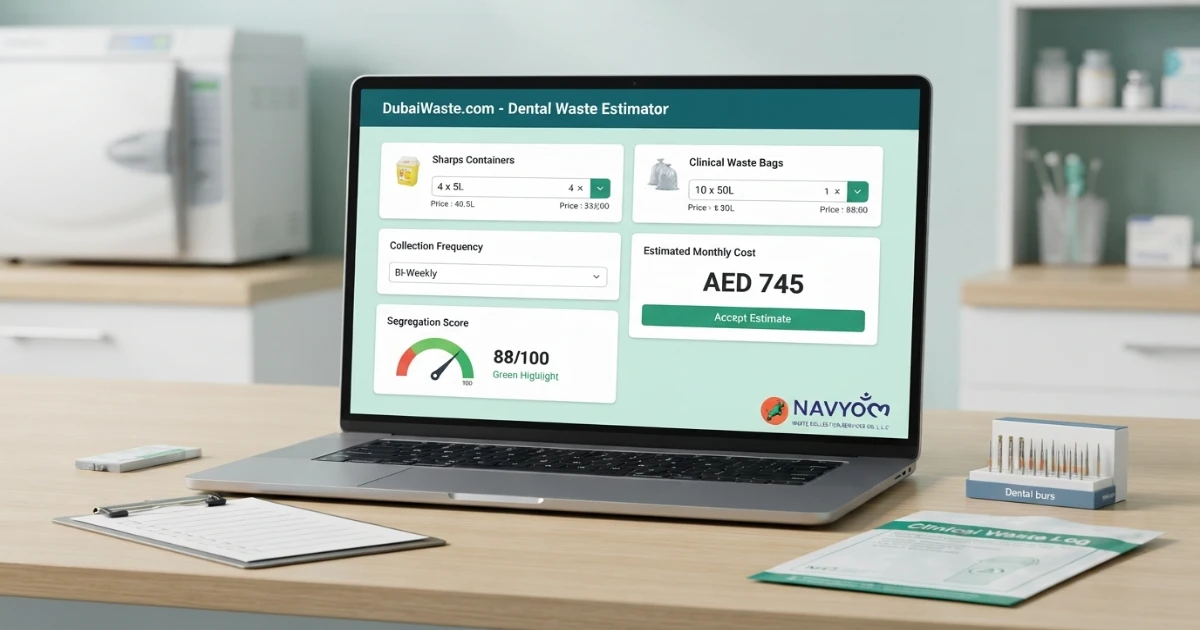
Cost varies with volume, collection frequency, container size and whether the clinic sits in mainland Dubai or a free zone with its own environmental authority, so any number quoted without seeing your actual waste profile should be treated as a rough guide only. In practice, cost is driven far more by contamination than by the underlying medical waste rate — clinics that keep clean recyclables genuinely clean and avoid over-filling sharps containers routinely pay less per month than clinics generating the same clinical volume with sloppier segregation, because contaminated “general” waste often gets rebilled at the medical waste rate. Before changing collection frequency or switching providers, run the numbers through a proper cost model rather than guessing — see the tool link below.
Common Pitfalls & When to Ignore This Advice
Most of this guidance applies broadly, but there are situations where a general article shouldn’t be your only reference.
- Ignore generic container advice if your DHA licence, building, contractor agreement or a specific inspection finding requires a different container or collection procedure.
- Don’t estimate pharmaceutical disposal casually if your clinic handles controlled or semi-controlled medicines — route those through DHA’s Drug Control Section, not general medical waste.
- Don’t use normal waste routes for chemical, amalgam or contaminated sharps waste just because the quantity looks small.
- Don’t promise “zero medical waste” as a sustainability target — the realistic goal is correct segregation, safer handling and maximum landfill diversion for the genuinely clean streams.
- Don’t copy another clinic’s waste plan wholesale if your procedure mix, building logistics, jurisdiction (mainland vs. free zone) or collection frequency differs.
How to Use DubaiWaste.com Tools for Dental Waste Planning
A dental waste plan gets easier once you measure it. Start with the Waste Management Cost Estimator to see how volume, collection frequency and stream separation affect your monthly cost. Then compare your clinical and clean streams with the mixed waste vs segregated waste guide.
If your team is unsure what counts as medical, hazardous, recyclable or general waste, the waste types in Dubai guide breaks it down further. For a broader starting point on regulated healthcare waste routes, see medical waste management in Dubai.
Put This Into Practice
If your dental clinic handles sharps, amalgam, expired medicines, chemical residue or runs multiple treatment rooms, walk your waste setup before the next collection cycle. Thirty minutes is usually enough to reveal whether staff are using the right bins, whether your register matches actual waste, and whether clean recyclables are quietly being lost into clinical waste.
Try the Waste Management Cost EstimatorReal-World Example: A Four-Chair Dental Clinic in Dubai
Consider a four-chair clinic offering general dentistry, whitening, endodontics and implants, with a busy sterilization room, one surgical room and a small storage area near the service corridor. Every treatment room shares one clinical bin, one general bin and one sharps container. The clinic notices a high medical waste bill and frequent staff complaints about full sharps boxes.
An internal audit finds three issues. Clean packaging from implant stock is landing in clinical waste. One chair sits too far from its sharps container, so staff temporarily park burs on trays before disposing of them. Expired materials are sitting in a drawer with no labelled disposal process at all.
The fix isn’t complicated. The clinic adds a sharps container within reach of every chair, sets up a clean-cardboard collection point in storage, starts a simple pharmaceutical waste log, labels the clinical waste storage area, and adds a monthly waste review to the practice manager’s checklist. Collection frequency doesn’t change, but clinical waste contamination drops and staff stop treating the sharps box as a source of daily friction.
FAQs About Dental Clinic Waste Management Dubai
What colour bins should a Dubai dental clinic use?
Yellow, foot-operated bins for medical waste — sharps, blood-contaminated material and biohazard items — placed in every treatment, procedure and examination room. Black bins for general, non-contaminated waste, kept in reception and admin areas away from clinical zones. This is a direct requirement of DHA’s current Standards for Outpatient Facilities, not just good practice.
When should a sharps container be replaced in a dental clinic?
Once it reaches three-quarters full, according to DHA’s outpatient facility standard — not when it’s overflowing or forced shut. Replacing containers at this threshold is one of the simplest changes a clinic can make to cut sharps-injury risk.
Do dental clinics in Dubai need a separate sharps disposal process?
Yes. Dental sharps such as needles, burs, blades and endodontic files must go into puncture-resistant, wall-mounted sharps containers — never bags, never general waste bins. DHA’s dental infection-control guidance classifies sharp objects as medical waste requiring this handling.
Can a dental clinic put medical waste into general waste bins in Dubai?
No. Medical waste must be segregated at source and collected under contract by a company approved through Dubai Municipality’s Public Health Department. Mixing medical and general waste breaches both DHA’s outpatient facility standard and Dubai’s broader medical waste regulations.
What records should a dental clinic keep for medical waste?
At minimum, a register recording the nature and quantity of medical waste generated, plus collection and disposal documentation from the licensed contractor. Inspectors are authorized to request this register at any time, so it needs to be current, not reconstructed after the fact.
Is dental amalgam waste handled the same as normal clinical waste?
No. Amalgam waste — contact and non-contact — needs airtight, labelled containers of its own because of its mercury content, and clinics with meaningful restorative caseloads should also confirm whether an ISO 11143-compliant amalgam separator is fitted to the suction line.
How often should a dental clinic arrange medical waste collection?
It depends on waste volume, procedure mix, storage capacity and contractor terms. A low-volume clinic may manage on a scheduled pickup, while a busy surgical or multi-chair practice often needs more frequent collection. The constant across both is sealed, secure storage with no overflow and no delayed disposal.
Can clean packaging from dental supplies be recycled?
Yes, provided it’s genuinely clean and uncontaminated. Cardboard, paper and some packaging can go into the black general/recyclable stream. The moment packaging touches blood, saliva or contaminated instruments, it moves into the medical waste stream and stops being recyclable.
Who should be trained on dental waste procedures?
Everyone who handles or moves waste: dentists, dental nurses, sterilization staff, cleaners, reception supervisors and practice managers. DHA’s dental guidance specifically calls for initial orientation plus regular refresher training so staff understand the reasoning behind the rules, not just the rules themselves.
Does a small dental clinic need a dedicated medical waste room?
Not always — DHA’s requirement for a ventilated, lockable medical waste room with biohazard signage applies mainly to facilities generating enough volume to need one. Smaller clinics should still replicate the same principle in miniature: a locked, ventilated, clearly signed interim storage area rather than an open shelf or unsecured cupboard.
1. Use yellow, foot-operated bins for medical waste and black bins for general waste, exactly as DHA’s outpatient standard requires. 2. Replace sharps containers at three-quarters full — not when full. 3. Keep amalgam, pharmaceutical, chemical and clinical waste in separate, correctly labelled containers. 4. Hold an active contract with a Dubai Municipality–approved medical waste collector and keep the waste register current. 5. Train every role that touches waste — not just clinical staff — with refreshers, not a one-time briefing.
- Dubai Health Authority — Standards for Outpatient Facilities, Code DHA/HRS/HPSD/ST-45, Issue 1, effective 19 January 2025 (colour-coded bins, foot-operated bins, ¾-full sharps rule, medical waste room, contractor requirement).
- Dubai Health Authority — Clinical Guidelines for Infection Control in Dentistry, Code DHA/HRS/HPSD/CG-10 (sharps handling, biopsy specimen handling, staff training expectations).
- Government of Dubai — Local Order No. 115 of 1997 concerning medical waste (definition and scope of medical waste, generator obligations, registers).
- Dubai Municipality — waste classification framework for the Emirate of Dubai (general, hazardous, medical and liquid waste categories).