E-Waste Bulk Collection for Businesses Dubai — IT Asset Disposal Done Right
Your office just refreshed 60 laptops. The server room has two decommissioned racks sitting behind a fire door. Somewhere in a storage room, there are crates of old monitors, dead UPS units, and a pile of mobile phones no one has touched in three years. This is one of the most common waste accumulation problems in Dubai’s corporate landscape — and it’s also one of the most mishandled.
E-waste bulk collection for businesses in Dubai is not simply a matter of calling a van and loading up equipment. There are regulatory expectations, data security considerations, documentation requirements, and material-specific handling protocols that differ significantly from ordinary commercial waste. Getting this wrong doesn’t just create a compliance headache — it can expose your business to reputational risk, data breaches, and rejection by waste facilities that require pre-sorted, documented loads.
This guide covers everything a facility manager, IT procurement lead, or sustainability officer needs to know about arranging IT asset disposal in Dubai — from identifying what qualifies as e-waste to choosing the right collection model, protecting your data, and ensuring your disposal route is both compliant and traceable.
Businesses in Dubai disposing of electronic equipment in bulk must use a licensed e-waste collector approved under Dubai Municipality or UAE environmental authority frameworks. Loads should be documented with a waste transfer record, data-bearing devices must be securely wiped or destroyed before handover, and all equipment must be segregated from general waste streams. Mixing e-waste into standard commercial bins is not compliant and creates downstream recycling contamination.
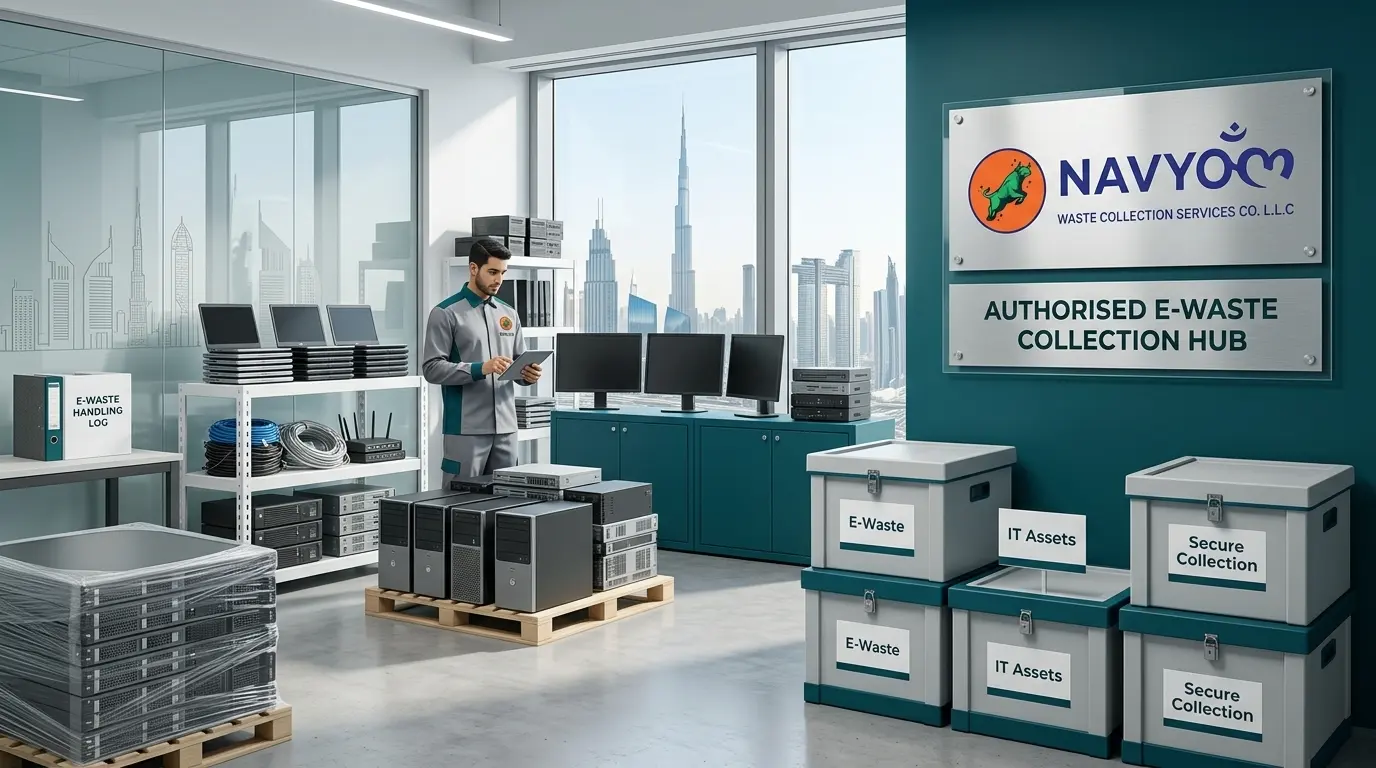
What Counts as E-Waste for Businesses in Dubai
The category is broader than most businesses assume. E-waste — formally called Waste Electrical and Electronic Equipment (WEEE) — covers any device or equipment with a plug, battery, or circuit board that has reached end-of-life. In a typical Dubai commercial setting, that includes:
- Desktop computers, laptops, and tablets
- Monitors, screens, and display panels (including LED and LCD)
- Servers, networking hardware, routers, and switches
- Printers, scanners, and multifunction devices
- Mobile phones, smart devices, and accessories
- UPS units, power supplies, and battery backup systems
- Air conditioning control units and building management terminals
- POS systems and hospitality tech hardware
- Lab equipment with electronic components
- Cables, chargers, and peripheral devices
Batteries — particularly lithium-ion — require separate handling and are often a hidden compliance risk. Many businesses lump battery-embedded devices into general e-waste collections without confirming the collector handles lithium safely. If that collection route ends at an unsecured landfill, both the business and the collector face exposure.
One of the most overlooked e-waste categories in Dubai corporate environments is the “drawer graveyard” — old phones, chargers, earbuds, and accessories that accumulate across workstations and meeting rooms. For a company of 100+ employees, this typically represents 50–80 kg of mixed WEEE that rarely makes it into formal disposal channels. Running an annual internal collection sweep before scheduling a bulk pickup improves load value, reduces scatter waste, and strengthens your ESG reporting data.
Why E-Waste Bulk Collection for Businesses Dubai Requires a Different Approach
Commercial e-waste volumes, material complexity, and documentation requirements are categorically different from residential e-waste drop-offs. A household disposing of a broken laptop can use a nearby e-recycling point. A business retiring 200 laptops from a lease refresh cannot — and should not — use the same route.
Several factors make business-scale IT asset disposal genuinely distinct in the Dubai context.
Data Security Is Non-Negotiable
Any device that touched corporate data — laptops, phones, servers, hard drives, even photocopiers with internal storage — must have that data rendered unrecoverable before it leaves your premises. This is not just good practice; it’s a legal exposure if devices containing customer, financial, or confidential business data end up accessible through resale channels.
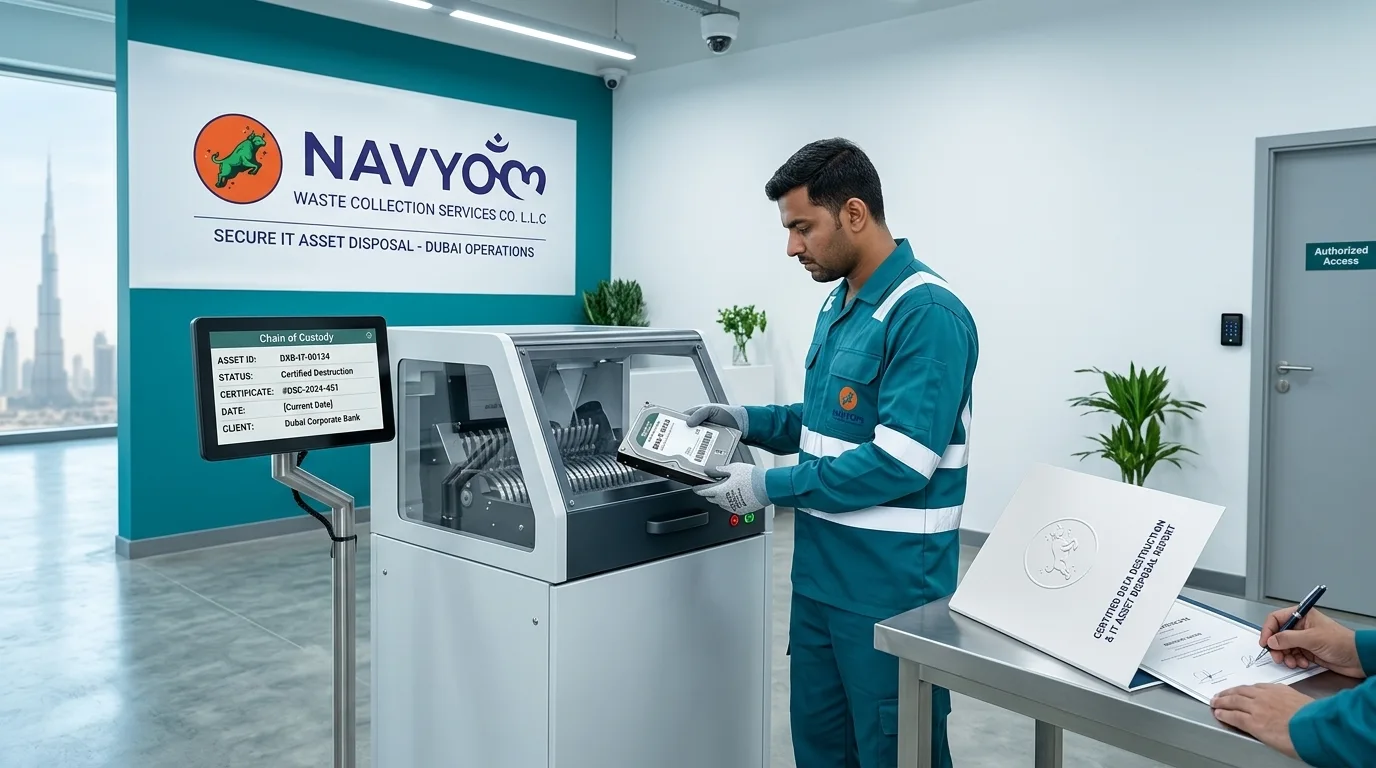
The two standard approaches are DoD-standard data wiping (software-based, produces a certificate of destruction) and physical destruction of storage media. For servers and high-sensitivity environments, physical shredding of hard drives is the safest option. A reputable IT Asset Disposition (ITAD) provider will handle this and issue a destruction certificate as part of the service — which you should retain for audit purposes.
Volume Changes the Collection Economics
Small volumes of e-waste — a few laptops, a monitor — can be dropped at Tadweer collection points or similar community recycling infrastructure. But once you’re dealing with a full floor refresh, a datacenter decommission, or an office relocation with hundreds of devices, you need a scheduled bulk collection with pre-agreed logistics, appropriate vehicle capacity, and a documented handover process.
At bulk scale, the economics can shift significantly. Certain categories of e-waste — particularly functional or near-functional laptops, networking equipment, and phones — carry residual value that some ITAD providers will offset against your collection cost. This is worth negotiating upfront.
Mixed Loads Are a Problem
Dropping e-waste into a general commercial waste skip is non-compliant and creates serious downstream contamination. Many recycling processors in the UAE refuse to accept mixed loads where e-waste has been bundled with food, liquids, construction debris, or general office waste. The load gets rejected, your business is left with the same problem, and the cost typically rises. Segregating e-waste at source — even just boxing it separately — is the minimum operational step before any collection.
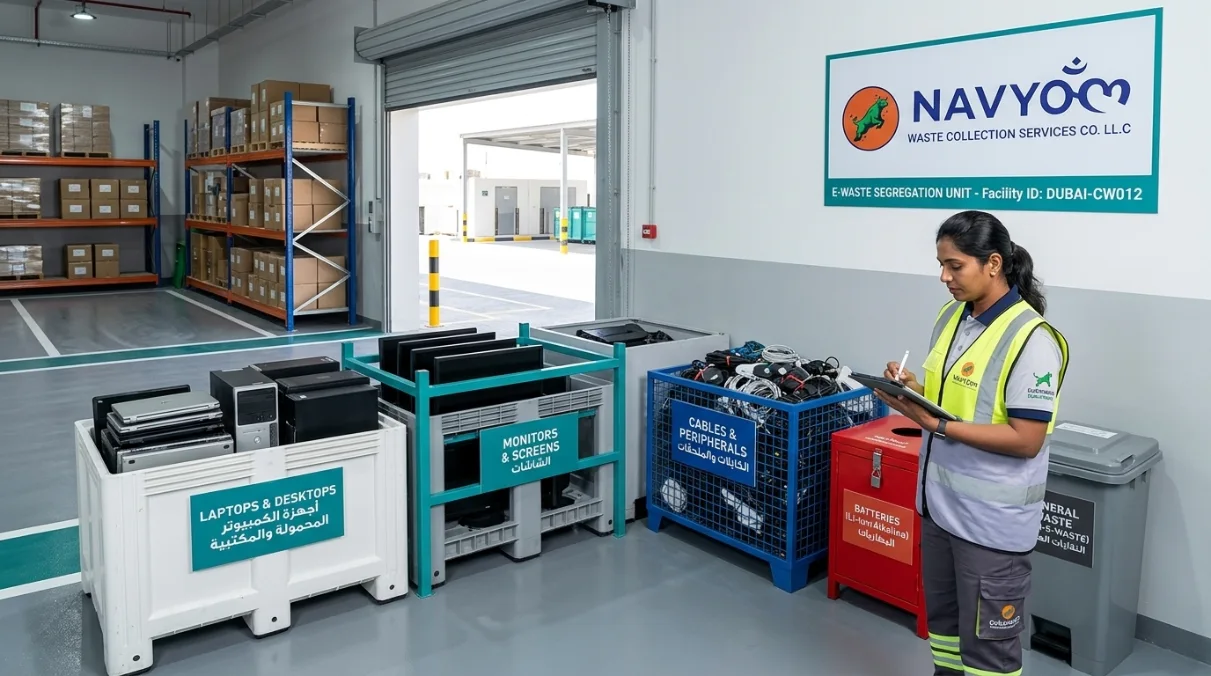
How to Arrange Compliant IT Asset Disposal in Dubai: A Step-by-Step Process
- Conduct an internal IT asset audit
Before contacting any collector, know exactly what you have. Categorise devices by type (laptops, servers, phones, peripherals), estimated age, functional status, and data sensitivity. This shapes both the collection logistics and your ability to negotiate residual asset value. A spreadsheet-level asset register is usually sufficient for smaller refreshes; larger datacenter decommissions may warrant a dedicated ITAD audit tool.
- Assess data sensitivity and choose a destruction method
Identify every device or storage medium that held corporate, customer, or regulated data. Decide whether you’ll use certified wiping (appropriate for most functional devices) or physical destruction (recommended for failed drives, high-security environments, or healthcare/financial sector requirements). Confirm your chosen ITAD provider can supply a chain-of-custody certificate and destruction report for each device.
- Select a licensed e-waste collector or ITAD provider
In Dubai, e-waste collectors and processors must operate under relevant Dubai Municipality environmental approvals or applicable UAE federal licensing. Ask any prospective provider for their licence documentation and their downstream processing route — responsible collectors should be able to tell you where your equipment goes after collection. Avoid any provider who can’t answer this question clearly.
- Segregate and stage your e-waste
Before collection day, physically separate e-waste from all other waste streams. Box or pallet equipment appropriately. For server decommissions, ensure rack-mounted equipment is safely removed and staged in a secure area. Label boxes clearly by equipment type. This reduces collection time, avoids load contamination, and simplifies the documentation process.
- Obtain and retain your waste transfer documentation
At handover, obtain a signed collection receipt or waste transfer document from your provider. This should reference the quantity and type of equipment collected, the date, the collector’s licence details, and the intended processing destination. File this against your environmental management records. For businesses reporting under ESG or sustainability frameworks, this data feeds directly into Scope 3 waste metrics.
- Review your diversion data and recycling rate
After collection, ask your provider for a recycling rate report if they offer one — this shows what percentage of your e-waste was recovered as recyclable material versus sent to residual processing. Use this data in your sustainability reports and to benchmark future disposals. The DubaiWaste.com Recycling Savings Calculator can help you translate diversion data into estimated cost and environmental savings.
Get a Cost Estimate Before You Commit
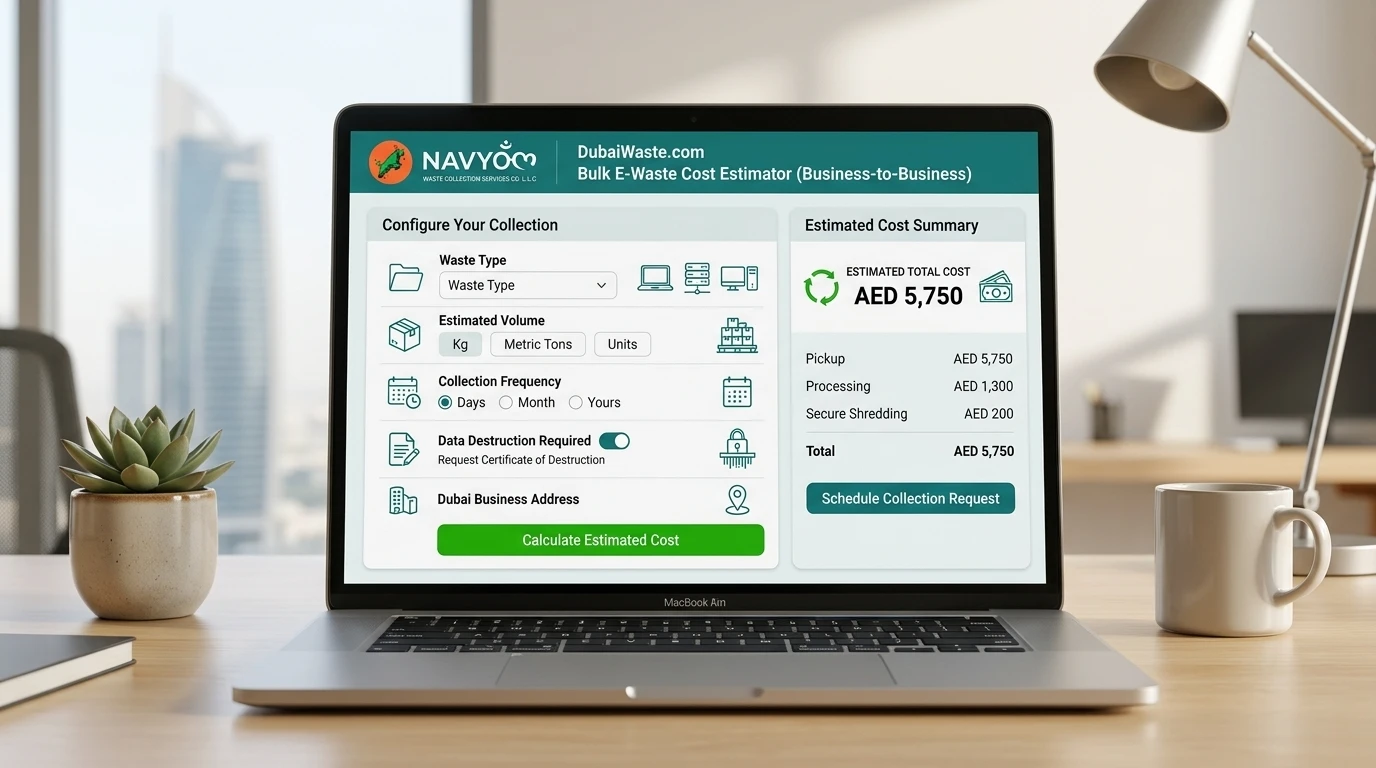
Collection pricing for bulk e-waste varies by volume, device type, collection complexity, and whether you need data destruction services bundled in. Run your numbers through the estimator first — it takes 2 minutes and gives you a realistic baseline before you speak to any provider.
Try the Waste Cost Estimator Calculate Recycling SavingsComparing Your E-Waste Disposal Options in Dubai
Not every business has the same volume, urgency, budget, or data-security requirement. The table below maps the most common disposal routes against the scenarios where each makes sense.
| Disposal Route | Best For | Data Security | Documentation | Cost Indicator |
|---|---|---|---|---|
| Licensed ITAD Provider (full service) | Medium-large refreshes, datacenters, regulated industries | ✅ Certified wipe or shred + destruction cert | ✅ Full chain-of-custody report | Moderate–High; asset recovery may offset |
| Licensed E-Waste Collector (drop & collect) | Smaller volumes, non-sensitive hardware, peripherals | ⚠️ Data prep is your responsibility before handover | ✅ Basic collection receipt | Low–Moderate |
| Manufacturer Take-Back Program | Single-brand refreshes (e.g., HP, Dell, Apple) | ✅ Vendor managed (varies by program) | ✅ Vendor certificate | Often free or discounted |
| Retailer / Resale Channel (functional devices) | Working devices with significant residual value | ⚠️ Wipe required; resale chain must be verified | ❌ Minimal documentation | Revenue generating |
| Community E-Recycling Drop Points | Residential use / micro-scale office disposals | ❌ Self-managed; no verification | ❌ No documentation | Free |
| General Commercial Waste (skip / bin) | ❌ Not appropriate for e-waste under any circumstances | ❌ No data security | ❌ No compliance trail | Non-compliant — avoid |
For most mid-to-large businesses in Dubai, the full-service ITAD route offers the cleanest combination of compliance, data protection, and documentation — and the ability to recover value from functional assets can make the cost considerably more manageable than it initially appears.
Situation-Based Guidance: How Your Context Shapes the Right Approach
The right e-waste disposal model for a 10-person fintech startup is not the same as for a 500-person logistics company completing a full fleet refresh. Here’s how context changes the calculation.
Small Businesses and Startups (Under 50 Devices)
At this scale, a full ITAD engagement may be overkill, but that doesn’t mean the community drop-point route is appropriate either — especially if any devices held business or customer data. The pragmatic middle ground is a licensed e-waste collector that handles small commercial pickups, combined with a self-managed data wipe using certified software (Blancco, DBAN, and similar tools are widely available). Retain a copy of the wipe log and your collection receipt. That’s a defensible paper trail for a business of this size.
Mid-Size Companies Running Annual or Biennial Refreshes
This is the most common scenario in Dubai’s commercial market — a technology refresh cycle that generates 50 to 500 devices at a time. At this volume, the economics of a full-service ITAD provider genuinely start to work in your favour. Functional laptops and phones from a major-brand refresh typically have enough residual value to offset a meaningful portion of the collection and destruction fee. Negotiate this upfront, ask for a value report post-collection, and use the output in your sustainability reporting.
Datacenter Decommissions and Server Room Clearances
This is the most complex scenario, and rushing it creates the most risk. Server hardware, storage arrays, network equipment, and UPS units represent a combination of high data sensitivity, significant weight, and sometimes hazardous battery content. A professional datacenter decommission should involve a pre-collection site survey, secure data destruction with per-device certification, heavy lifting logistics for rackmount equipment, and a post-project recycling report. Budget accordingly — this is not a one-van job.
Hospitality, Retail, and Mixed-Use Operators
Hotels, retail chains, and large hospitality operators often deal with a mix of consumer-grade end-of-life devices (TVs, tablets, POS units, in-room tech) and back-of-house IT infrastructure. The challenge here is volume fragmentation — e-waste spread across multiple locations, mixed with other waste types, and managed by facilities teams who may not be familiar with e-waste segregation requirements. A scheduled quarterly or biannual collection across all sites, coordinated through a single licensed provider, is usually more efficient than location-by-location ad hoc disposals.
Industrial and Manufacturing Environments
Factories and industrial operators in zones like Al Quoz, Jebel Ali, and Dubai Industrial Park (DIP) often generate specialist e-waste beyond standard IT equipment — industrial control systems, PLCs, manufacturing terminals, and machine-embedded electronics. These require a provider with specific WEEE processing capability for industrial electronics, not just consumer IT. Confirm this before scheduling — not every e-waste collector is equipped for non-standard industrial kit.
The UAE’s Federal Law No. 12 of 2018 on Integrated Solid Waste Management establishes requirements for the management of special and hazardous waste, under which e-waste typically falls. Dubai Municipality operationalises these requirements locally, and licensed waste management companies operating in Dubai must hold valid approvals to handle, transport, and process electronic waste.
Businesses generating e-waste are expected to use licensed routes and retain records of disposal. While enforcement intensity varies and the regulatory landscape continues to evolve, the practical risk of non-compliance includes contractor liability, facility audits, and the reputational cost of a reportable data incident tied to improperly discarded devices.
What Businesses in Dubai Usually Get Wrong
E-waste disposal failures in Dubai’s corporate environment tend to follow predictable patterns. These are the ones that come up most often.
Treating Data Destruction as Optional
The assumption that wiping a device with a factory reset is sufficient is dangerously outdated. Factory resets on both laptops and mobile devices leave data recoverable with standard forensic tools. For any business device that handled corporate systems, client data, financial records, or regulated information, only a certified multi-pass overwrite or physical media destruction is adequate. The certificate matters as much as the act itself — without documentation, you can’t demonstrate compliance.
Using Unlicensed Collectors to Save Cost
Dubai has an active grey market for electronic scrap. Unlicensed operators — including some who operate through informal WhatsApp networks or walk-in collections — will often offer to collect e-waste for free or even pay a small amount for usable equipment. The risks are significant: no documentation trail, no data security guarantee, no environmental compliance, and a chain of custody that could directly link your business to improperly disposed material. The cost saving is not worth the exposure.
Stockpiling Until Volumes Justify a Collection
Waiting until e-waste accumulates enough to “make a collection worthwhile” is a reasonable instinct but creates operational problems. Stored e-waste takes up valuable space, poses a fire risk (lithium batteries in particular), and can include equipment that degrades in value rapidly if left too long. Many ITAD providers will accommodate smaller but more frequent collections for a marginal fee premium — often worth paying to avoid the storage and degradation risk.
Overlooking ESG Reporting Value
For businesses with ESG commitments or sustainability reporting obligations, bulk e-waste disposal events are a reportable activity that contributes to Scope 3 emissions accounting and waste diversion KPIs. Many businesses go through the effort of arranging compliant ITAD and then fail to collect the documentation needed to report it. Ask your provider upfront for a post-collection sustainability summary — recycling weight, material recovery rate, diversion from landfill. This data has direct value in your annual ESG disclosures.
Assuming All E-Waste Is Equally Recyclable
It isn’t. Well-functioning laptops and smartphones from major brands have high recovery rates and strong secondary markets. Old CRT monitors, mixed-media printers, and legacy industrial electronics may have limited recyclability and can incur processing fees rather than recovery credits. Know your mix before you negotiate — it prevents unpleasant surprises at invoicing time.
Understanding IT Asset Value Recovery in Dubai
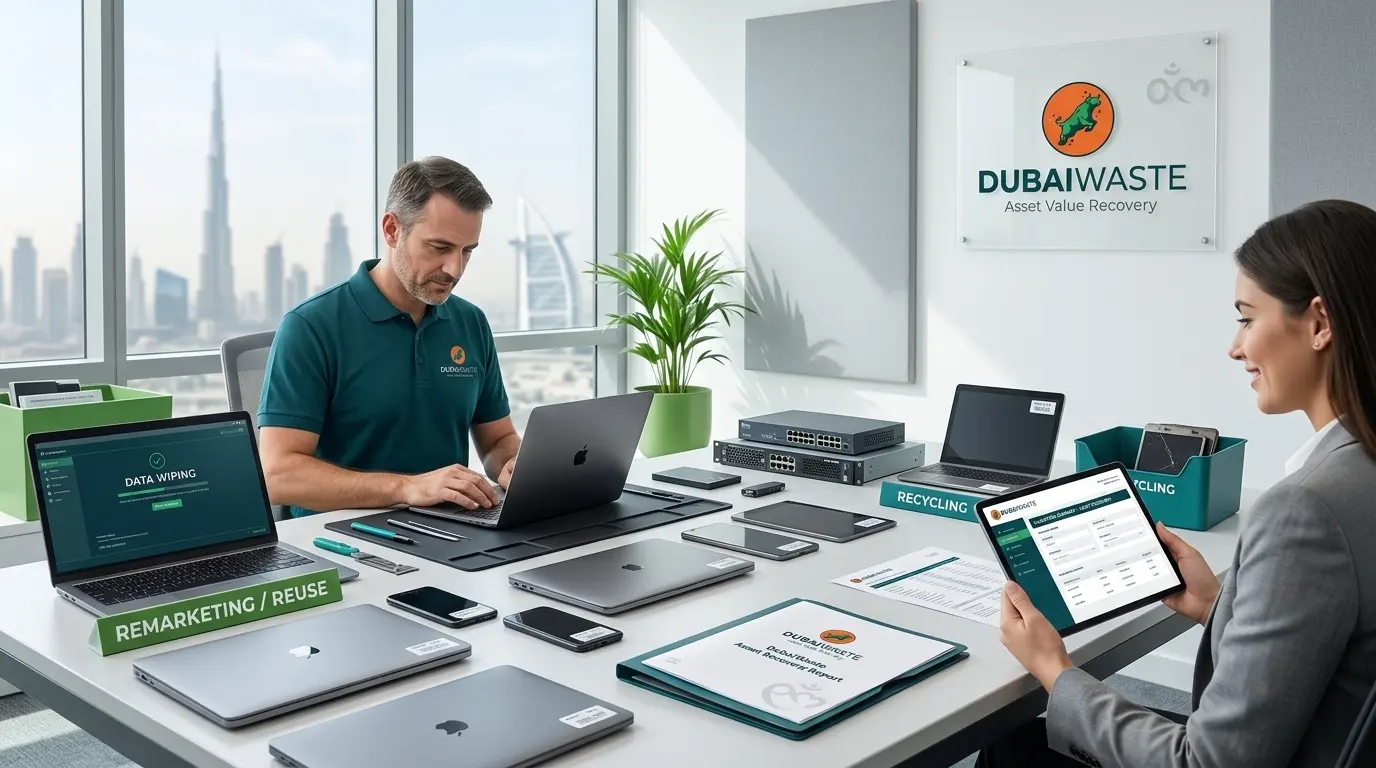
One aspect of ITAD that many Dubai businesses don’t fully explore is the potential for recovering residual value from decommissioned equipment. This doesn’t apply to every refresh cycle, but for organisations disposing of relatively recent hardware, it can meaningfully offset disposal costs.
The assets most likely to carry realisable resale or parts value are laptops manufactured within the last four years, smartphones and tablets from major brands, networking equipment from Cisco, HP, and similar, functional servers and storage arrays, and UPS units with remaining battery capacity. Equipment older than five to six years, heavily worn devices, and highly specialised hardware typically have minimal secondary market value and may incur processing fees.
When engaging an ITAD provider, ask specifically about their residual value assessment process. A reputable provider will audit the equipment before quoting and provide a clear breakdown of what they can recover versus what incurs a processing charge. The net cost — after asset recovery credits — is often significantly lower than the gross collection fee suggests.
What to Look for in a Dubai E-Waste Collection Provider
Choosing the right collection partner matters more than most businesses realise. Here’s a practical checklist of what to verify before signing any agreement.
- Licensing: Confirm the provider holds a current Dubai Municipality environmental approval or equivalent UAE regulatory licence for e-waste handling and transport. Ask to see it.
- Data destruction methodology: Do they offer certified data wiping, physical destruction, or both? Can they supply per-device destruction certificates?
- Downstream processing route: Where does your equipment actually go? Reputable providers should be able to name their processing partner and confirm they use compliant e-waste recycling facilities.
- Insurance and liability: Is the provider insured for data-related incidents during transit? What happens if a device is lost or improperly handled?
- Reporting capability: Can they produce a post-collection summary covering weight collected, recycling rate, materials recovered, and diversion from landfill? For ESG reporting, this documentation is essential.
- Asset recovery transparency: If they offer residual value credits, how is the valuation calculated and reported? Are you getting a fair market assessment or a discounted bulk offer?
Not Sure What Your E-Waste Disposal Should Cost?
Before requesting quotes, estimate your baseline with the DubaiWaste.com cost estimator. It factors in waste type, volume, collection frequency, and site type — giving you a realistic benchmark before any provider conversation.
Estimate Your Collection CostA Real-World Example: Office Relocation E-Waste Clearance in Dubai
Consider a mid-size professional services firm with 180 staff relocating from Business Bay to DIFC. The IT team has identified 175 laptops due for replacement (average age: 4.5 years), 30 monitors (mixed ages), two server cabinets with eight servers total, assorted phones and tablets across departments, and a storage room with legacy hardware accumulated over seven years.
They engage a licensed ITAD provider six weeks before the move date. The provider conducts a pre-collection survey to assess residual value — 80 of the 175 laptops are identified as recoverable for secondary market resale, while the servers are flagged for data destruction with physical media shredding. The remaining laptops, monitors, and peripherals go to the licensed e-waste recycling stream.
At collection, the ITAD provider issues a device-level collection register, destruction certificates for all storage media, and a chain-of-custody report. The residual value recovered from the 80 saleable laptops offsets approximately 40% of the total collection and destruction fee. Three months later, the firm’s ESG lead uses the recycling weight report — 2.3 tonnes of WEEE diverted from landfill — in their annual sustainability disclosure.
That’s what a well-run ITAD engagement looks like. The key factors: early planning, a pre-collection audit, clear data destruction requirements communicated upfront, and a provider capable of producing the documentation the business needs downstream.
Note on Batteries: Lithium-ion batteries in laptops, phones, and UPS systems require specific handling and cannot be processed through standard e-waste recycling streams. Always confirm your chosen collector has a compliant battery processing route — this is particularly important for large server UPS units, which can contain significant battery weight.
Common Pitfalls — and When to Ignore This Advice
Most of this guide assumes a medium-to-large business with genuine compliance responsibilities and data security considerations. A few scenarios where the standard advice doesn’t apply cleanly:
- If your devices genuinely held no business data — dedicated display units, kiosks, or equipment that was never connected to corporate systems — a full ITAD engagement with certified destruction may be disproportionate. A licensed basic collection with a standard receipt may suffice.
- If your organisation has a manufacturer take-back arrangement already in place — some enterprise procurement agreements include end-of-life take-back services from the OEM. Check this before engaging a third-party provider; you may already have a compliant route at zero additional cost.
- If you’re a very small business disposing of one or two non-sensitive devices — use a licensed drop point. Don’t over-engineer the process. The complexity scales with volume and data sensitivity, not with the act of disposal itself.
⚡ Your Fast-Track Cheat Sheet: Top 3 Actions
- Audit before you book. Catalogue your devices by type, age, functional status, and data sensitivity before contacting any collector. This shapes your entire ITAD approach, determines which devices may have residual value, and helps you ask the right questions when comparing providers.
- Demand documentation at every step. A collection receipt is the minimum; a full chain-of-custody report with destruction certificates and a recycling weight summary is the standard you should expect from any credible ITAD provider in Dubai. No documentation means no compliance trail — and no ESG reporting material.
- Don’t skip the data destruction conversation. Every device that touched corporate systems needs a certified wipe or physical destruction before it leaves your premises. Confirm your provider’s methodology, confirm they issue per-device certificates, and file those certificates — they’re your evidence of compliance if a data-related question ever arises.
Frequently Asked Questions — E-Waste Bulk Collection for Businesses Dubai
Do Dubai businesses need a licensed collector for e-waste disposal?
Yes. Commercial e-waste disposal in Dubai must go through a licensed operator — an unlicensed collector creates both compliance exposure and a data security risk. Licensed providers should hold current Dubai Municipality environmental approvals for e-waste handling and transport. Always ask to see their documentation before engaging.
Can I put old laptops or monitors in a general commercial waste bin or skip?
No. Mixing e-waste with general commercial waste is non-compliant and creates serious downstream contamination. Many waste processing facilities reject mixed loads where electronics have been combined with general rubbish. E-waste must be segregated and collected through a dedicated, licensed e-waste route.
What data destruction standard should I require for decommissioned devices?
For most corporate environments, a DoD 5220.22-M or equivalent multi-pass overwrite meets standard requirements and produces a verifiable certificate. For higher-risk environments — healthcare, financial services, government — physical destruction of storage media is the more defensible option. In either case, obtain a per-device destruction certificate from your provider.
How much does bulk e-waste collection cost for businesses in Dubai?
It depends on volume, device type, data destruction requirements, and whether the provider identifies residual value in your hardware. Basic collections for small volumes may incur minimal fees; full ITAD engagements for larger refreshes can range from a few hundred to several thousand dirhams before asset recovery credits. Use the DubaiWaste.com cost estimator for a realistic baseline.
Can businesses recover money from old IT equipment in Dubai?
Yes, in many cases. Functional devices from major brands — particularly laptops, phones, and networking equipment under five years old — often carry secondary market value. A good ITAD provider will assess your equipment pre-collection and offer residual value credits that offset disposal costs. This doesn’t apply to all equipment, but it’s worth asking about before signing any agreement.
Is e-waste disposal in Dubai relevant to ESG or sustainability reporting?
Absolutely. Bulk e-waste disposal events generate reportable data for Scope 3 waste accounting and support landfill diversion KPIs in sustainability disclosures. Request a post-collection recycling report from your ITAD provider — weight collected, recycling rate, materials recovered — and retain this for your annual ESG reporting cycle.
What happens to e-waste after it’s collected in Dubai?
Licensed e-waste processors disassemble devices to recover valuable materials including copper, aluminium, steel, and precious metals. Functional devices may be refurbished and resold. Hazardous components — including batteries, capacitors, and certain circuit board materials — are processed separately to prevent environmental contamination. A reputable collector should be able to tell you exactly where your equipment is processed.
How long in advance should I plan a bulk e-waste collection in Dubai?
For routine refreshes of under 100 devices, two to three weeks is usually sufficient. For datacenter decommissions or office relocations involving hundreds of assets, plan at least four to six weeks ahead — this allows time for a pre-collection audit, data destruction planning, logistics coordination, and paperwork. Rushed decommissions are where most compliance and documentation gaps occur.