Aluminum can recycling centers gather, sort, and recycle used cans to melt and manufacture new ones at low energy. A lot of centers pay by the kilo, with rates that fluctuate by market price.
Clean, crushed cans boost payout and cut handling time. They all have drop-off hours, ID requirements, and accepted forms of payment posted online.
To help you plan a pit stop, the next sections map nearby alternatives, fees, and pointers.
Key Takeaways
- Find aluminum can recycling centers and bottle return locations, compare hours and materials accepted, and check out facility reviews. List nearby highly rated sites so you can recycle more often.
- Consult local government for curbside pick-up schedules, drop-off points and deposit return legislation. Participate in events in your community and adhere to local recycling rules to maintain low contamination levels and high involvement.
- Return cans to retail partners in deposit states for refunds. Check store limits and accepted items before visiting to save time and ensure a smooth return.
- Watch the market rates and weigh pure, sorted cans for the highest payouts. Take off non-aluminum components and maintain cans dry to prevent allowances and meet the criteria for higher prices.
- Experience the recycling loop from sorting to remaking to learn how cans become new products. Support the circular economy by selecting centers with these specs: efficient processes and acceptance of clean aluminum.
- Recycle aluminum and save 95% of the energy compared to virgin production. Get involved to make your local economy more robust and the world a better place to recycle!
Locating Aluminum Can Recycling Centers
Finding the right drop-off spot is a matter of trusted tools, defined guidelines, and being nearby. Search phrases such as ‘aluminum can recycling near me’ or ‘aluminum recycling centers near my location’ assist in quickly revealing these possibilities.
Compare hours, accepted items and site quality. Some accept only sorted or rinsed cans. Find aluminum can recycling centers using Earth911 and city waste pages, and balance travel distance and accessibility to keep trips as convenient and frequent as possible.
1. Digital Tools
Earth911, Google Maps, and online yard locators can help you identify aluminum can sites and mixed-material centers in your area. Apps like iScrap App and ScrapWorks Recycling provide real-time scrap aluminum prices, verified addresses and driving directions, minimizing the guesswork.
Online listings typically contain user comments and images, so you can steer clear of lines or locked gates. Or if you gather cans in bulk, check live pricing tables to time a bigger drop. If markets slide, opt for convenience and curbside instead.
Make a shortlist of top rated centers from saved map lists: hours, materials accepted, and notes such as ‘rinsed only’ or ‘crushed okay’. For areas with limited availability, track new centers or promotions.
2. Local Government
Many city or county waste sites publish recycling maps, accepted materials and collection days, including curbside programs that accept aluminum cans at the bin. Others list any special drop sites, school drives or municipal depots with fixed hours.
Inquire regarding deposit return schemes, policy regulations and goals that may impact refunds or restrictions. Attend community cleanups to identify regular drop points.
3. Retail Partners
In deposit states, most grocery stores give a per-can refund for returns and may limit daily totals per person. Big box stores frequently have in-store can recycling bins, which is convenient while you’re shopping.
Verify every store’s accepted items and ID or receipt requirements. In no-bottle-bill states, certain stores continue to host take-back events.
4. Community Hubs
Community centers, schools, and nonprofits hold drives that direct cans to trusted recyclers. They put dates on bulletin boards and social streams.
Parks and community gardens can sometimes have volunteer-run stations. Help local ambassadors who educate on correct prep, rinse, remove liquids, and no food waste to ensure loads remain uncontaminated.
5. Scrap Yards
Scrap yards pay by weight, with on-site scales linked to prevailing rates. Inquire about aluminum grades, cleanliness policies, and payment options.
Call ahead; some will only purchase in larger quantities or have restricted hours.
| Facility | Typical Hours | Accepted Materials | Service Quality |
|---|---|---|---|
| Municipal Drop-off | 08:00–17:00 | Cans, paper, glass | Clear rules, steady |
| Retail Return | Store hours | Cans (deposit states) | Fast, limits apply |
| Scrap Yard | 07:00–16:00 | Aluminum grades, mixed scrap | Pricing varies |
| Community Drive | Event-based | Cans only | Seasonal, volunteer-led |
Need Fast & Reliable Waste Collection in Dubai?
Navyom Waste Collection Services offers same-day pickups, eco-friendly disposal, and certified recycling solutions for homes and businesses across Dubai.
Book Your Pickup NowWhat Is Your Aluminum Worth?
Aluminum can prices fluctuate with scrap markets, local demand, and the cleanliness and sorting of your load. To maximize your payout for everyday recyclables, consider price checks, weight precision, and the condition of your recyclables, whether you arrive with a grocery sack or a pallet load.
Market Rates
Keep tabs on scrap prices daily with commodity exchanges, regional recycling bulletins, and big buyer sheets to stay informed about your recycling needs. Prices fluctuate frequently, with trade publications reporting five to ten percent shifts within a month. Seasonal patterns also play a role; warmer months and increased construction tend to drive demand for everyday recyclables, pushing bids up.
Energy costs, trade policies, and global supply shifts create volatility in the market. For instance, aluminum smelter power prices can ripple into melt prices, affecting metal recycling operations. When beverage demand softens or can sheet supply rises, buyers may cut bids, impacting the rates for recyclables.
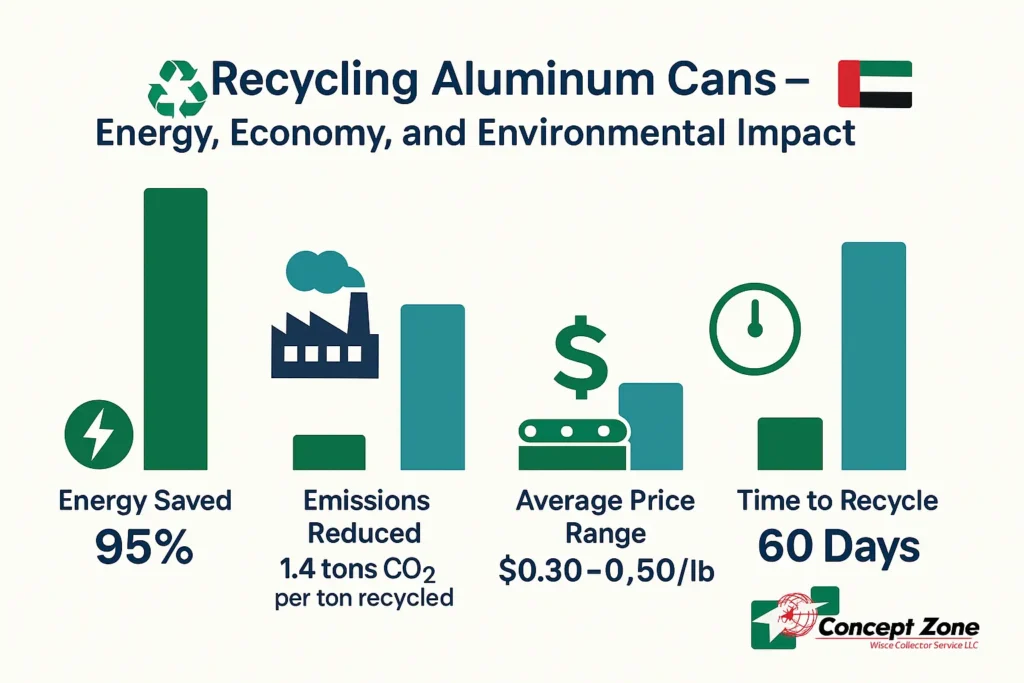
Check local rates regularly. Most yards pay between 0.30 to 0.50 per pound for aluminum cans, but rates can vary based on purity and quantity. Currently, aluminum cans are trading around 0.38 USD per pound at the low end, with some centers reaching as high as 0.40 to 0.45 USD. Other grades, like clean siding, may reach 0.46 to 0.51 USD, while vehicle rims can hit about 1.00 USD per pound due to their consistent alloys.
- Recent average can price: 0.38 USD per pound. Daily moves are typical and you can see same-day quotes.
- Typical yard range is 0.30 to 0.50 USD per pound, driven by purity and volume.
- Related grades: Siding at 0.46 to 0.51 USD per pound if clean. Rims are close to 1.00 USD per pound. Don’t anticipate allowances for paint, screws, or contaminants.
- Anticipate month-to-month fluctuations in active markets of 5 to 10 percent and seasonal spikes during building rushes.
| Period | Avg Can Price (USD/kg) | Notes |
|---|---|---|
| 12 months ago | 0.77 | Low demand period in several regions |
| 6 months ago | 0.86 | Energy prices are soaring and there is a slight recovery |
| 3 months ago | 0.92 | Construction pick-up, tighter supply |
| Now | 0.84 | Approximately 0.38 USD per pound, daily variation probable |
Weight Factors
Weigh cans post sort. Use a home scale, then verify at the yard for accuracy. Request a ticket printed with gross, tare, and net weight.
Big loads can unlock higher levels. A few centers bump rates for loads of 100 kilograms or more, pallets, or semi loads because handling is streamlined. Call ahead to find out thresholds and scheduling.
Small things do indeed go a long way. A clean bale means less loss at the buyer which can boost your rate.
Condition Matters
Separated clean dry sorted cans hold their value. Wet loads are subject to moisture discount.
Separate aluminum from steel, plastic, and glass to protect grade and avoid re-sorting fees. Bring clean, uniform cans to minimize the processing time and assist in achieving a higher price.
- Dry, food-free cans
- No dirt, oil, or residue
- No mixed metals or attachments
- Minimal paint or coatings
- Properly bagged or baled for quick inspection
The Can’s Second Life
Aluminum can recycling centers transform everyday recyclables into new products in a beer-tight, infinitely recyclable cycle. The road goes from curbside pickup to MRFs and then on to shredders, rolling mills, and furnaces, showcasing the capabilities of metal recycling operations.
Sorting
At MRFs, conveyors shuttle commingled recyclables past magnets and eddy current separators, which push non-aluminum away, while quality workers remove contaminants by hand. Clean feed is important because it recycles 100 percent of a can’s content, which preserves bauxite ore and the energy associated with its mining and refining.
Homes and offices contribute upstream through the use of a special bin for aluminum beverage cans. Rinse them so you don’t attract roaches or rodents, and confirm with your local ordinances before crushing them. Some plants can’t detect squished cans on optical sorters.
New plants throw in optical sensors and AI-guided robotics to locate alloys and kick out any rogue plastic or steel. This drives up collection rates and minimizes leakage, which is critical since an empty can is valued at around €0.01 to €0.02 per unit in many markets, or about 1 cent in the U.S.
Shredding
Sorted cans head to industrial shredders that slice them into tiny chips to increase surface area and expedite subsequent steps. The chip, after screening and air flow, has all labels, paints, and fines removed.
A thermal/mechanical cleaning line strips coatings and food residues so the melt phase remains stable and clean. Facilities bag or bale the chips for secure handling and efficient shipment to smelters, reducing shipping expenses and minimizing oxidation in transit.
Melting
Smelters deliver clean chips to smelters. Smelters use furnaces to melt aluminum above 650ºC. Operators skim dross and tweak alloy chemistry for the end grade.
A lot of sites source hydro or renewables to reduce the footprint. Recycling uses around 95% less energy than producing new metal from ore. The melt is poured into solid blocks known as ingots, which cool and stack nicely for the next step.
Remaking
Mills melt and roll ingots into thin coil for new beverage can sheet, or thicker sheet and extrusions for parts in cars, trains, and building systems. Some ingots turn into slabs for construction panels.
Others supply wire and cable lines. Brands are demanding recycled content to hit packaging targets without compromising performance. A can remade today can go back to a store shelf in about 60 days, and it continues this cycle without sacrificing integrity or quality.
Why Your Effort Matters
Tiny, consistent actions at aluminum can recycling depots assist in boosting nationwide recycling levels, reducing landfill demand, and supporting local legislation ambitions that drive greater recovery targets. Every can you return helps the circular economy, keeps valuable materials in circulation, and sends a message to brands that consumers want better collection, fair deposits, and transparent labeling.
Your effort prods peers to participate, particularly when the impact is tangible and local.
Energy Savings
From James, Why Your Effort Matters. Recycling aluminum cans consumes only 5% of the energy required to make primary aluminum, so your every returned can saves up to 95% energy. One can alone can power a TV for as many as three hours. Scale that: 100 cans can power a TV for 300 hours.
This sort of savings adds up rapidly across neighborhoods and cities. Less energy consumption implies reduced greenhouse emissions from power plants and smelters. Once centers run clean, the footprint shrinks even more, helping meet national clean energy goals.
A number of facilities post energy and emissions data, making the impact easy to monitor and communicate. On a grid level, recycled feedstock means more electricity and fuel for homes and industry. It reduces expenses for producers who can divert savings into superior gear, safer workspaces, and increased redemption rates.
That efficiency loop boosts the national recycling percentage and sustains policy goals.
Resource Conservation
Recycled aluminum stands in for bauxite mining and refining, which is energy-intensive and disrupts land and water. Cans in the system mean you’re saving limited ore and cutting tailings and habitat destruction. Aluminum is infinitely recyclable.
Less than 75% of all aluminum ever produced is still in circulation. A can can be back on a shelf in as little as 60 days, which keeps supply chains steady during commodity swings. Less of that being extracted means less landfill pressure too.
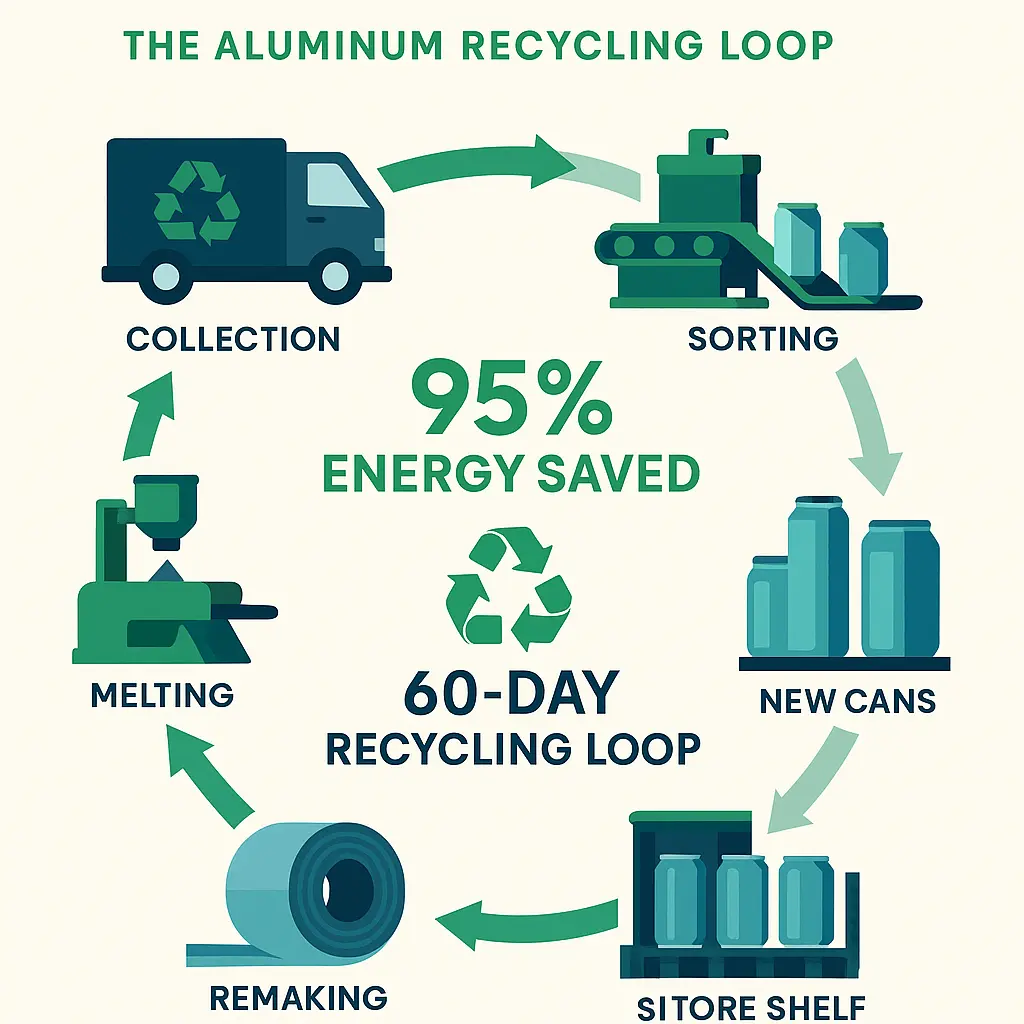
For every ton of cans recycled, it saves 1.4 tons of bauxite, 0.7 tons of refining energy, and 1.4 tons of greenhouse gas emissions.
- Cuts demand for new mines and long-haul transport
- Extends product life through repeat melt cycles
- Keeps materials local and available in tight markets
- Lowers total waste and landfill space needs
Economic Impact
Recycling centers, scrap yards, haulers, sorters, and mills are consistent jobs, and that kind of local spending really pumps up an economy. Regular can returns generate proceeds for community campaigns, local collectors, and city programs.
The quick cycle, typically 60 days from used can to new, keeps cash moving and factories humming. Recycled aluminum feedstock bolsters U.S. Manufacturing and decreases the dependence on imported primary materials.
Most countries, including the US, consider aluminum a critical material. A robust recycling stream fortifies supply security and dampens price shocks. Local governments get tax revenue from thriving recycling businesses and downstream manufacturers.
Markets answer with investment in sorting technology, clean furnaces, and data tools that improve capture rates. The outcome is a robust, next-generation recycling infrastructure that achieves policy goals and societal demands.
Overcoming Recycling Hurdles
Aluminum can recycling centers face pragmatic obstacles that hinder the recycling of everyday recyclables and elevate costs. By addressing contamination, access gaps, and market fluctuations, they enhance metal recycling operations and lower energy consumption.
Contamination
Food and residue can significantly reduce the scrap value of recyclables and waste energy. To effectively recycle materials like aluminum cans, simply rinse them with a swift splash, drain, and discard straws, plastic seals, or foil lids. Be sure to check with the facility guidelines, as most centers will accept all empty, uncrushed, unlabeled cans, while some may prefer them crushed to save space.
It’s crucial not to combine cans with food scraps, plastic wrap, or batteries, as even small leaks can mar a bale and lower furnace yields. Clean streams enable metal recycling operations to function more efficiently, allowing secondary smelters to operate at lower temperatures and conserve fuel. Surprisingly, melting recycled aluminum requires roughly 95 percent less energy than primary metal, and just one saved can can power a television for approximately three hours.
Modern sorting technologies aid in the recycling process but do not resolve the issue of dirty feed. Eddy current separators effectively blast non-ferrous metals such as aluminum out of mixed streams at high velocity, but they work best with clean, non-heavily contaminated cans. Since energy savings in secondary production depend on scrap quality, clean inputs are essential for increasing output and reducing emissions.
To encourage better recycling practices, train households and cafés with simple signage: empty, rinse, no lids, no liquids. This will help ensure that the recycling process is efficient and that valuable resources are not wasted.
Accessibility
Curbside access to recycling services is still very uneven. To improve this, communities can get bigger bins, clear labels, and trustworthy weekly pickup to extend recycling beyond the kitchen. Where curbside is not possible, supplementing with staffed drop-off locations at supermarkets, transit hubs, and schools during evening and weekend hours can help. These locations can also accept everyday recyclables like aluminum cans and bottles.
Rural and underserved communities deserve their own customized recycling solutions. Mobile collection vans on set routes reduce transport costs and allow sorting to be done closer to the source. Some of these vans even recycle materials again since MRF processing is expensive and landfill fees are minimal.
By overcoming recycling hurdles, better collection and pre-sort quality can diminish the burden on MRFs and tip the math toward recycling. Enhanced metal recycling operations can also help in this regard.
Deposit laws increase return rates for recyclables, but most places don’t have them. Just 10 US states operate deposit schemes, achieving around 90% net return compared to approximately 35% in other areas. In regions unwilling to pass deposits, voluntary industry partnerships can pay for bins, logistics, and buy-back bonuses.
This is combined with improved source-segregated collection systems so that aluminum remains uncontaminated and retains its high value. The ability to effectively recycle appliances and other materials is essential for a sustainable future.
Market Shifts
Recycling challenges: Aluminum scrap prices track global demand, energy, and policy. Follow price indices and buyer specifications, and time sales when margins recover without hoarding above safe storage limits.
Expand acceptable items when prices fall. Throw in other non-ferrous metals, steel cans, and PET to even out income. Secure stability in long-term contracts and floor-price clauses with smelters or mills and develop regional partnerships to minimize haul distance.
Watch trade regulations, import duties, and packaging requirements. Rapid policy changes can disrupt export markets overnight and impact margins.
The Future of Aluminum Recycling
Aluminum can recycling centers play a crucial role in managing recyclables, as aluminum is a metal that can be recycled time and again without a hit in quality. Remarkably, nearly 75% of all aluminum ever produced is still in circulation, showcasing the importance of efficient metal recycling operations in our everyday recyclables.
Invest in advanced recycling technologies and efficient equipment to increase recycling rates.
Better capture, cleaner bales begins at the sort line. New eddy-current separators and optical sorters with AI vision and robotic pickers reduce loss and increase purity, which raises sale prices. Closed-loop plants shredding, decoating, and melting in one flow reduce dwell time and energy consumption.
Lightweight, low-NOx furnaces and improved flux systems make it possible to use mixed and painted scrap with reduced yield loss. These measures are important because the aluminum can cycle can transform one used can into a new one in 60 to 90 days, but only if facilities maintain material clean and circulating.
In the US alone, patching collection, contamination, and sorting gaps could contribute an additional 290,000 tons of recycled aluminum annually.
Promote circular economy principles and loop recycling systems for sustainable aluminum use.
Aluminum is made for a loop model: infinite recyclability, stable properties, and strong end markets. DRS and return-to-retail bring the highest return rates and lowest contamination, with Germany at 99% and Brazil at 98.4%.
Design-for-recycling includes plain labels, easy-to-remove tabs, and fewer mixed materials to keep feedstock consistent. When makers pledge fixed recycled content in cans and other products, centers get predictable demand, which enables investment in improved equipment and staff.
Encourage policy development and producer responsibility laws to support recycling infrastructure growth.
EPR can fund bins, centers and data tools while establishing clear performance benchmarks. Policy-driven countries tend to post even higher rates. Poland came in at 80.5% in 2015.
Standardized labeling, fair bale specs and transparent reporting help buyers trust quality and pay for it, tackling two core challenges: lifting volumes and maximizing value. Crucially, these subsidies to incorporate more recycled aluminum into local manufacturing mean plants can take in more lower-grade scrap domestically rather than export it.
Foster innovation and community engagement to ensure continued success in aluminum recycling efforts.
Tech trials require authentic feedstock and consistent availability. Brands, smelters, and cities can partner to pilot high-speed sorters, digital deposit refunds and smart bins that flag contamination.
Providing residents with clear directions and easy feedback at drop-off points increases participation and purity. Sharing results at the country level shows that the US recycles just over half its used cans compared to top performers above 95%.
This provides a benchmark without blame and highlights practical next steps.
Join Concept Zone in Building a Greener Dubai!
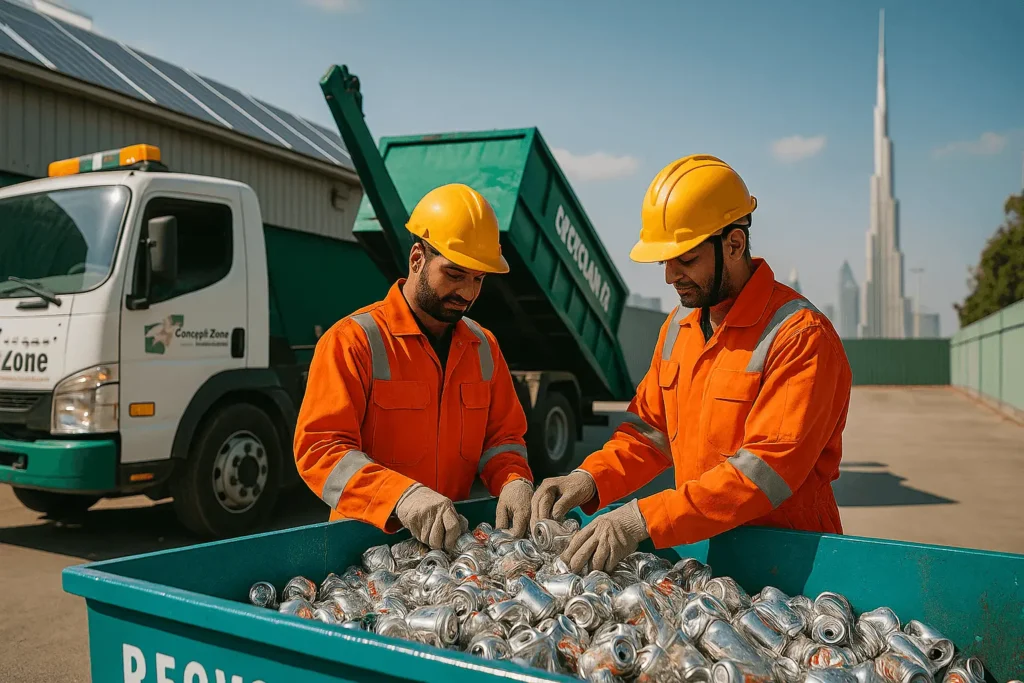
At Concept Zone, we’re helping communities and businesses recycle smarter and cleaner. Whether it’s aluminum cans, general waste, or construction debris, our certified recycling services ensure every material finds its way back into the circular economy. Partner with us to reduce your carbon footprint, save energy, and make every can count toward a cleaner, sustainable future.
📞 Contact us at +971 50 342 4742 or email waste@conceptzone.net to schedule your recycling pickup or learn more about our eco-driven waste management solutions.
Conclusion
To recap, you know where to drop cans, how prices work and what your haul can bring in. You witnessed how cans become NEW cans quickly, in less than two months, often. You witnessed how baby steps triumphed over usual obstacles — no bins at home or no defined hours at local sites. You glimpsed what trends might drive the next few years, from smart sort tech to cleaner loops.
To make it real, start little. Pile cans in a single bag. Mark a good rate per kilo. Choose one drop-off with defined hours. Record one month of returns. Pass along a tip to a buddy.
Have cans and an empty hour? Locate your nearest aluminum can recycling center now. Then cash in, free up some space, and help reduce waste.
Frequently Asked Questions
How do I find aluminum can recycling centers near me?
Search your city’s recycling locator or a national directory for aluminum can recycling centers. Look up ‘recyclables’ plus your postcode. Consult maps, local councils, and waste apps to find great service for your recycling needs.
How much money can I get for aluminum cans?
Prices for everyday recyclables differ across markets and areas, with rates around 0.50 to 1.50 USD per kilogram. Clean, sorted aluminum cans often fetch higher prices, so check today’s rate before you visit!
Do I need to clean and crush my cans?
Rinse cans to eliminate residue and smell, as proper recycling practices enhance the efficiency of metal recycling operations. Crushing is space-saving but optional; some centers prefer uncrushed recyclables for quicker sorting. When in doubt, inquire at your local recycling facility.
What happens to my cans after drop-off?
Cans, including everyday recyclables like aluminum cans, are separated and shredded, de-coated, and melted back into new ingots. These ingots can then be transformed into new cans, auto parts, or building materials, showcasing the great service of metal recycling operations.
Why is aluminum recycling so important?
It uses up to 95% less energy than making new aluminum. It slashes emissions, mining, and resource use. It bolsters local jobs and circular economies, too.
What if my area doesn’t have a nearby center?
Consider utilizing retail take-back points or deposit return locations for everyday recyclables. Coordinate community drives to batch bigger loads and ask your building manager to add bins for recycling needs.
Are there items aluminum centers won’t accept?
Most recycling centers accept everyday recyclables like beverage cans, but they may refuse items such as foil, aerosol cans, or mixed metals. Remember, no hazardous or food-contaminated materials are allowed.