Concrete is the backbone of construction in Dubai — and also its largest waste stream.
Yet every year, contractors across the emirate unknowingly pay mixed-waste rates for what should be the cheapest, fastest, and easiest waste stream to dispose of: clean concrete.
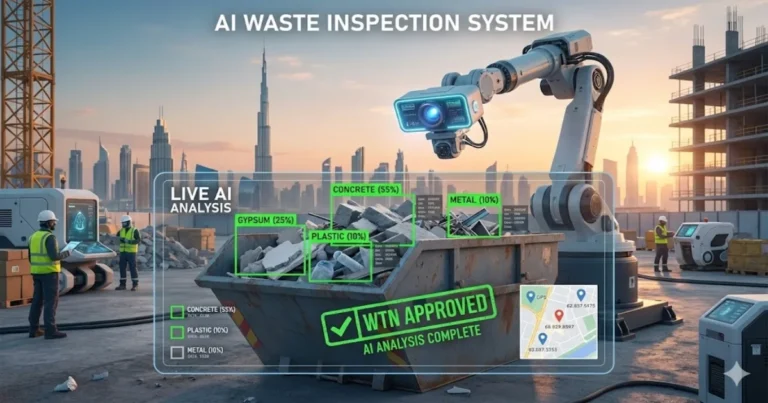
In 2025, with Dubai Municipality tightening enforcement through digital WTNs, AI photo validation, and landfill diversion targets, the difference between clean concrete and contaminated concrete is no longer a technical detail.
It’s a cost decision.
This guide on concrete waste disposal in Dubai explains — clearly and honestly — how concrete waste disposal works in Dubai, what it really costs, where it can legally go, and how to avoid the mistakes that quietly double disposal bills.
(Disclosure: This guide is written by Navyom Waste Collection Services, a Dubai Municipality-approved waste hauler. The principles here apply regardless of which licensed provider you use.)
What Qualifies as “Concrete Waste” in Dubai?
In Dubai Municipality terms, concrete waste (inert waste) includes:
- Plain concrete rubble
- Reinforced concrete (with embedded rebar)
- Broken slabs, columns, beams
- Precast concrete pieces
- Cured cement blocks
What instantly disqualifies a load from “concrete only”:
- Plastic sheets or bags
- Wood shuttering
- Gypsum or plaster
- Insulation material
- Cardboard packaging
- Paint buckets or aerosols
Even small contamination can cause reclassification.

Why Concrete Is the Cheapest Waste Stream — If Handled Correctly
Concrete is:
- Heavy
- Non-hazardous
- Highly recyclable
Because of this, disposal facilities:
- Process it faster
- Recycle or crush it into aggregate
- Charge lower tipping fees
Clean concrete loads typically cost 30–50% less to dispose of than mixed C&D waste.
The catch?
The load must look like concrete — not “mostly concrete. If it wouldn’t pass a visual inspection in daylight photos, it won’t pass WTN validation — even if it’s “mostly concrete.”
2025 Dubai Municipality Rules for Concrete Waste
In 2025, Dubai Municipality enforces concrete disposal through:
1. Digital Waste Transfer Notes (WTN)
- Correct waste category selection is mandatory
- “Concrete / Inert Waste” must match visuals
2. Photo Validation
- Clear daylight photos required
- AI flags color, texture, and foreign objects
3. Landfill & Recycling Route Matching
- Concrete must go to approved inert facilities
- Mixed or contaminated loads are redirected (at higher cost)
Repeated inconsistencies can result in:
- Delays
- Reclassification
- Increased inspection frequency
Concrete Waste Cost Breakdown (Dubai, 2025)
(Indicative ranges based on contractor invoices and disposal routing; actual prices vary by facility and project.)
Concrete-Only Load
- Lowest disposal rate
- Fast approval
- Minimal handling
Contaminated / Reclassified Load
- 30–50% higher cost
- Slower clearance
- Risk of rejection or return
Rejected Load
- Truck return to site
- Reloading labor
- New WTN submission
- Schedule disruption
This is where costs escalate quickly.
Concrete Disposal Cost Calculator (Dubai – 2025)
Concrete waste looks cheap on paper — until one contaminated load, reclassified WTN, or rejected truck quietly inflates your disposal bill. This calculator shows you the real cost of concrete waste disposal in Dubai, based on clean vs contaminated loads, trip frequency, and project duration. Enter your numbers to see how much you’re paying today — and how much you could save by keeping concrete loads clean, compliant, and correctly declared under Dubai Municipality’s 2025 rules.
Concrete Disposal Cost Calculator (Dubai)
Estimate your per-load, monthly, and annual concrete waste disposal cost — and see how much you can save by keeping concrete loads clean vs contaminated/mixed in 2025. (Rates are adjustable.)
Want “Concrete-Only” approval on the first attempt?
📞 Call 058 521 1155 | 🌐 dubaiwaste.com
Estimates are based on typical Dubai disposal rates and real project patterns. Actual costs vary by site location, facility routing, and load quality.
The Most Common Reasons Concrete Loads Get Rejected
From real site experience, rejections usually happen because of:
- Plastic bags blown into the skip
- Small wood pieces from shuttering
- Cardboard or cement bags
- Paint or adhesive containers
- Poor photo angles or low light
None of these are major mistakes — but all of them are costly.
Concrete Recycling in Dubai: How It Actually Works
Clean concrete in Dubai is typically:
- Crushed
- Screened
- Reused as recycled aggregate
This supports:
- DM landfill diversion targets
- Circular construction practices
- Lower environmental impact
But recycling only works if the load is clean at source.

Approved Concrete Disposal Routes (Dubai)
Concrete waste must be sent to:
- Dubai Municipality-approved inert waste facilities
- Licensed recycling yards
Exact routing depends on:
- Waste classification
- Project location
- Volume and load condition
Always confirm that:
- The hauler is DM-approved
- The destination accepts inert concrete
Approved facilities and routing are assigned based on project location, waste stream, and daily acceptance — not contractor choice.
Concrete vs Mixed Waste: Cost Comparison
| Factor | Concrete-Only | Mixed C&D |
|---|---|---|
| Disposal Cost | Lowest | 30–50% higher |
| Approval Speed | Fast | Slower |
| Recycling Rate | High | Low |
| Rejection Risk | Very low | High |
| Cost Predictability | High | Low |
Real-World Example (Typical Scenario)
A Dubai contractor handling demolition waste defaulted to mixed loads.
After reviewing invoices:
- Concrete made up ~60% of waste
- All loads charged at mixed rates
After separating concrete:
- Disposal costs dropped ~30%
- WTNs approved faster
- Fewer truck delays
No new equipment.
No extra labor.
Just better sorting.
When Concrete Can’t Be Kept Clean
There are legitimate cases:
- Early demolition
- Confined renovation
- Structural strip-outs
In these cases:
- Declare mixed waste honestly
- Avoid mislabeling as concrete
The issue isn’t mixed waste — it’s misdeclared waste.
How to Keep Concrete Loads Approved (Best Practices)
- Dedicated “Concrete Only” skips
- Clear signage
- Quick crew briefing
- Photo check before dispatch
- Immediate removal of contaminants
These small steps prevent most rejections.
🎁 Free Download: Concrete Load Approval Checklist (2025)
A one-page checklist used by site supervisors to:
- Verify concrete-only loads
- Pass WTN photo checks
- Avoid costly reclassification
👉 Download the Concrete Load Approval Checklist (PDF)
Local SEO Coverage: Dubai Zones We Serve
Concrete waste collection and disposal across:
- Dubai Industrial City (DIC)
- Jebel Ali Industrial Area
- Al Quoz Industrial Areas 1–4
- Dubai South
- DIP (Dubai Investment Park)
- Business Bay & Downtown construction zones
Each zone has:
- Different access rules
- Different routing considerations
- Different project profiles
Local knowledge matters.
How Navyom Supports Concrete Waste Compliance
Navyom Waste Collection Services helps contractors with:
- Concrete-only skip supply
- WTN category accuracy
- Photo validation checks
- DM-approved transport
- Correct disposal routing
The goal: lower cost, faster clearance, zero surprises.
Final Thought
Concrete waste is not a problem in Dubai.
Mishandled concrete waste is.
In 2025, keeping concrete clean is one of the simplest ways to cut waste costs, speed approvals, and stay compliant.
If you’re paying mixed-waste rates for concrete, you’re leaving money on the table.In 2025, clean concrete isn’t just compliant — it’s one of the easiest cost wins left on a Dubai construction site.

2️⃣ Concrete Load Approval Checklist PDF
✅ Ready to download
Frequently Asked Questions: Concrete Waste Disposal in Dubai (2025)
1. What qualifies as concrete waste under Dubai Municipality rules?
Concrete waste includes clean concrete rubble, slabs, columns, beams, and reinforced concrete. To qualify as “concrete only,” the load must be free from plastic, wood, gypsum, insulation, cardboard, paint containers, or packaging. Even small contamination can cause reclassification as mixed waste.
2. Why is concrete-only waste cheaper to dispose of in Dubai?
Concrete is inert, non-hazardous, and highly recyclable. Disposal facilities process it faster and often recycle it into aggregate, which lowers handling costs. Clean concrete typically costs 30–50% less to dispose of than mixed construction waste.
3. Can reinforced concrete with rebar still be treated as concrete waste?
Yes. Reinforced concrete is accepted as concrete waste as long as no other materials are present. Embedded steel does not disqualify the load, but loose metal, wood, plastic, or gypsum will.
4. What causes concrete loads to be rejected in Dubai?
The most common reasons are:
- Plastic bags or sheets in the skip
- Wood shuttering fragments
- Cardboard or cement bags
- Paint buckets or adhesives
- Poor-quality WTN photos (dark, unclear, incorrect angles)
These issues trigger reclassification or rejection under Dubai’s digital WTN system.
5. How does Dubai’s WTN photo validation work in 2025?
Dubai Municipality requires clear daylight photos uploaded with each WTN. AI-assisted checks review color, texture, and foreign objects. If the declared category (“Concrete / Inert Waste”) doesn’t visually match the load, the WTN can be delayed or rejected.
6. Where can concrete waste be legally dumped in Dubai?
Concrete waste must be sent to Dubai Municipality-approved inert waste or recycling facilities. The exact destination depends on load type, volume, and routing. Always ensure your hauler and disposal site are DM-approved to avoid violations.
7. Is concrete waste recyclable in Dubai?
Yes. Clean concrete is typically crushed and reused as recycled aggregate for road base, backfilling, and other applications. Recycling is only possible if the concrete is kept clean at source.
8. What happens if a concrete load is misdeclared as “concrete only” but is contaminated?
The load may be:
- Reclassified as mixed waste (higher cost)
- Delayed for manual review
- Rejected and returned to site
Repeated issues can increase inspection frequency for the project.
9. Is separating concrete worth it on small projects?
Absolutely. Small projects feel WTN rejections and truck returns more sharply. Even separating concrete alone can significantly reduce disposal costs and avoid schedule delays.
10. How can I ensure my concrete loads are approved every time?
Use a dedicated “Concrete Only” skip, brief workers, remove contaminants immediately, and check the load visually before dispatch. Using a Concrete Load Approval Checklist greatly reduces rejection risk.