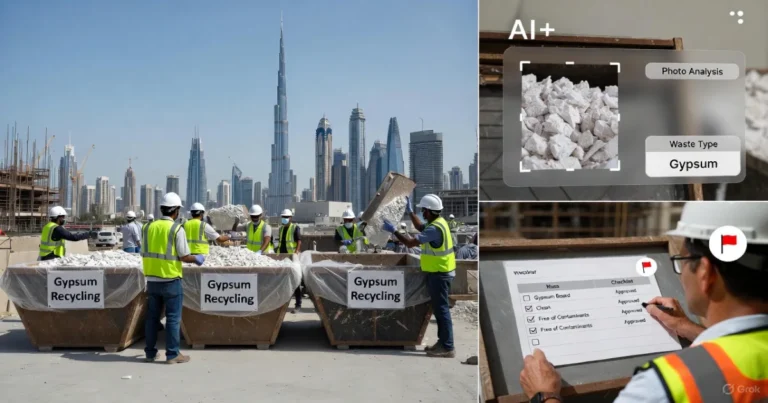
Construction waste compliance in Dubai is no longer just about knowing the rules — it’s about how well those rules are applied on site, day after day. Correct segregation, accurate documentation, and using approved disposal routes remain the foundation, supported by digital systems but still reviewed by people. Contractors who tighten site practices early avoid delays, reduce rejections, and stay ahead as oversight becomes more structured toward 2026.
At the same time, compliance is evolving quietly. Not through sudden regulation changes, but through higher expectations around documentation quality, clearer segregation standards, and more data-driven review at disposal facilities. Official guidelines explain what is required, but rarely show why loads pass or fail in real conditions. This guide fills that gap with practical, field-tested insight from daily waste movements, facility feedback, and current enforcement practices across Dubai — helping contractors operate correctly today while preparing for what’s coming next.
What is enforced today, what is already digitized, and what is clearly coming next.
Why This Guide Exists (And What It Is — and Isn’t)
Construction waste compliance in Dubai is not static.
Between 2024 and 2026, enforcement has been moving through a clear transition:
- From paper → digital
- From manual checks → system-assisted review
- From reactive inspections → data-driven risk attention
This guide explains:
- What Dubai Municipality officially enforces today
- Where AI and automation are already used
- Which AI-assisted controls are emerging (but not yet fully autonomous)
- How contractors should adapt now to avoid future disruption
This is not an official government document.
It is a field-level, operational guide built from:
- Current regulations
- On-ground disposal practices
- WTN workflows
- Recycling facility processes
- Market signals from 2025–2026
Who Regulates Construction Waste in Dubai?
Construction waste in Dubai is regulated by Dubai Municipality through:
- Approved disposal facilities
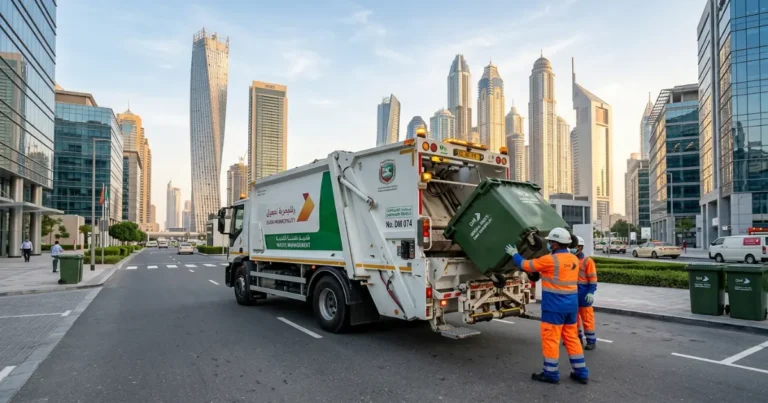
- Licensed waste collectors
- Digital Waste Transfer Note (WTN) systems
- Site inspections and audits
Key clarification:
Dubai Municipality remains the regulatory authority.
Technology supports enforcement — it does not replace it (yet).
How Waste Compliance Is Actually Enforced Today (2025–2026)
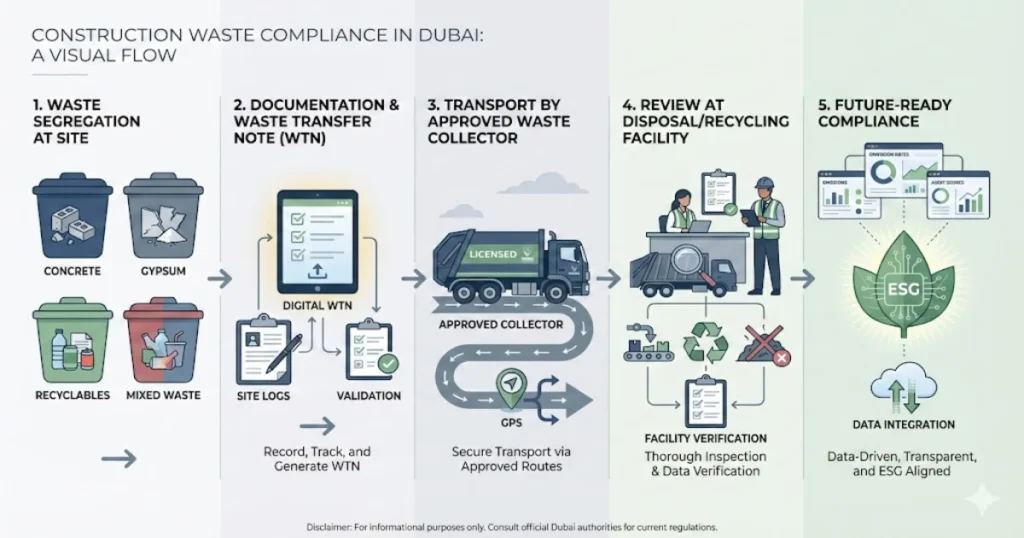
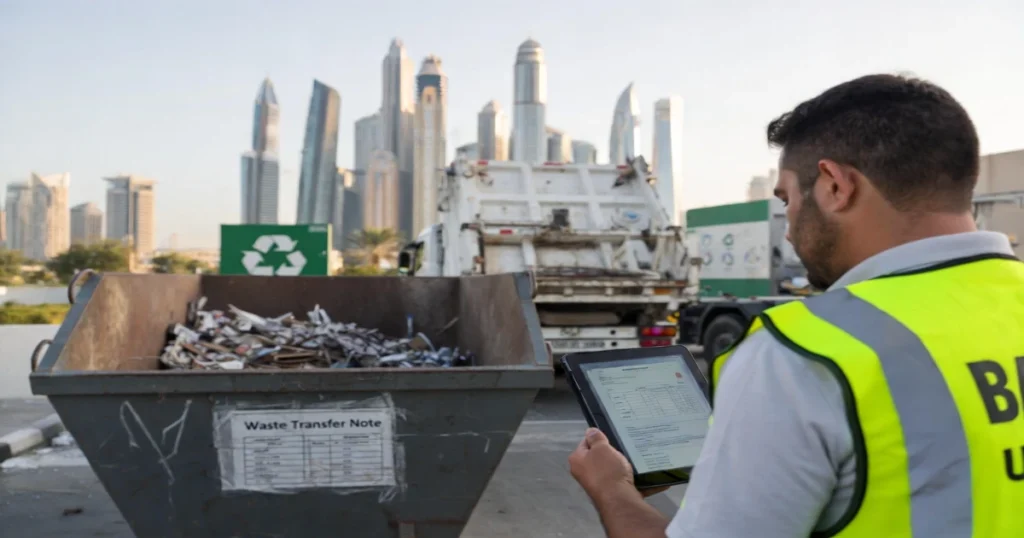
1️⃣ Digital WTNs Are Mandatory — But Not Fully AI-Approved
Today:
- WTNs are issued digitally
- Load details and waste categories must match disposal rules
- Supporting photos are often required
However:
- Final acceptance or rejection typically happens at the disposal facility
- Review is performed by operators, inspectors, and system checks
- Automation assists — it does not fully decide on its own
2️⃣ Where AI Is Already Used (Confirmed & Public)
AI and automation are actively used in:
- Sorting and recycling facilities (material separation, contamination detection)
- Vehicle tracking and routing systems
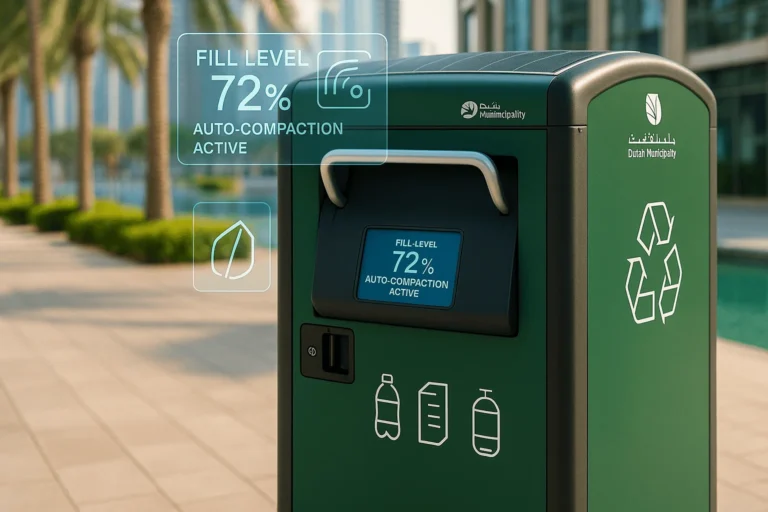
- Smart bins and fill-level monitoring
- Operational analytics and reporting
- Pattern identification across waste streams
These systems support enforcement decisions but do not yet function as a single autonomous compliance authority.
AI-Assisted Checks: What Exists vs What’s Emerging
What Exists Today
- Digital WTN validation rules
- Basic system logic (category mismatches, missing data)
- Visual review of photos by humans
- Facility-level contamination detection
- Historical compliance records
What Is Emerging (2026 Direction)
4
- Pre-screening tools used by private waste operators to:
- Detect mixed materials
- Reduce rejection risk
- Image-assisted review, not full machine vision enforcement
- Contractor history awareness, not formal “AI risk scoring”
- Metadata consistency checks, mostly rule-based
Important distinction:
These tools assist humans — they do not replace official approval decisions.
WTN Rejections: What Actually Triggers Them
Common Real-World Causes
| Issue | Why It Fails |
|---|---|
| Mixed waste in a declared category | Disposal rules violated |
| Gypsum in inert waste | Requires separate handling |
| Excess moisture | Facility contamination risk |
| Incorrect waste declaration | Compliance mismatch |
| Poor documentation | Insufficient evidence |
These decisions are typically:
- Confirmed at the landfill or recycling facility
- Backed by DM regulations
- Logged digitally for traceability
Carbon, ESG & Why Waste Records Matter More Than Before
4
Even without full AI enforcement, waste data now feeds into:
- Sustainability reporting
- Recycling ratios
- Green building certifications
- Developer and consultant evaluations
For large contractors and developers:
- Waste handling quality increasingly affects prequalification
- Repeated non-compliance raises operational scrutiny
- ESG alignment is becoming a commercial requirement
The Real Cost of Getting It Wrong (Beyond Fines)
Direct Impact
- Reclassification fees
- Additional transport costs
- Disposal delays
Indirect Impact
- Project schedule disruption
- Increased inspection attention
- Reputation risk with consultants & developers
These costs occur even without advanced AI enforcement.
Site-Level Systems That Work Today (No Speculation)
4
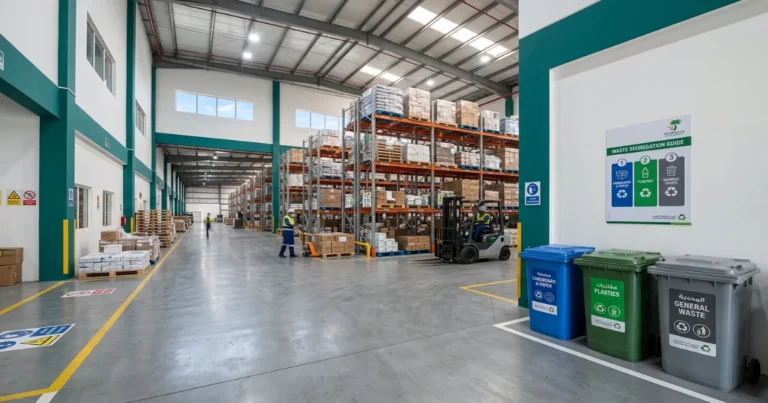
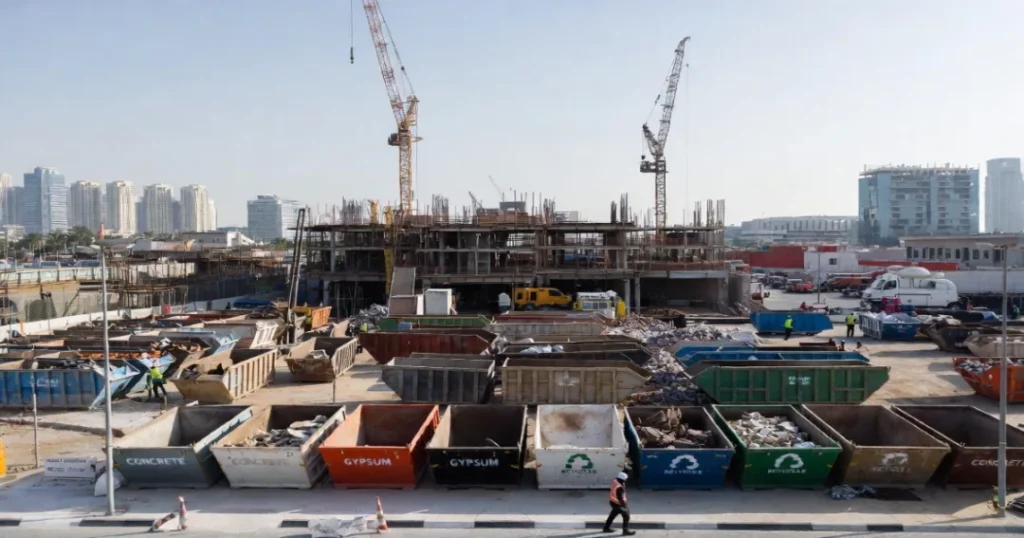
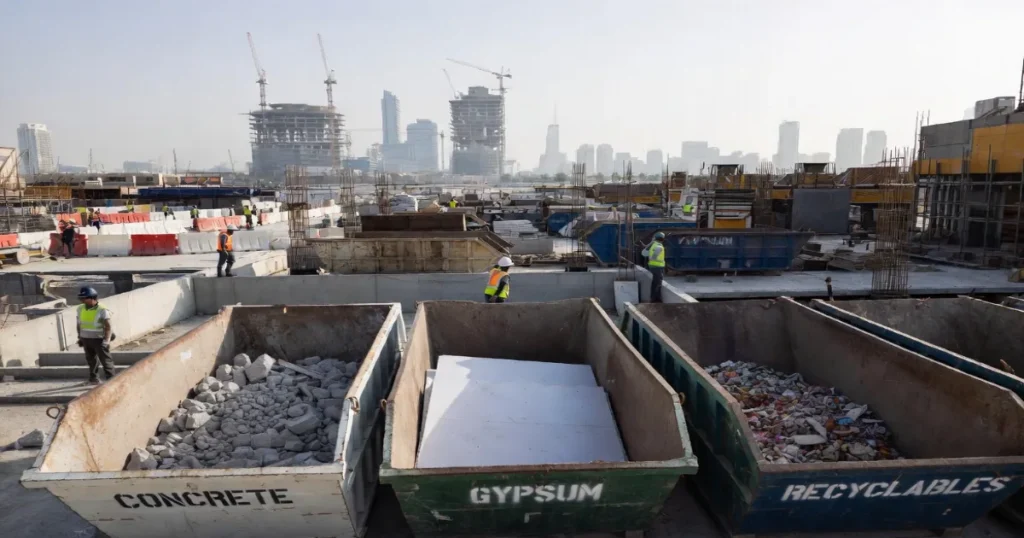
1️⃣ Physical Segregation
- Clearly labeled skips
- Material-specific containers
- No “temporary mixing”
2️⃣ Photo Documentation Discipline
- Clear, honest site photos
- Correct angles
- No reuse or staging
3️⃣ Worker Awareness
- Simple toolbox talks
- Visual signage
- Supervisor responsibility
4️⃣ Correct Classification
- Know what is inert vs non-inert
- Separate gypsum, insulation, chemicals
5️⃣ Approved Waste Partners
- Licensed collectors
- Facility-compliant routing
- Clear documentation support
These controls work now, regardless of future AI adoption.
Why “Rules & Fines” Articles Are No Longer Enough
They explain:
- What you should do
They don’t explain:
- How waste is reviewed in practice
- Where rejections actually happen
- How compliance affects timelines and tenders
- Why documentation quality matters
This guide fills that gap — without overstating technology.
Frequently Asked Questions
Clear, practical answers to the most common construction waste compliance questions contractors ask in Dubai — based on current enforcement practices and 2026 transition signals.
Is construction waste compliance fully automated in Dubai?
No. Dubai uses digital systems, analytics, and tracking tools to support enforcement, but human inspectors and disposal facility operators still play a central role in approvals, inspections, and final decisions.
Are AI photo checks mandatory for Waste Transfer Notes (WTNs)?
Not officially. Some waste operators use internal photo pre-checks to reduce rejection risk, but Dubai Municipality has not mandated fully automated AI-based photo approval for WTNs.
Why do WTNs get rejected even when the waste looks correct?
Rejections usually occur due to mixed materials, incorrect classification, excess moisture, or documentation mismatches discovered at the disposal facility — not because of advanced AI judgment alone.
Is gypsum waste considered hazardous in Dubai?
No. Gypsum is not classified as hazardous, but it must be segregated correctly. Mixing gypsum with inert or construction debris often leads to reclassification or rejection.
Do waste rules change across different Dubai zones?
Core rules are uniform across Dubai, but enforcement sensitivity, inspection frequency, and operational scrutiny can vary depending on the zone, project type, and contractor compliance history.
Will construction waste rules become stricter in 2026?
Yes. The direction is clearly toward tighter documentation, improved traceability, and greater use of digital systems — even if full automation is not yet in place.
Does recycling construction waste reduce compliance risk?
Yes. Higher recycling rates, proper segregation, and landfill diversion improve operational credibility and align with sustainability and ESG expectations increasingly used by developers and consultants.
How does poor waste handling affect tenders and approvals?
Repeated waste issues can cause delays, raise inspection attention, and negatively influence contractor evaluations during prequalification or tender review — even without formal penalties.
What is the best way to prepare for future compliance changes?
Focus on accurate segregation, honest documentation, trained site staff, and working with Dubai Municipality–approved waste partners who follow correct routing and disposal procedures.
Should contractors wait for official changes before adapting?
No. Contractors who improve systems early experience fewer disruptions, smoother inspections, and better operational control as enforcement standards gradually tighten.
Work With a Compliance-First Waste Partner
If you want your site operations to stay aligned with current Dubai Municipality requirements — and remain ready as controls tighten — work with a waste collection partner that focuses on accuracy, documentation discipline, and zero-guesswork segregation.
Navyom Waste Collection Services Co. LLC supports contractors, fit-out firms, and developers across Dubai with:
- Dubai Municipality–approved waste collection
- Correct waste classification & routing
- Clear WTN documentation support
- Practical guidance to reduce rejections and delays
📞 Talk to a compliance specialist before your next pickup — and avoid learning the hard way at the disposal gate.
The Real 2026 Takeaway
Dubai is not yet fully AI-enforced — but it is moving in that direction.
Contractors who:
- Treat compliance as operational discipline
- Improve segregation and documentation
- Align with sustainability goals
Will adapt smoothly as systems evolve.
Those who rely on outdated habits will feel the pressure first — regardless of whether enforcement is human-led or system-assisted.
Final Note on Credibility
Always cross-reference:
- Official Dubai Municipality circulars
- Approved facility guidelines
- Licensed waste collector instructions
This guide is designed to prepare you, not replace official rules.