Dubai is no longer inspecting waste with clipboards and gut instinct. Now, the era of AI Waste Inspections in Dubai.
In 2026, waste compliance in Dubai is driven by AI, computer vision, GPS tracking, and real-time data verification. If you manage construction, fit-out, demolition, or renovation projects, this shift directly affects your costs, timelines, and legal exposure.
Many contractors still believe:
“The waste is correct — so the WTN will be approved.”
That assumption is now outdated.
Today, Dubai Municipality’s AI systems do not judge intent.
They judge data alignment.
And when images, GPS, waste category, and historical patterns don’t match perfectly — your WTN fails, even if the waste looks fine to the human eye.
This guide explains how AI waste inspections really work in Dubai (2026), why “correct waste” still gets rejected, and what smart contractors are doing differently to stay compliant and avoid penalties.
Why AI Waste Inspections Exist (And Why They’re Expanding)
Dubai processes millions of tonnes of construction and demolition waste every year. Manual inspections simply cannot scale with:
- High-rise construction
- Mega infrastructure projects
- Fast-paced fit-out cycles
- Multiple daily waste movements per site
To solve this, Dubai Municipality introduced AI-driven inspection layers that sit on top of the traditional WTN system.
The goal is not punishment.
The goal is predictability, traceability, and zero ambiguity.
AI allows DM to:
- Detect misclassification instantly
- Reduce landfill contamination
- Identify repeat offenders
- Standardize enforcement across all zones
In short: every waste load is now treated as a data object, not just physical debris.
How AI Verifies Waste Photos (What the System Actually Sees)
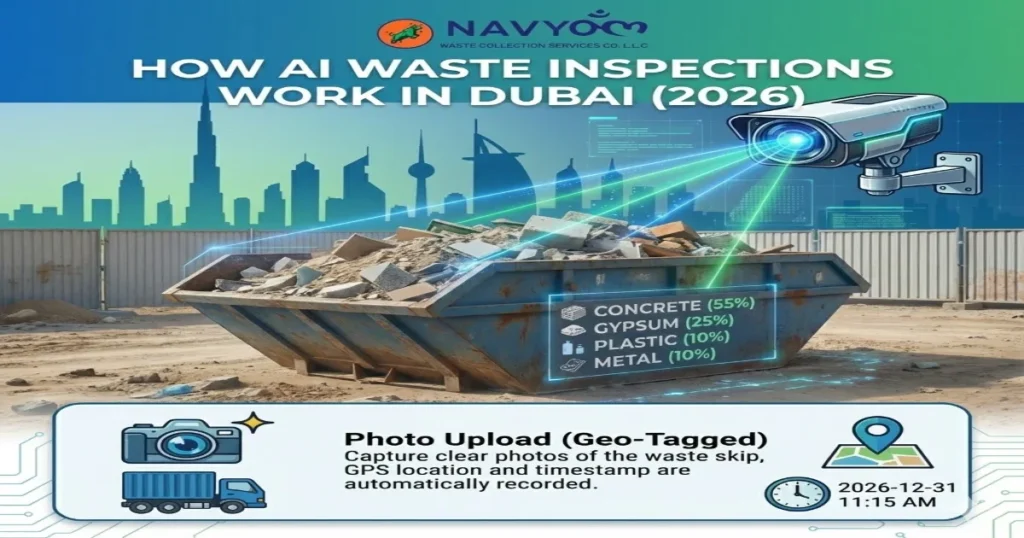
When you upload photos with your Waste Transfer Note, the system doesn’t “look” like a human does.
It analyzes patterns.
1. Texture Recognition
AI models are trained on thousands of reference images:
- Rough, fractured concrete
- Powdery gypsum
- Fibrous insulation
- Smooth plastic surfaces
- Metallic reflections
If a declared “concrete-only” load shows even minor powdery textures, the system flags potential gypsum contamination.
2. Color & Contrast Analysis
Humans ignore small color variations. AI doesn’t.
Examples that trigger mismatches:
- White or off-white fragments inside inert waste
- Brown wood tones in rubble
- Shiny plastic or reflective foil
Even 5–10% visual contamination can trigger a rejection.
3. Object Shape Detection
AI identifies:
- Flat sheet-like objects (drywall, gypsum boards)
- Cylindrical containers (paint cans, aerosols)
- Bagged waste inside skips
If detected objects don’t belong to the declared category, the WTN is flagged automatically.
4. Image Consistency Checks
The system compares:
- Angle
- Distance
- Lighting
- Framing
Blurry, dark, partial, or rushed photos are treated as high-risk submissions, even if the waste is technically correct.
Why “Correct Waste” Still Fails in 2026
This is the most misunderstood part of AI inspections.
Contractors often say:
“But it’s the right waste.”
AI doesn’t ask what you intended.
It asks whether all signals match.
Here’s why correct waste still fails:
1. Micro-Contamination Is No Longer Ignored
In the past, inspectors allowed small errors.
In 2026:
- One gypsum fragment in concrete
- One plastic bag in inert waste
- One painted surface in demolition debris
…is enough to trigger rejection.
👉 This is why gypsum waste has become one of the most common silent failure points in Dubai projects.
2. Declared Category vs Visual Reality
Many WTNs fail because of category mismatch, not illegal waste.
Examples:
- Declared: Mixed C&D waste
- AI sees: Mostly concrete + gypsum → mismatch
- Declared: Inert waste
- AI sees: Insulation + wood → rejection
The system expects visual dominance to match the declared category, not just inclusion.
🔗 Related reading: Mixed waste vs segregated waste in Dubai
3. Photo Quality = Compliance Signal
Poor photos are treated as risk indicators.
Common issues:
- Night photos without flash
- Overfilled skips hiding base layers
- Waste photographed after partial removal
- Shadows masking material types
Low-quality photos increase inspection frequency for the entire site.
4. GPS & Timestamp Mismatches
Every photo is geo-tagged.
The system checks:
- Is this the approved site location?
- Does the timestamp align with the pickup window?
- Does the truck route match declared movement?
If GPS data doesn’t align, the system assumes potential manipulation — even if the waste itself is compliant.
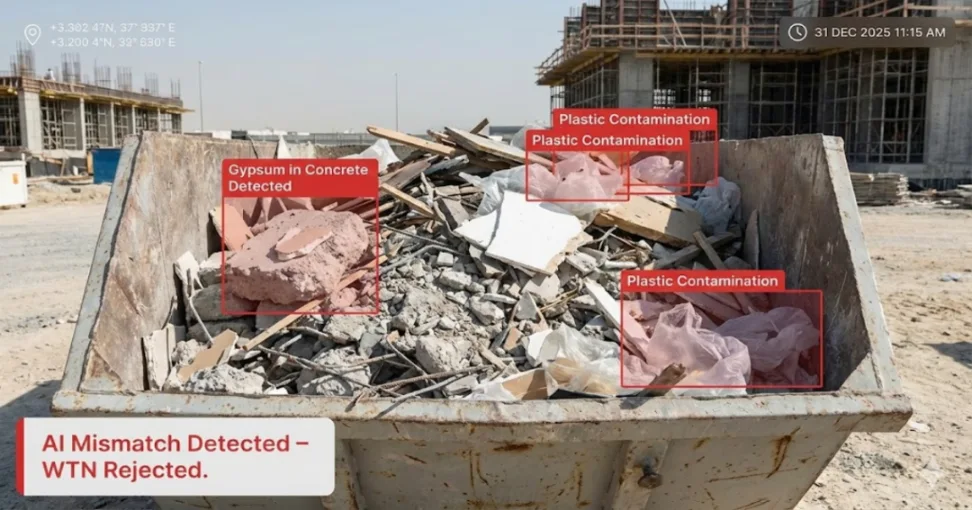
Common AI Mismatch Triggers (Seen Across Dubai Sites)
Based on real rejection patterns, these triggers account for the majority of failures:
📸 Image-Based Triggers
- Blurry or zoomed-out photos
- Waste not fully visible
- Skip photographed from one angle only
🧱 Material Triggers
- Gypsum mixed into concrete
- Painted wood inside inert loads
- Plastic packaging left with rubble
📍 Data Triggers
- Photos uploaded from incorrect coordinates
- WTNs submitted outside approved time windows
- Reused images across multiple loads
🗂 Process Triggers
- Incorrect waste category selection
- Missing secondary verification images
- Repeated minor mismatches triggering risk scoring
How AI Risk Scoring Works (What Contractors Don’t See)
One rejected WTN is not the real danger.
Patterns are.
Dubai’s AI systems maintain risk profiles for:
- Contractors
- Waste carriers
- Project sites
Factors include:
- Rejection frequency
- Type of mismatches
- Photo quality consistency
- Category changes
- Historical fines
High-risk profiles result in:
- More manual reviews
- Slower approvals
- Higher inspection probability
- Increased scrutiny during audits
In other words: AI remembers everything.

The 2026 Enforcement Roadmap (What’s Coming Next)
Dubai is not slowing down AI enforcement — it’s accelerating it.
1. Predictive Enforcement
AI will flag risky loads before they reach disposal facilities, forcing re-classification or re-segregation on site.
2. Live Inspector AI Tools
Inspectors will use mobile AI scanning to:
- Validate loads instantly
- Suggest corrections
- Approve or reject on-site
3. Fleet-Level Integration
All licensed waste carriers will be fully integrated via:
- GPS
- Route history
- Load frequency
- Pickup timing
4. Cross-System Linking
WTN data will be cross-checked with:
- Permit systems
- Site approvals
- Previous violations
This closes loopholes that once allowed “minor” non-compliance to pass.
What Smart Contractors Are Doing Differently in 2026
Top-performing sites don’t fight the system.
They design operations for AI compliance.
✔ Waste Segregation at Source
Gypsum, concrete, wood, and mixed waste are separated before loading, not after rejection.
✔ Photo SOPs
Teams follow strict rules:
- Daylight photos
- Multiple angles
- Clear base visibility
- No obstructions
✔ Category Discipline
No guessing.
If unsure, they choose the more restrictive category, not the convenient one.
✔ DM-Approved Waste Partners
Approved waste collectors understand:
- AI thresholds
- Rejection patterns
- Documentation standards
This reduces back-and-forth, delays, and surprise fines.
Why This Matters for Cost, Not Just Compliance
AI inspections don’t just reject WTNs.
They:
- Delay project timelines
- Increase disposal costs
- Trigger repeat inspections
- Raise insurance and compliance risk
A single rejected load can:
- Delay site clearance
- Block follow-up work
- Increase skip rental days
- Expose the site to fines
Compliance is now a cost-control strategy, not an admin task.
Final Thought on AI Waste Inspections in Dubai
Dubai’s AI waste inspection system is not unpredictable.
It is extremely consistent.
Problems arise when contractors rely on:
- Old habits
- Visual judgment
- Manual logic
In 2026, waste compliance is about alignment:
- Images match categories
- GPS matches permits
- Data matches reality
Contractors who adapt win faster approvals, fewer fines, and smoother operations.
Those who don’t… keep wondering why “correct waste” keeps getting rejected.
Want Zero-Rejection Waste Handling in Dubai?
Stop guessing. Start passing.
If your WTNs are getting delayed, rejected, or flagged — the issue is no longer your effort.
It’s AI misalignment.
Work with DM-approved waste specialists who understand how Dubai Municipality AI inspections actually work in 2026 — from image verification to GPS validation and risk scoring.
✅ What you get:
- Zero-rejection WTN workflows
- AI-compliant waste segregation (including gypsum control)
- Correct category mapping (no costly guesswork)
- Photo & GPS SOPs aligned with DM systems
- Faster approvals, fewer fines, smoother projects
📞 Talk to an AI-compliance waste expert today
Because in 2026, compliance is not paperwork — it’s system alignment.
Frequently Asked Questions (AI, WTN & Dubai Waste Inspections)
1. What is AI waste inspection in Dubai?
AI waste inspection is Dubai Municipality’s automated system that verifies waste using photos, GPS data, timestamps, and historical patterns before approving or rejecting a Waste Transfer Note (WTN).
2. Why is my WTN rejected even when the waste is correct?
Because AI checks data consistency, not intent.
If images, waste category, GPS location, or visual composition don’t align perfectly, the system flags the load — even if it looks acceptable to humans.
3. How important are photos for WTN approval in 2026?
Extremely important.
Photos are analyzed using computer vision for texture, color, object shape, and contamination. Poor lighting, blur, or partial visibility can trigger rejection.
4. Can small amounts of mixed waste really cause rejection?
Yes.
Even minor contamination (like gypsum fragments in concrete or plastic in inert waste) can trigger AI mismatch alerts and WTN rejection.
5. Why is gypsum waste such a big issue in Dubai now?
Gypsum visually overlaps with concrete but behaves differently in landfills.
AI systems are trained to detect gypsum textures, making it one of the most common silent rejection triggers in 2025–2026.
6. Does GPS location affect WTN approval?
Yes.
Every photo is geo-tagged. If the location, route, or timestamp doesn’t match the approved site and pickup window, the system may flag or reject the WTN.
7. What happens if my site gets repeated WTN rejections?
Repeated rejections increase your AI risk score, leading to:
- More manual inspections
- Slower approvals
- Higher audit probability
- Greater exposure to fines
AI systems remember historical behavior.
8. Is mixed waste still allowed in Dubai?
Yes — but only when correctly declared and visually consistent.
If AI detects dominant materials that don’t match the declared “mixed” category, the WTN can still be rejected.
9. How can contractors reduce AI inspection failures?
By:
- Segregating waste at source
- Using correct waste categories
- Taking clear, well-lit photos from multiple angles
- Ensuring GPS and timing accuracy
- Working with DM-approved waste collectors who understand AI rules
10. Will AI enforcement become stricter after 2026?
Yes.
Dubai’s roadmap includes predictive enforcement, live AI inspections, full fleet integration, and cross-system data linking — making compliance more data-driven and less forgiving.