Waste Collection Cost in Dubai: Complete 2026 Pricing Guide for Businesses
Waste collection costs in Dubai range from AED 100/tonne for general waste to AED 550/tonne for hazardous waste, based on Dubai Municipality’s 2026 published fee schedule. Monthly commercial waste bills run from around AED 1,500 for small offices to AED 60,000+ for hotels and construction sites. Businesses that implement correct source segregation under Law No. 18 of 2024 consistently reduce total disposal spend by 20–65% — not by cutting corners, but by routing materials to lower-cost and revenue-generating streams instead of landfill.
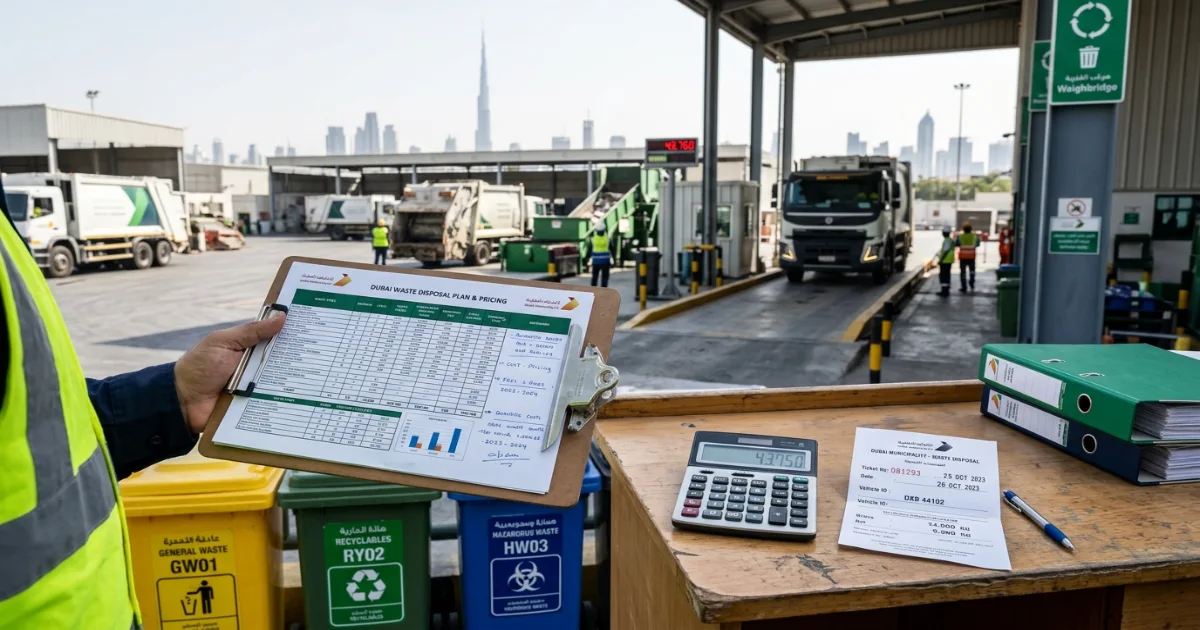
Here’s what most Dubai businesses don’t realise about their waste bill: a significant chunk of it is completely avoidable. Not because the DM rates are negotiable — they’re not — but because the way waste is handled before it reaches the collection truck determines which rate applies. A skip full of clean concrete costs as little as AED 2 per tonne to process. That same skip, if it has a few bags of general rubbish thrown in, reclassifies to AED 100 per tonne. That’s a 4,900% cost increase for one decision made on a construction site.
Waste collection costs in Dubai are driven by three things: waste stream, volume, and compliance quality. Get all three right, and disposal becomes a manageable, predictable budget line. Get even one wrong, and costs — plus the risk of fines from AED 1,000 to AED 100,000 — escalate fast.
This guide breaks down every cost factor: the official DM fee schedule, real-world monthly estimates by industry, skip hire pricing, contractor selection factors, and — most practically — exactly how to engineer your waste operation to pay the lowest compliant rate possible. It’s the cost companion to our Dubai Waste Management Guide 2026, which covers the full compliance and regulatory picture.
Dubai Municipality Waste Disposal Fee Schedule 2026
Dubai Municipality publishes official landfill disposal rates that form the baseline cost for all regulated waste streams. These are per-tonne gate fees charged at transfer stations and treatment facilities — they do not include contractor collection charges, vehicle costs, or WTN administration, which are added on top by your licensed hauler.
| Waste Stream | DM Rate 2026 | Optimised Route | Optimised Rate | Max Saving |
|---|---|---|---|---|
| General / Mixed Waste | AED 100/t | Segregation + diversion | AED 38/t avg | Up to 62% |
| Food / Organic Waste | AED 100/t | Biogas / composting | AED 25–30/t | Up to 75% |
| Clean Dry Recyclables | AED 100/t (if mixed) | MRF buyback facility | AED 0 or revenue | 100%+ |
| C&D Mixed / Contaminated | AED 100/t | Separate inert streams | AED 2–20/t | Up to 98% |
| C&D Clean Inert | AED 20/t | DM treatment plant | AED 2/t | Up to 90% |
| Hazardous / Special Waste | AED 550/t | Certified specialist handler | Category dependent | Varies |
To model what these rates mean for your specific business, use our Landfill Savings Calculator — it applies DM 2026 benchmarks to your actual waste volumes and current practices and outputs a prioritised cost-reduction action plan.
Monthly Waste Collection Costs by Industry in Dubai (2026 Benchmarks)
Waste costs vary enormously by sector because the volume and mix of streams differs so significantly. A restaurant generating 600kg of food waste a day has a completely different cost profile from a law firm producing mostly paper and packaging. Here’s how the numbers break down across Dubai’s main commercial sectors.
🍽️ Restaurants, Cafés & F&B Outlets
Food-service businesses generate high volumes of organic waste, contaminated packaging, and recyclable materials. Without segregation, all of it lands in general waste at AED 100/tonne — and volumes are typically 18–25 tonnes per month for a mid-size operation.
The fastest win for F&B: separate organic waste and route it to composting (AED 25–30/tonne vs AED 100). Paired with clean recyclables separation for cardboard, plastic, and aluminium, most restaurants can cut disposal costs by more than half within a single billing cycle.
🏨 Hotels & Resorts
A full-service Dubai hotel is essentially every business type in one building — restaurant, office, laundry, construction, retail, and sometimes healthcare. That complexity translates into multi-stream waste at scale: 30–45 tonnes per month is typical for a mid-tier property.
Hotels also carry significant audit exposure. Fines for segregation failures range from AED 1,000 to AED 50,000 per incident.
🏢 Offices & Corporate Tenants
Offices generate mostly paper, cardboard, plastic packaging, and low volumes of general waste — 8–12 tonnes per month for a medium-sized operation. They are among the most likely to overpay because their streams are easy to segregate yet often are not.
Clean paper, cardboard, and plastic from offices often qualify for zero-cost or nominal-fee collection when volumes are sufficient.
🏗️ Construction & Demolition Sites
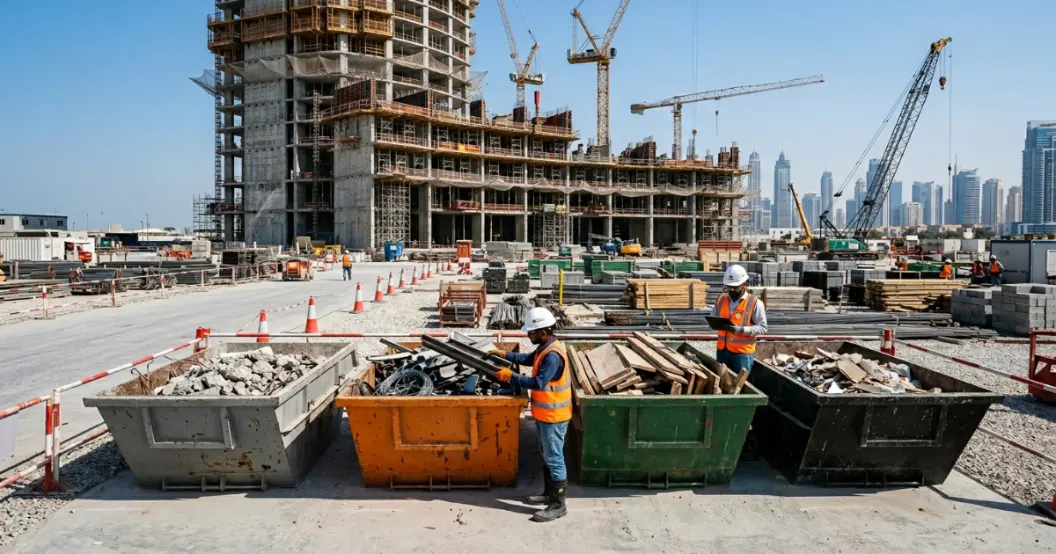
C&D waste is Dubai’s largest waste stream by volume and the most dramatic example of how segregation decisions translate directly into cost. A 60–120 tonne per month site with mixed, contaminated loads can spend AED 360,000–720,000 annually. The same volume, correctly segregated, costs a fraction of that.
Clean concrete, steel, and inert materials processed at a DM treatment plant are charged at AED 2/tonne. The same materials, contaminated, jump to AED 100/tonne.
🛍️ Retail, Malls & Commercial Centres
Skip Hire Costs in Dubai: What to Expect in 2026
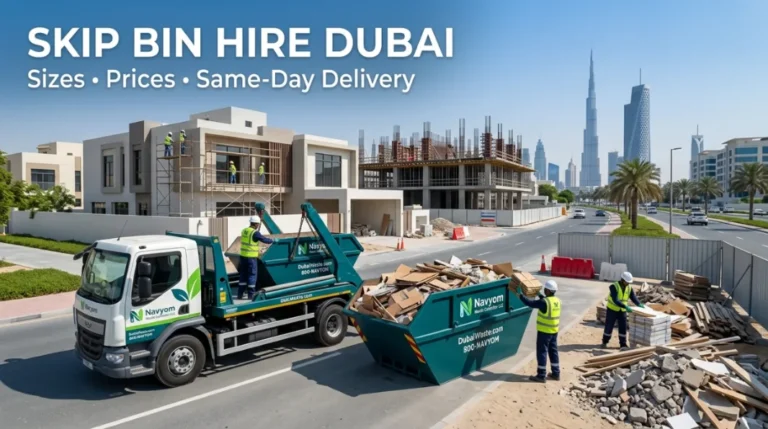
Skip hire is the most common waste collection format for commercial and construction operations. Pricing in Dubai depends on skip size, waste type, collection frequency, and whether the job requires WTN documentation.
| Skip Size | Typical Use | Cost Per Lift (AED) | Monthly Contract (AED) |
|---|---|---|---|
| 4–6 yard (small) | Office clearances, small retail, villa renovation | 350–550 | 1,200–2,000 |
| 8–10 yard (medium) | Restaurant waste, mid-size commercial, shop fit-out | 500–900 | 2,000–4,500 |
| 12–16 yard (large) | Mid-size construction, industrial sites, warehouse clearance | 700–1,200 | 3,500–7,000 |
| 20–30 yard (construction) | Active construction sites, demolition, large C&D operations | 900–1,500 | 5,000–15,000+ |
These per-lift rates include delivery, collection, and transport to a licensed transfer station. They do not always include the DM gate fee — confirm with your contractor whether disposal is included or charged separately.
Hidden Cost: The Wrong Skip Size
Oversized skips are one of the most common unnecessary costs on Dubai construction sites. A 30-yard skip that’s only partially full on collection day is paying per lift on mostly air. Equally, undersized skips that overflow generate contamination issues when waste spills across categories.
What Actually Drives Your Total Waste Collection Bill
The DM fee schedule is the floor. Your actual bill is shaped by four variables that sit above it — and every one of them is within your control.
1. Contamination — The Single Biggest Cost Driver
When different waste streams mix, the entire load gets classified at the most expensive applicable rate. A skip of clean concrete is AED 2/tonne at a DM treatment plant. Add one bag of food waste, and the entire skip can be reclassified to general waste at AED 100/tonne.
2. Contractor Type — Licensed vs Unlicensed
Unlicensed or non-WTN contractors often quote lower headline rates. What looks like a saving on the invoice becomes a liability when a Dubai Municipality inspector identifies your waste at an unapproved site.
3. Collection Frequency — Matching Volume to Schedule
Over-frequent collections on low-volume streams waste money. Under-frequent collections cause overflow, contamination between bins, and compliance risk.
4. Recyclables Recovery — Revenue vs Cost
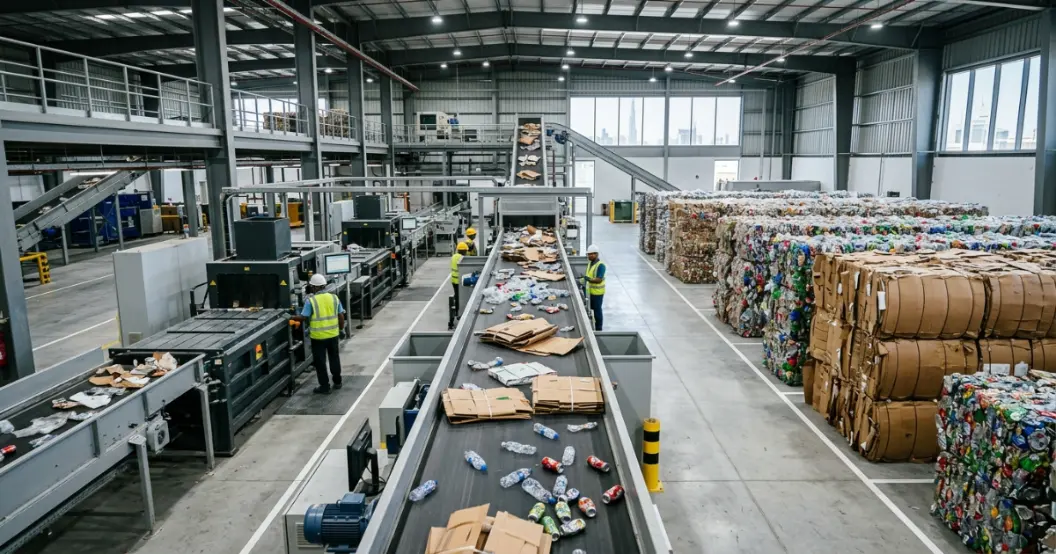
Clean, high-volume recyclable streams such as aluminium, clean PET plastic, cardboard, and paper can carry zero disposal cost or even generate buyback revenue.
How to Reduce Waste Collection Costs in Dubai (Step-by-Step)
Every cost reduction in waste management starts with the same action: understanding what you’re currently generating and paying.
For a detailed compliance and contractor checklist, see our Dubai Waste Management Guide 2026. To model the exact savings for your business before making changes, use our free Landfill Savings Calculator.
Does Waste Collection Cost Vary by Zone in Dubai?
DM gate fees are fixed emirate-wide — a tonne of general waste costs AED 100 regardless of where it is generated. What does vary by location is contractor collection pricing, which reflects access, transport distance, and the availability of competing licensed collectors in a given area.
Industrial zones such as Jebel Ali Free Zone, Dubai Industrial Park, Dubai Industrial City, Al Quoz, and National Industries Park typically have better contractor density, which supports more competitive collection pricing and faster response times.
For zone-specific collection services, see our service area guides: Dubai Industrial City, Dubai Investment Park, Jebel Ali Industrial, and Al Quoz.
Frequently Asked Questions: Waste Collection Cost in Dubai
How much does waste collection cost in Dubai?
Dubai Municipality’s 2026 gate fees start at AED 100 per tonne for general and organic waste, rising to AED 550 per tonne for hazardous streams. All-in collection costs are typically above the DM gate fee once contractor and logistics charges are included.
What is the Dubai Municipality waste disposal rate in 2026?
General and organic waste are AED 100 per tonne, hazardous and special waste are AED 550 per tonne, clean C&D at a DM treatment plant is AED 2 per tonne, and mixed C&D ranges from AED 20–100 per tonne based on contamination.
How much does skip hire cost in Dubai?
Skip hire in Dubai ranges from around AED 350–550 for small skips to AED 900–1,500 per lift for large construction skips, depending on size, stream, and contract type.
Why does mixed waste cost more in Dubai?
Mixed waste removes the ability to route materials to lower-cost recovery facilities. Once contaminated, the whole load is often charged at the higher applicable rate.
How can businesses reduce waste collection costs in Dubai?
Audit invoices, separate streams at source, divert organic waste, recover clean recyclables, and work only with a licensed contractor that issues WTNs.
Does a restaurant in Dubai need a licensed contractor?
Yes. Commercial waste from restaurants and cafés must be collected by a DM-licensed contractor with proper documentation.
What should a commercial waste contract in Dubai include?
A compliant contract should include the contractor licence number, collection schedule, WTN issuance, and end-destination documentation.
How much can a Dubai hotel save on waste collection?
A hotel can materially reduce annual costs by improving source segregation, food waste diversion, and specialist stream control.
The Bottom Line on Waste Collection Costs in Dubai
Waste collection in Dubai does not have to be a runaway cost. The DM fee schedule is transparent and publicly published. The main levers that control what you actually pay — stream segregation, contamination prevention, contractor quality, and organic diversion — are all within your operational control.
The starting point is always an honest look at your current invoices. How much are you paying per tonne, per stream? Is your contractor issuing WTNs? Are you paying general-waste rates for materials that could route to lower-cost or zero-cost recycling streams?
For the full picture on DM regulations, Montaji documentation, fine schedules, and approved contractor lists, our Dubai Waste Management Guide 2026 is the complete reference.
Find Out What You’re Actually Paying Per Tonne
Use our free Landfill Savings Calculator to model your 2026 disposal costs — then book a free site audit to turn the numbers into action.
Calculate Your Savings Now → Read the Full Compliance Guide → Book Waste Collection →Related Guides on dubaiwaste.com
- Dubai Waste Management Guide 2026 — Complete Compliance & Cost Resource
- Waste Types in Dubai — Every Category, Rule & Colour-Coded Bin Explained
- Landfill Savings Calculator — Estimate Your 2026 Disposal Cost Savings
- Construction Waste Disposal in Dubai — Complete 2026 Guide
- Construction Waste Control Stack — 5-Layer Framework for Dubai Sites
- General Waste Collection Dubai — Services, Costs & DM Rules
- Best Waste Management Companies in Dubai (2026 Comparison)
- Dubai Municipality Waste Management Systems Explained
- Navigating Dubai’s AED 100/Tonne Landfill Fee — Budget Guide for Developers