Hotel & Hospitality Waste Management Dubai: DTCM Compliance Guide
Running a hotel in Dubai means managing far more than guest experience. The moment your kitchen opens at 6 a.m. and housekeeping starts their rounds, your property is generating a continuous stream of waste that needs to be handled correctly — segregated properly, documented where required, and collected by licensed contractors. Get this wrong and the consequences range from rejected loads and unexpected collection surcharges to compliance notices that put your DTCM operating licence at risk.
This guide is written for hotel general managers, facility managers, and sustainability leads who need a practical, realistic picture of what hotel waste management in Dubai actually involves — not a generic recycling checklist, but a working framework that reflects how waste collection, segregation, and compliance operate in Dubai’s hospitality sector right now.
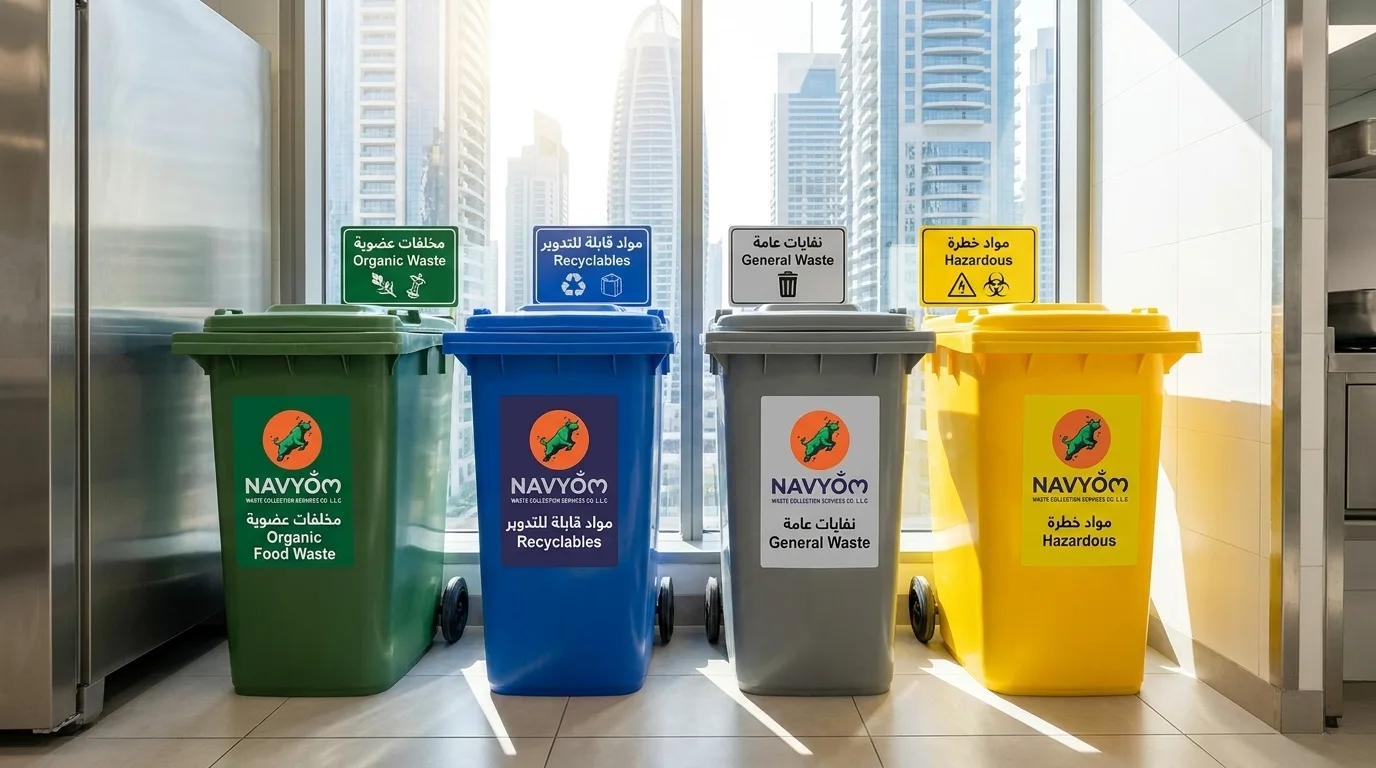
Hotel waste management in Dubai requires compliance with Dubai Municipality waste segregation standards, use of licensed waste contractors, and alignment with DTCM’s sustainability expectations under its responsible tourism framework. Hotels must separate general waste, food waste, recyclables (paper, cardboard, glass, plastic), and hazardous streams (chemicals, used oils, e-waste) at source. Failure to segregate correctly increases collection costs, risks load rejection at transfer stations, and can trigger compliance action against your operating licence.
Why Hotel Waste Management in Dubai Is Under More Scrutiny in 2026
Dubai’s hospitality sector produces a disproportionate volume of waste relative to other commercial sectors. A mid-sized four-star hotel with 250 rooms and two food and beverage outlets can generate between 800 kg and 1,500 kg of mixed waste per day, depending on occupancy and F&B throughput. Scale that across Dubai’s thousands of licensed accommodation units and the cumulative landfill impact is significant — which is precisely why the regulatory environment has tightened.
The Dubai Clean Energy Strategy and the Dubai Waste Management Master Plan both carry explicit diversion targets. Dubai Municipality has moved from broad guidance to active monitoring of commercial waste generators, and DTCM’s responsible tourism requirements increasingly cross-reference environmental performance. For hotels pursuing Green Key, EarthCheck, or any sustainability certification that supports DTCM’s quality grading, waste management records are no longer a background administrative exercise — they are an auditable operational commitment.
The practical implication for hotel operators: the way your property handles waste from kitchen to collection point needs to be deliberate, documented, and defensible. This doesn’t require a sustainability department or a large capital budget. It requires a clear waste stream map, the right contractor relationships, and an on-the-ground segregation protocol that your team actually follows.
The Six Waste Streams Every Dubai Hotel Generates
Understanding what you’re producing is the prerequisite for handling it correctly. Most hotel properties generate waste across six distinct categories, each with its own handling requirements under Dubai Municipality guidelines:
1. Food and Organic Waste
For hotels with restaurants, buffets, room service, and banqueting operations, food waste is typically the largest single waste stream by weight. Pre-consumption waste from kitchens (prep offcuts, spoiled stock, expired goods) and post-consumption waste from guest-facing areas combine to create a high-volume, high-moisture stream. Dubai Municipality encourages food waste diversion through composting and organic processing — hotels with significant F&B operations should be tracking this stream separately and exploring organic waste collection contracts if volume justifies it.
2. General Municipal Waste
Residual waste after recyclables and organics are removed — packaging that can’t be recovered, sanitary waste from guestrooms and public areas, mixed contaminated materials. This goes into standard general waste collection and ultimately to Tadweer processing or landfill. The goal is to reduce this stream’s volume through better segregation upstream, not to manage it more efficiently once it arrives.
3. Cardboard and Paper
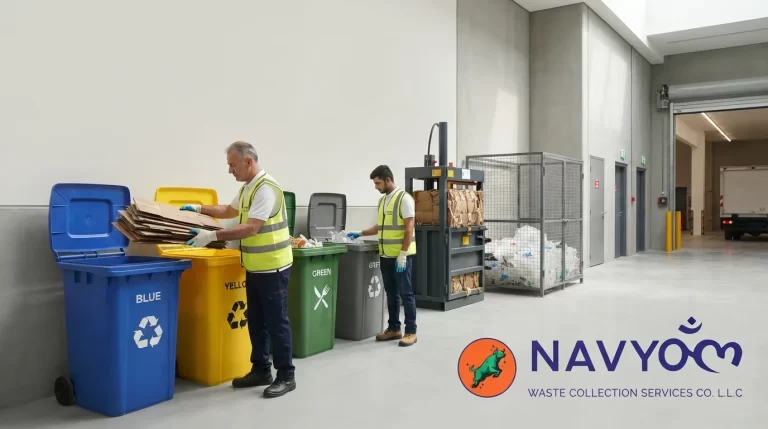
Hotels generate substantial cardboard from purchasing, receiving, linen and amenity packaging, and kitchen deliveries. Clean, dry cardboard is highly recyclable and collected at no cost or for rebate by many licensed recyclers in Dubai. Contaminated or wet cardboard — a common problem when it’s mixed with food waste in receiving areas — loses its value entirely. Dedicated cardboard baling or compaction in receiving areas is one of the easiest and cheapest waste efficiency wins available to any hotel property.
4. Glass
F&B-heavy properties with bars, restaurants, and banqueting generate significant glass volume through bottles and glassware breakage. Glass recycling in Dubai is available through licensed collectors and the Tadweer network. Glass must be kept separate from general waste — mixing it creates contamination across other recyclable streams and results in the full load being downgraded to general waste at the transfer station.
5. Hazardous and Regulated Waste
This is the stream most hotels underestimate. It includes used cooking oil from F&B operations (a separately regulated waste stream in Dubai with its own licensed collection pathway), housekeeping and laundry chemicals, pool treatment chemicals, batteries, fluorescent tubes, and e-waste from replaced guest-room technology. These materials cannot legally go into general waste in Dubai and require licensed hazardous waste contractors for collection and disposal. Using an unlicensed contractor or disposing of these streams through general waste channels creates a compliance exposure that sits directly with the hotel operator.
6. Textiles and Linen
Worn or damaged linen, towels, and staff uniforms accumulate over time and represent a waste stream that many hotels simply dispose of through general waste by default. Dubai has several textile recycling and reuse pathways — charitable redistribution and rag-grade textile recycling are both viable options that divert this material from landfill and can be documented as part of a sustainability reporting framework.
Hotel Waste Streams: Handling Requirements at a Glance
| Waste Stream | Typical Volume | Segregation Required | Licensed Contractor Needed | Recyclable / Divertible |
|---|---|---|---|---|
| Food / Organic | 30–50% of total | ✔ Yes | ✔ Yes | ✔ Compost / organic processing |
| General Waste | 25–40% of total | ▲ After segregation | ✔ Yes | ✘ Landfill / Tadweer |
| Cardboard / Paper | 10–20% of total | ✔ Yes — keep dry | ▲ Recycler or licensed collector | ✔ High recyclability |
| Glass | 5–12% (F&B-heavy) | ✔ Yes — separate bin | ✔ Licensed recycler | ✔ Recyclable |
| Used Cooking Oil | Variable | ✔ Yes — sealed containers | ✔ Specialist required | ✔ Biodiesel / oleochemical |
| Hazardous Chemicals | Low — high risk | ✔ Yes — segregated storage | ✔ Hazardous waste only | ▲ Varies by material |
| E-Waste | Periodic | ✔ Yes — never in general | ✔ Licensed e-waste collector | ✔ Component recovery |
| Textiles / Linen | Low but recurring | ▲ Best practice | ▲ Or charity handoff | ✔ Reuse / textile recycling |
What DTCM Compliance Actually Means for Hotel Waste Management
DTCM (the Department of Economy and Tourism, previously DTCM) doesn’t operate its own waste inspectorate — it doesn’t send officials to check your bin room. What it does do is embed environmental performance expectations into the broader hotel classification and quality assurance framework. For properties seeking or renewing star classifications, sustainability indicators form part of the assessment criteria, and documented waste management practices are included.
The practical compliance exposure for Dubai hotels comes primarily through Dubai Municipality’s commercial waste enforcement framework, which applies to all large-volume waste generators regardless of sector. Hotels that generate above threshold volumes — which essentially means any hotel with more than 50 rooms and a functioning F&B operation — are treated as significant commercial waste producers with corresponding documentation and contractor obligations.
The single most common compliance failure we see in Dubai hotel properties is not hazardous waste mishandling or missing documentation — it’s contaminated recyclable streams. Wet cardboard mixed with food waste, glass in general bags, or cooking oil poured into organic waste bins all result in the same outcome: the entire collection is downgraded to general waste, the hotel pays general waste disposal rates for material that should have been recycled for free or at rebate, and the diversion record shows zero.
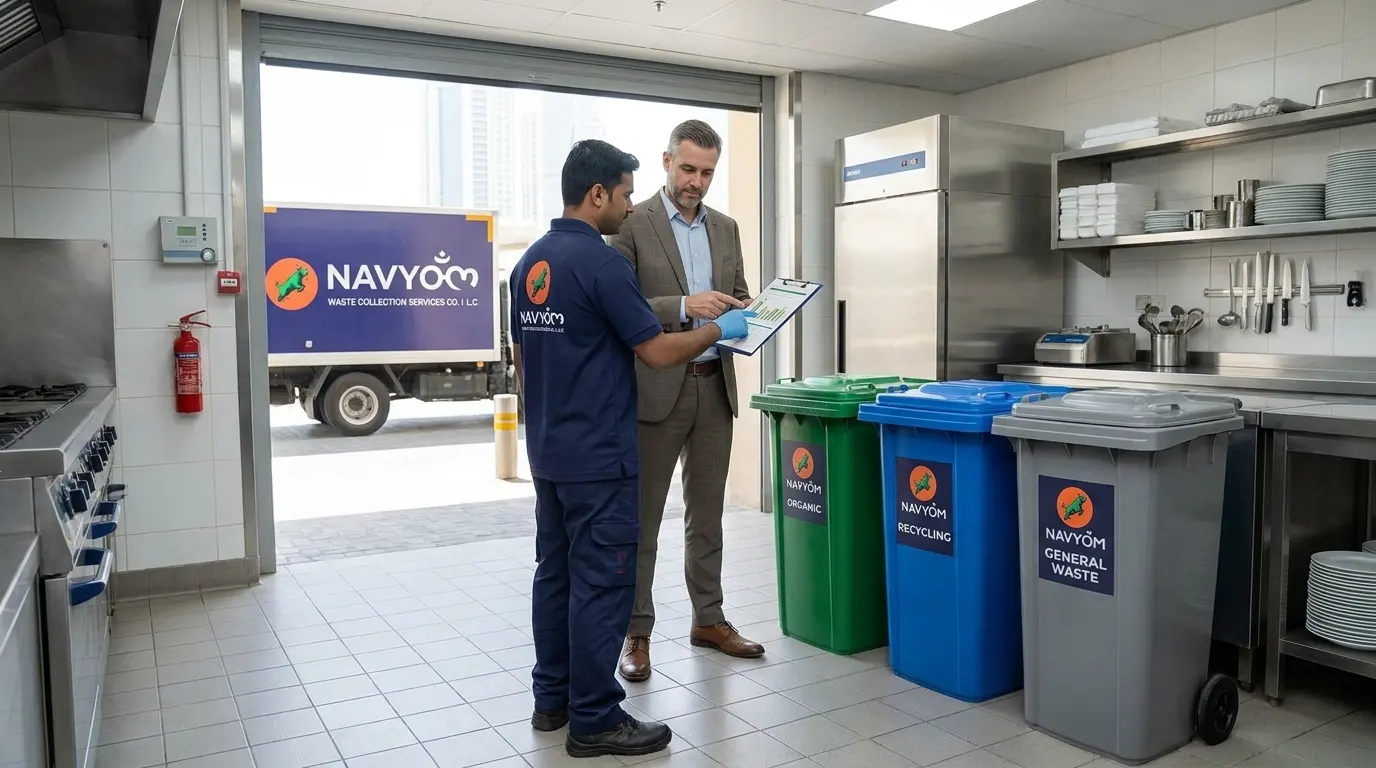
Fixing this doesn’t require new contractors or capital expenditure. It requires three things: clear bin labelling in Arabic and English at every point of generation, a brief operational briefing for kitchen and housekeeping staff each month, and a supervisor walkthrough of the bin store twice weekly during the first month of any new protocol.
How to Build a Compliant Hotel Waste Management System in Dubai
Step 1 — Map Every Waste Generation Point
Walk every area of the property — kitchen, receiving, guestroom floors, laundry, back-of-house corridors, pool area, parking, and any retail or spa space — and document what waste is generated, in what volumes, and how frequently. Most hotels have a reasonable picture of their kitchen waste but a very incomplete picture of what’s coming out of housekeeping, engineering stores, and guest amenity restocking. A complete map is the foundation. Without it you’re guessing at contractor requirements and bin infrastructure.
Step 2 — Identify Which Streams Need Licensed Specialist Contractors
Separate the general and recyclable waste streams (handled by a standard licensed commercial waste collector) from the specialist streams: used cooking oil, hazardous chemicals, e-waste, and any medical waste if the property has a medical centre. Each specialist stream needs its own licensed contractor with the correct Dubai Municipality or relevant authority approval for that waste type. Verify contractor licences — don’t assume a contractor who handles your general waste is authorised for hazardous or regulated streams.
Step 3 — Set Up Segregation Infrastructure at Point of Generation
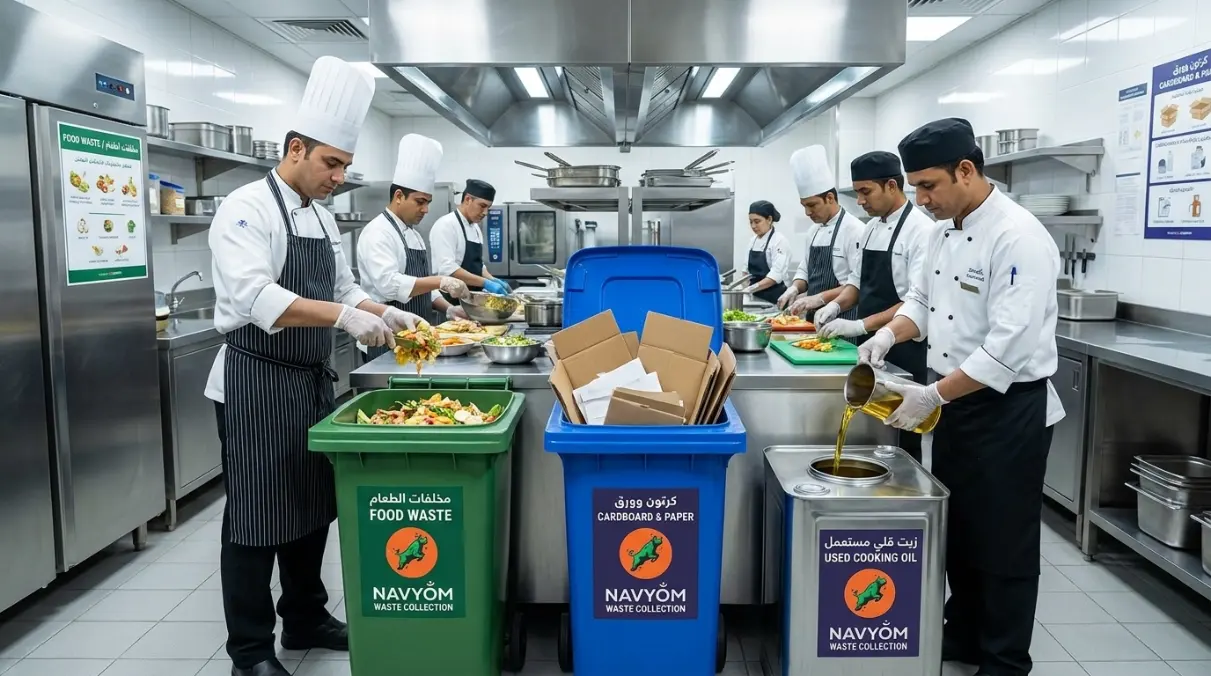
Bins at the bin store alone don’t work. Segregation happens in kitchens, on housekeeping trolleys, in receiving areas, and in back-of-house corridors — not retrospectively when waste reaches the holding area. Each generation point needs the correct bin type, clearly labelled, correctly sized for the volume generated in that area. Oversized bins in low-generation areas encourage mixing. Undersized bins cause overflow and cross-contamination.
Step 4 — Brief Your Team in Arabic and English
In a UAE hotel workforce, waste instructions need to be multilingual and visual. Laminated bin-side cards with icons showing accepted and rejected items outperform written procedures by a wide margin. Kitchen brigades, housekeeping teams, and stewarding staff are the people who determine whether your segregation system works in practice. A 15-minute briefing with physical demonstration at the start of their shift has more impact than a policy document filed in the sustainability folder.
Step 5 — Track, Review, and Adjust Monthly
Request monthly waste data reports from your contractors — total weights per stream, collection frequency, and any load rejection incidents. Plot this against occupancy and F&B covers to establish a waste-per-guest-night baseline. If general waste per occupied room is increasing while recycling volumes stay flat, something is wrong in the segregation chain and needs a physical investigation, not a policy revision.
How the Approach Changes by Property Type
Not every hotel in Dubai faces the same waste challenge. Here’s how the priorities shift by property type:
Large Five-Star Resort (300+ rooms, multiple F&B outlets)
Food waste is the dominant issue — both by volume and by cost. Dedicated organic waste contracts, on-site or off-site composting arrangements, and food waste tracking integrated into kitchen management systems are the priority investments. Used cooking oil volume will be significant and requires a properly managed specialist collection contract. Sustainability reporting requirements at this level typically require verified diversion data, so documentation accuracy matters as much as the operational performance itself.
Mid-Scale Business Hotel (100–250 rooms, limited F&B)
Cardboard from purchasing and general recyclables are the most actionable opportunities. Food waste volumes are lower and may not justify a separate organic collection contract — a well-managed general waste contract with a compliant licensed collector and good kitchen segregation will cover the base requirement. The compliance exposure is relatively manageable if contractor licences are current and hazardous streams are correctly separated.
Boutique or Aparthotel (under 60 units, self-catering)
Lower overall volumes but the same compliance obligations apply. Some smaller properties attempt to handle waste through shared building collection systems, which creates complications if the building’s contractor doesn’t hold the correct commercial licence category. Verify that your contractor arrangement is appropriate for commercial hospitality classification, not just residential building waste.
⚠️ Regulatory Note: Specific permit conditions, documentation requirements, and enforcement thresholds for hotel waste management in Dubai vary by property size, zone, and current Dubai Municipality guidelines. The framework described in this article reflects general commercial waste management requirements. If your property has received a compliance notice or is preparing for a DTCM quality audit, consult directly with a licensed waste management provider or the relevant authority for current requirements applicable to your specific classification and location.
Common Mistakes — and When This Advice Doesn’t Apply
Assuming your main contractor covers all streams. The most expensive mistake in hotel waste management is discovering after a compliance review that your general waste contractor was collecting used cooking oil or hazardous chemicals without the specific authorisation to do so. Check the scope of each contractor’s licence. It takes five minutes and prevents a significant problem later.
Outsourcing the responsibility to the contractor entirely. A licensed contractor handles collection and disposal — they don’t manage segregation on your property. The hotel operator owns the waste until it is collected. If waste is incorrectly presented or mixed on your premises, the compliance exposure sits with the property, not the contractor.
Setting up segregation infrastructure and not maintaining it. Bin labels fade, staff turn over, procedures drift. A segregation system that worked in month one can be effectively non-functional by month six if it isn’t checked regularly. A five-minute walkthrough of the bin store and kitchen waste points twice a week catches problems before they become patterns.
When this advice is less relevant: If your property operates within a larger integrated development with a centrally managed waste contract covering all tenants — as is common in some DIFC, Downtown, or master-planned resort developments — your operational obligations are governed partly by the master development’s waste management plan. In these cases, the development’s facilities management team typically manages contractor relationships, and your obligation is primarily correct source segregation before waste reaches collection points. Confirm the arrangement in writing with your facilities management contact.
Use DubaiWaste.com Tools to Size Your Waste Costs
Before approaching contractors for quotes or making the case internally for waste management investment, it helps to have a realistic cost baseline. The Waste Management Cost Estimator on DubaiWaste.com lets you input your estimated waste volumes by stream and generate a cost comparison between mixed collection and segregated collection approaches.
For hotels focused on sustainability reporting or landfill diversion targets, the Landfill Savings Calculator translates diversion volumes into both cost savings and carbon impact figures — useful for ESG reporting, DTCM sustainability assessments, or internal stakeholder communication.
Not Sure Where Your Property Stands?
Request a free site waste audit from our Dubai network of licensed waste advisors. We’ll review your current contractor arrangement, stream segregation, and compliance documentation — and identify the highest-value improvements for your property type.
Request a Free Hotel Waste Audit →Available to Dubai-based hotel and hospitality operators. No obligation.
Frequently Asked Questions: Hotel & Hospitality Waste Management Dubai
- Audit your contractor coverage today. Confirm that every waste stream your property generates — especially used cooking oil, hazardous chemicals, and e-waste — is covered by a contractor with the correct Dubai Municipality licence for that specific stream. This single check eliminates the most common compliance exposure in hotel waste management.
- Install segregation at the point of generation, not just at the bin store. Kitchens, receiving areas, and housekeeping staging areas are where waste streams either stay clean or get contaminated. Labelled bins at these points — in Arabic and English — are the cheapest, highest-impact intervention available to any hotel property.
- Request monthly weight data from your contractors and track it against occupancy. Waste per guest-night is a meaningful KPI. It tells you whether your protocols are working, whether volumes are aligned with operational expectations, and whether you have a credible data story for sustainability reporting or DTCM quality assessments.
Use the Waste Management Cost Estimator to benchmark your current spend, or request a site audit if you need a detailed review of your property’s current setup.