School & University Waste Management Dubai: A Practical KHDA-Era Compliance Guide
School and university waste management in Dubai works best as a layered system: licensed collection for general and food waste, dedicated streams for paper, e-waste, and lab or clinic materials, and documentation that stands up to scrutiny. KHDA doesn’t issue waste permits itself, but its Sustainable Schools Initiative and inspection framework increasingly reward campuses that can show real segregation, real diversion data, and a genuine environmental programme rather than a poster on a wall.
Walk through the back-of-house area of almost any Dubai campus and you’ll find the same story repeating itself: a canteen skip overflowing with mixed food and packaging waste, a general bin quietly absorbing broken laptops and printer cartridges, and a facilities manager who genuinely wants to do better but has never been handed a clear framework for how a school’s waste stream is supposed to work.
That gap matters more than it used to. Dubai’s private education sector has grown fast, campuses have gotten bigger and more complex, and Dubai’s waste management guide now sits alongside a separate but overlapping pressure: KHDA’s push toward sustainable, well-governed schools. Inspectors, parents, and increasingly students themselves are asking what actually happens to the waste a 1,500-student campus produces every day.
This guide covers what a school or university operator in Dubai actually needs to get right — the waste streams involved, where segregation genuinely pays off, what KHDA’s sustainability expectations do and don’t cover, and how to avoid the two most common failure modes: doing nothing, or building an elaborate recycling programme that quietly collapses because nobody trained the cafeteria staff.
Why Campus Waste in Dubai Behaves Differently
A school or university site doesn’t generate waste like a typical office or retail unit. It behaves more like a small town: a canteen or dining hall running on commercial-kitchen volumes, admin offices producing paper and packaging, IT departments cycling through hardware, science and chemistry labs producing regulated waste, and — on larger campuses — dormitories, clinics, sports facilities, and landscaped grounds each adding their own stream.
That mix is exactly why a single “general waste” bin strategy tends to fail on campuses faster than almost anywhere else. Mixed loads from a school aren’t just inefficient; they blend food waste, recyclable packaging, and occasionally regulated material (a broken fluorescent tube, a leaking printer cartridge, expired lab reagents) into the same skip, which increases contamination and removes any realistic path to landfill diversion.
On top of the operational picture, there’s a reputational one. KHDA’s Sustainable Schools Initiative — run alongside Dubai’s broader sustainability push — has made environmental practice part of how schools present themselves to parents and inspectors, even where it isn’t a hard licensing requirement. A campus that can show genuine diversion numbers is in a stronger position than one relying on good intentions.
The Core Waste Streams on a Dubai School or University Campus
Before building a system, it helps to separate what a campus actually produces. Most sites generate some combination of the following, and the right collection approach differs for each one.
General and mixed waste
Classroom bins, corridor bins, and admin office waste that doesn’t fit a dedicated stream. This is the default catch-all, and the one most likely to absorb material that should have gone somewhere else.
Food and organic waste
Canteens, dining halls, and staff rooms generate a disproportionate share of total campus waste by weight. Food waste collected separately can often be diverted rather than landfilled, but only if contamination from packaging and cutlery is controlled at the source.
Paper, cardboard, and packaging
Classroom material, exam papers (once retention periods lapse), delivery packaging, and printer output. This is usually the easiest stream to segregate because it’s dry, low-contamination, and familiar to staff and students alike.
E-waste
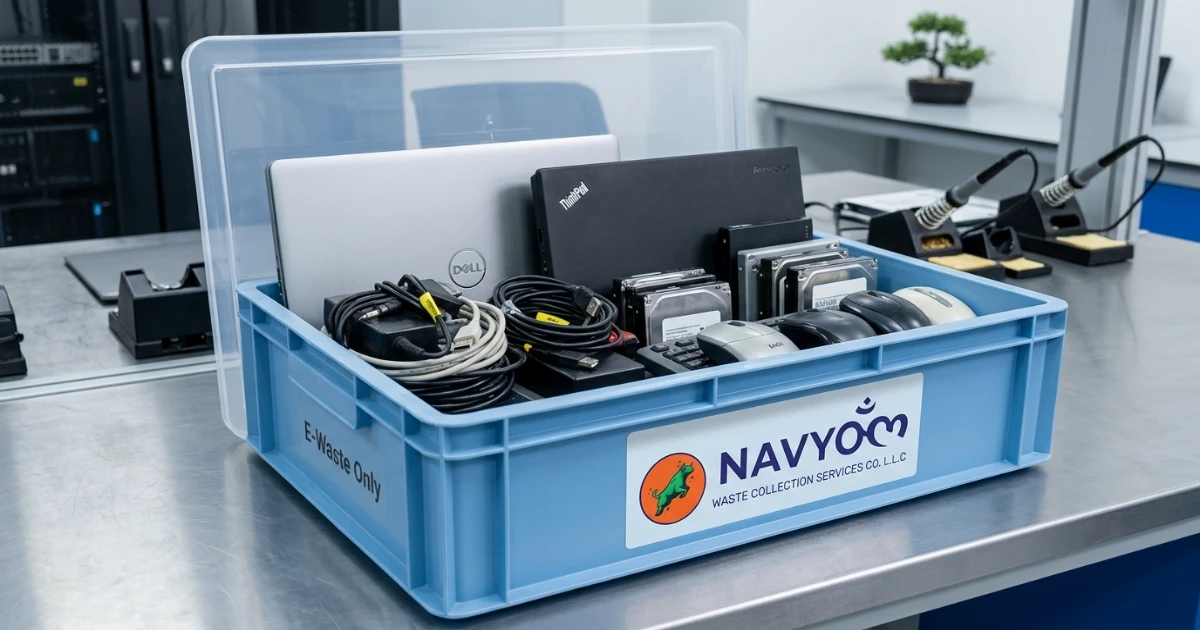
IT rooms, science departments, and admin offices cycle through laptops, projectors, cabling, and batteries. E-waste should never go into general bins — it needs its own collection route, both for environmental reasons and because it often contains materials with real recovery value.
Laboratory and chemical waste (university and senior-school science)
Reagents, solvents, and lab consumables fall outside general waste rules entirely. This is treated as regulated waste and requires a licensed handler — not a decision to make on cost grounds.
Clinic and first-aid waste
Any campus with a nurse’s office or clinic that handles sharps, dressings, or clinical consumables is generating a small but genuine medical waste stream, even at low volume. Volume doesn’t change the classification.
Landscaping and garden waste
Larger campuses with sports fields and grounds produce seasonal green waste that’s straightforward to divert but easy to forget when contracts are set up.
Segregated vs. Mixed Waste Collection for Educational Campuses
For most Dubai campuses, the decision isn’t whether to segregate at all — it’s how far to take it, and where the return on effort actually shows up.
| Dimension | Segregated Collection | Mixed Collection |
|---|---|---|
| Typical cost per lift | Higher setup cost, often lower blended cost over time | Lower setup cost, higher long-run disposal cost |
| Diversion potential | High for paper, food, e-waste when contamination is controlled | Low — mixed loads are rarely recoverable economically |
| Documentation needs | Requires stream-specific records; stronger for reporting | Minimal, but weak for any sustainability reporting |
| Contamination risk | Depends heavily on staff and student training | Not applicable — everything is treated as general waste |
| Best suited for | Mid-to-large campuses with canteens, labs, or dorms | Very small sites with minimal, uniform waste output |
| Value for KHDA-facing reporting | Provides real, defensible diversion figures | Little to show beyond a single collection contract |
Situation-Based Adjustments
The right setup depends heavily on what kind of campus you’re running. A boutique nursery and a 3,000-student university have almost nothing in common operationally.
Small private K-12 schools (single campus, no boarding)
A simple three-stream setup — general, paper/packaging, food — usually covers 80–90% of the practical benefit without the overhead of a full multi-stream programme. Lab waste only becomes relevant once chemistry moves beyond basic senior-school demonstrations.
Large university campuses with labs and dormitories
These sites effectively run several waste profiles at once: an institutional profile (offices, lecture halls), a residential profile (dorms, similar to household waste), a commercial-kitchen profile (dining halls), and a regulated profile (labs, clinics). Each usually needs its own contract terms and collection frequency rather than one blanket arrangement.
Campuses with an on-site clinic or nursery medical room
Even a single sharps bin changes the compliance picture. This waste needs a licensed clinical waste route separate from general collection, regardless of how small the volume looks on paper.
Campuses mid-expansion or renovation
Construction and demolition waste from a new building or renovation is a distinct stream from day-to-day campus waste and shouldn’t be folded into the existing school contract. See construction waste guidance for how this is typically handled.
Where KHDA Fits Into This Picture
It’s worth being precise here, because this is where a lot of campuses get confused. KHDA is Dubai’s regulator for private education quality — it doesn’t issue waste collection permits, set landfill diversion targets, or inspect skip contracts. Actual waste compliance in Dubai — collection, segregation rules, and documentation like Waste Transfer Notes — sits with Dubai Municipality and the licensed contractors operating under its framework.
What KHDA does influence is reputational and institutional. Its Sustainable Schools Initiative and broader inspection criteria increasingly recognise schools that demonstrate genuine environmental practice, and sustainability has become part of how schools are perceived by parents, staff, and inspection teams. A campus with a credible, documented waste programme is better positioned in that conversation than one that can’t show any real numbers — even though the underlying legal obligation for waste handling comes from municipal rules, not from KHDA itself.
Common Mistakes & When to Ignore This Advice
- Treating e-waste and lab waste as general waste because volumes are small — classification, not volume, determines the requirement.
- Building an ambitious multi-bin system with no staff training — segregation collapses fast in a canteen if catering staff weren’t briefed, and contaminated “recycling” often ends up landfilled anyway.
- Assuming one contractor can handle every stream equally well — general waste collectors don’t always have the licensing or logistics for regulated lab or clinical waste.
- Skipping documentation because “it’s just a school” — the size of the institution doesn’t change what’s legally required for a given waste type.
- Not reviewing the contract after enrollment growth — a collection frequency set for 400 students doesn’t scale cleanly to 1,200.
Where this advice can reasonably be relaxed: a very small nursery or single-floor learning centre with minimal food service and no labs genuinely doesn’t need a five-stream system. A well-run two-stream setup (general plus recyclables) with a clear plan for occasional e-waste disposal is proportionate — not every site needs the full university-scale approach.
How to Use DubaiWaste.com Tools for This
Two tools are particularly useful when setting up or auditing a campus waste programme. The Waste Management Cost Estimator lets facilities teams model the cost difference between a mixed contract and a segregated multi-stream setup based on real enrollment and campus size, rather than guessing. A WTN compliance checklist generator can help track which waste types on a given campus require formal Waste Transfer Note documentation and which don’t — useful for facilities managers juggling general, food, e-waste, and clinical streams under one roof.
Neither tool replaces a conversation with a licensed contractor about your specific site, but both make that conversation more productive — you show up with real numbers instead of a rough estimate.
Real-World Operational Example
Consider a mid-size K-12 campus in Dubai with roughly 1,200 students, a central canteen, and a senior-school science wing. Before any changes, the site ran a single mixed-waste contract, and the science department disposed of expired reagents through informal arrangements with lab suppliers — a gap that only surfaced when a new facilities manager audited existing contracts.
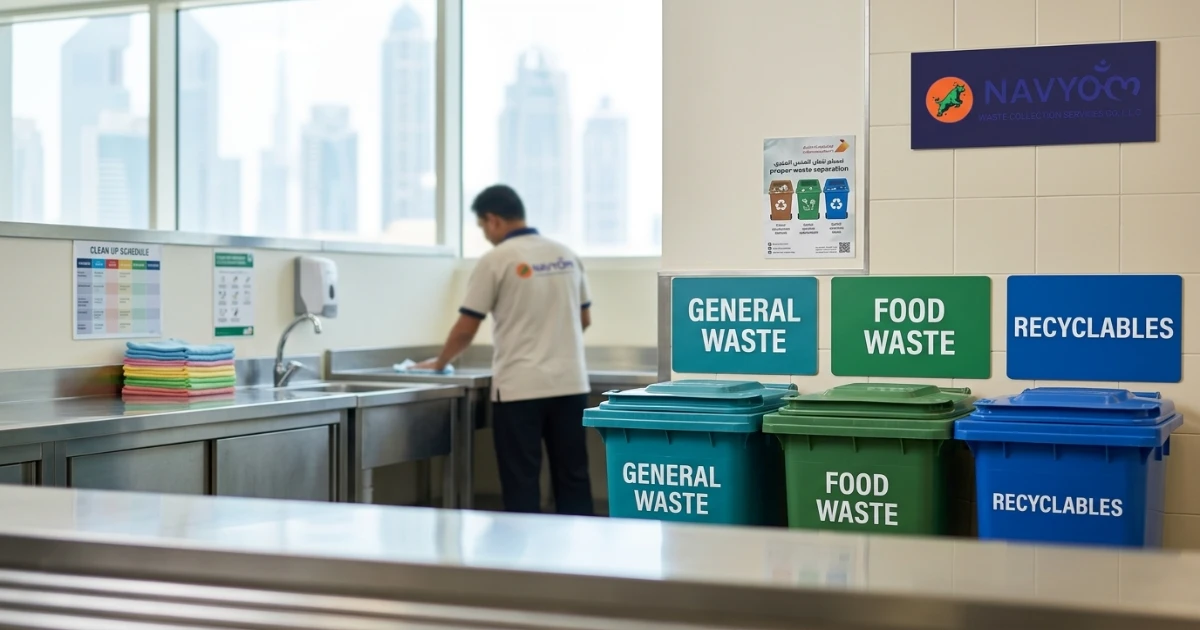
The fix wasn’t dramatic: a three-stream canteen setup (general, food, recyclables), a formal licensed route for lab waste with proper documentation, and a quarterly e-waste collection for the IT department. Canteen staff needed a short training session and clearer bin signage before contamination rates improved. Within two terms, the school could report a genuine — not estimated — diversion figure for the first time, which fed directly into its sustainability reporting for KHDA-facing material.
Nothing about that process required exotic technology or a large budget. It required knowing which streams existed, matching each to the right handling route, and closing the informal gap around lab waste before it became a real problem.
Not sure where your campus stands?
Run your enrollment and campus size through the cost estimator, or request a free site audit if you’re managing multiple waste streams across labs, dining halls, and dorms.
Try the Waste Management Cost EstimatorFrequently Asked Questions about School & University Waste Management Dubai
Do schools in Dubai need a licensed waste contractor?
Yes. General waste collection on any commercial or institutional site in Dubai should run through a licensed contractor, and regulated streams like lab or clinical waste require a contractor specifically licensed to handle that material.
Does KHDA regulate waste management directly?
Not directly. KHDA regulates private education quality and increasingly factors sustainability practice into its broader inspection and Sustainable Schools framework, but waste collection permits and handling rules come from Dubai Municipality and licensed operators, not KHDA itself.
What is a Waste Transfer Note, and do schools need one?
A Waste Transfer Note documents where waste came from, what type it was, and where it went. Schools typically need one for regulated streams such as lab or clinical waste; requirements for general waste vary by contractor and waste type, so it’s worth confirming with your provider.
Can a science lab dispose of chemical waste in general bins?
No. Lab chemicals and reagents fall outside general waste rules and need a licensed handler, regardless of the quantity involved. Informal disposal arrangements are a common gap that audits tend to uncover.
How can universities improve recycling rates in dormitories?
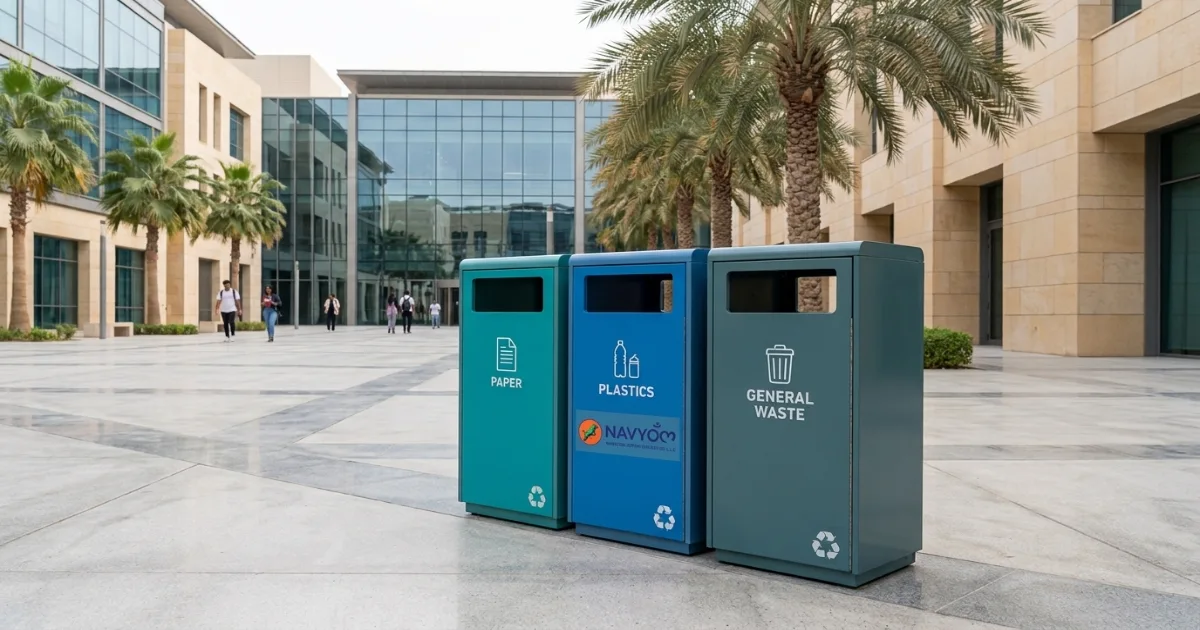
Clear, consistent bin colours per building, short onboarding for new residents each term, and visible signage at the point of disposal tend to matter more than the number of bins provided. Contamination — not lack of bins — is usually the limiting factor.
Is food waste collected separately from general waste on Dubai campuses?
It can be, and often should be — canteens and dining halls typically generate the largest single waste stream by weight. Separate food waste collection is available through most commercial waste contractors, though it depends on the provider and site setup.
Do sustainability practices actually affect a school’s KHDA rating?
Sustainability and environmental practice have become part of how schools present themselves within KHDA’s broader quality framework and Sustainable Schools Initiative, though it operates alongside — not as a substitute for — core academic inspection criteria.
How much does waste collection cost for a school campus in Dubai?
It varies significantly by enrollment, number of streams, collection frequency, and whether the campus includes labs, dorms, or a large dining operation. Running your specifics through a cost estimator gives a far more accurate picture than a generic per-bin rate.
Your Fast-Track Cheat Sheet: Top 3 Actions to Take
Map your streams before your contract. List every waste type your campus actually produces — general, food, paper, e-waste, lab, clinic — before deciding how many bins or contractors you need.
Get regulated streams right first. Lab and clinical waste carry the highest compliance risk despite low volume; confirm licensed handling and documentation before optimising anything else.
Train the people who touch the bins. Segregation only works if canteen staff, cleaners, and students understand it — signage and a short briefing usually matter more than adding another bin.