
Construction Waste ESG Reporting in Dubai 2026
Turn construction and demolition waste data into credible ESG reporting. This guide covers diversion metrics, Scope 3 emission tracking, Dubai Municipality requirements, landfill cost exposure, and what documentation sustainability teams need for investor audits.
📊 Why Construction Waste Matters in ESG Reporting
Construction waste is no longer just a site management issue. In Dubai’s 2026 regulatory environment, waste performance directly affects ESG scores, tender competitiveness, stakeholder trust, and financial reporting. Investors, rating agencies, and procurement teams evaluate waste diversion rates as a signal of operational maturity and environmental responsibility.
What Sustainability Teams Need from Waste Data
ESG reporting doesn’t fail because companies lack commitment. It fails when waste data is incomplete, inconsistent across reporting periods, or unsupported by verifiable documentation. Here’s what creates defensible waste disclosures in Dubai construction projects.
Consistent Measurement Methodology for Construction Waste ESG Reporting in Dubai
Track total waste generation by material stream (concrete, metal, timber, gypsum, mixed), calculate diversion rates using the same formula each month, and document any methodology changes. Consistency lets you show progress over time and compare performance across different project phases or developments.
Third-Party Verification Trail
ESG auditors expect documentation from independent sources: weighbridge tickets from certified facilities, digital WTNs approved by Dubai Municipality, recycling certificates from licensed processors, and facility compliance records. Internal estimates without external verification get challenged during materiality assessments.
Cost Per Tonne Visibility
Financial controllers increasingly tie waste performance to budget variance analysis. Tracking disposal costs per tonne, segregation labor costs, contamination penalties, and revenue from recycled materials creates the financial materiality connection that CFOs and sustainability committees need for ESG disclosures.
Hazardous Stream Separation
Hazardous construction waste (asbestos, lead paint, contaminated soil, chemical containers) requires separate classification, handling procedures, and disposal pathways. Mixing hazardous materials into general C&D streams triggers WTN rejections, creates compliance exposure, and damages ESG governance scores.
Diversion Rate Benchmarking
Dubai Municipality sets minimum diversion targets, but ESG leaders track performance against industry benchmarks, peer projects, and green building certification requirements. Contextualizing your diversion rate (50%, 65%, 80%+) against comparable developments strengthens sustainability narratives in annual reports and investor presentations.
Tender Scoring Enhancement
Public sector RFPs and private developer procurement increasingly include sustainability scoring criteria. Documented waste management systems, historical diversion performance, and ESG reporting capabilities can differentiate bids, especially for major infrastructure projects, government developments, and LEED/green certified buildings.
What is ESG reporting in construction?
ESG reporting in construction means disclosing measurable environmental performance (waste diversion, emissions, resource efficiency), social outcomes (worker safety, community impact, labor practices), and governance controls (compliance systems, transparency, audit readiness) using standardized frameworks. It’s backed by documentation that external auditors can verify against reported claims.
How Construction Waste Affects Scope 3 Emissions
Construction waste primarily impacts Scope 3 in corporate carbon accounting through value chain emissions: transportation logistics, processing operations, and end-of-life treatment pathways. Understanding which activities generate reportable emissions helps sustainability teams build defensible carbon footprint disclosures.
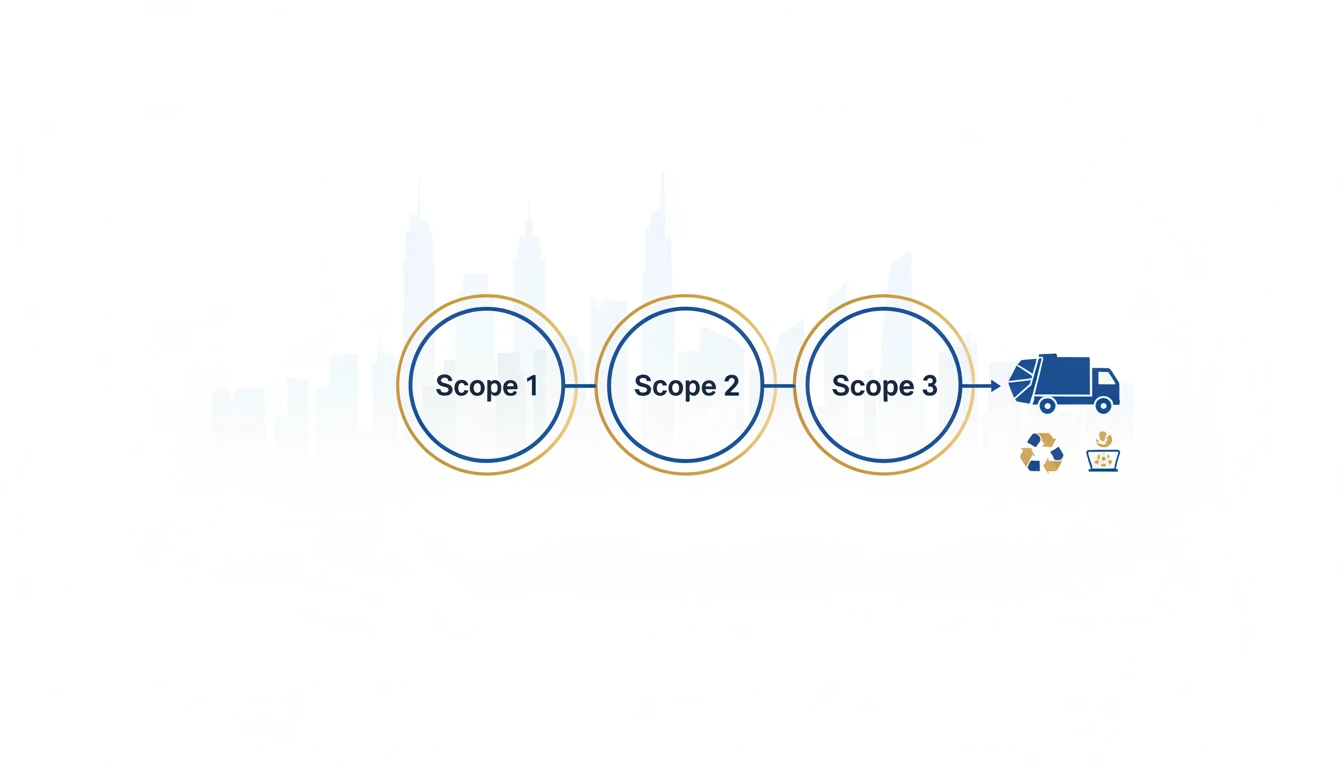
| Emission Scope | Definition (GHG Protocol) | Construction Waste Impact |
|---|---|---|
| Scope 1 (Direct) | Emissions from sources owned or controlled by the reporting organization | Limited impact from waste operations. May include emissions from company-owned site equipment used for waste handling, but typically minimal compared to other direct sources like generators or vehicles. |
| Scope 2 (Indirect Energy) | Emissions from purchased electricity, steam, heating, cooling | Indirect connection through energy consumed by waste processing facilities receiving project materials. Usually reported at facility/supplier level rather than project level. |
| Scope 3 (Value Chain) | All other indirect emissions occurring in the value chain, including upstream and downstream activities | Primary reporting category. Includes transportation emissions (diesel fuel for hauling), waste treatment emissions (landfill methane generation, processing energy), and lost embodied carbon when recyclable materials go to landfill instead of re-entering production cycles. |
Does construction waste count as Scope 3 emissions?
Yes, in most ESG reporting frameworks. Waste from construction operations typically falls under GHG Protocol Scope 3 Category 5 (waste generated in operations) and potentially Category 4 (upstream transportation and distribution). The specific categorization depends on organizational boundaries and which framework (GHG Protocol, CDP, TCFD, ISSB) guides your reporting.
How does landfill waste affect carbon reporting?
Landfilling creates emissions through transportation (fuel consumption for hauling waste to disposal sites) and decomposition processes (organic materials breaking down in anaerobic conditions produce methane, which has significantly higher global warming potential than CO2). Both emission sources need accounting in comprehensive Scope 3 calculations, though the priority is consistent methodology and verifiable improvement over time rather than perfect precision.
Total Waste Generated
Your baseline measurement tracked through weighbridge receipts and digital WTNs. Essential for calculating all downstream metrics, carbon estimates, and cost allocations.
Waste Diversion Rate
Percentage of total waste diverted from landfill through recycling, reuse, or recovery. Your primary ESG waste metric, reported to stakeholders and compared against targets.
Landfill Dependency
Proportion of waste sent to landfill versus total generated. Shows where cost and environmental risk concentrates, helping prioritize improvement efforts.
Cost Per Tonne
Average disposal cost including hauling, processing, and tipping fees. Makes waste “financially material” for CFO-level ESG conversations and budget variance analysis.
Carbon Footprint (Waste)
Estimated Scope 3 emissions from waste activities using recognized emission factors. Document your calculation methodology and assumptions for audit transparency.
Documentation Compliance
Percentage of waste loads with complete WTN documentation, photos, and facility verification. Target 100% for audit readiness and Dubai Municipality compliance.
Landfill Fees Create Quantifiable ESG Cost Exposure
When waste diversion rates are low, the financial impact becomes straightforward arithmetic rather than theoretical risk. This direct connection between waste performance and project budgets makes landfill fees a tangible “materiality” topic in ESG disclosures and financial reporting.
Dubai Landfill Fee Context
Dubai implemented a landfill disposal fee structure that charges per tonne of waste deposited at municipal facilities. This fee creates direct financial incentive for waste segregation, recycling, and diversion activities. For current rates, policy details, and cost reduction strategies, see the dedicated internal resource:
ESG Cost Exposure Formula
Example scenario: A high-rise development generating 2,800 tonnes of waste with 35% diversion achieves 980 tonnes recycled and 1,820 tonnes landfilled. If the same project improved diversion to 70%, landfill tonnage drops to 840 tonnes. The difference (980 tonnes avoided) represents direct cost savings plus reduced Scope 3 emissions, stronger ESG metrics, and improved sustainability positioning for future tenders.
Related Resources for ESG Teams
Use these guides as supporting documentation in ESG appendices, audit evidence packs, and investor Q&A preparation.
What Makes Waste Data Defensible in ESG Audits
Audit-ready waste reporting relies less on sophisticated dashboards and more on a complete evidence trail that explains each tonne, each month, using consistent categorization and documentation standards.

ESG Audit Documentation Requirements
What is considered audit-ready waste data?
Audit-ready waste data meets four criteria: (1) Verifiable – supported by third-party documents like weighbridge tickets and facility certificates; (2) Complete – covers all waste loads with no estimation gaps; (3) Consistent – uses standardized categories and calculation methods across reporting periods; (4) Traceable – provides clear documentation chain from raw receipts and WTNs through calculations to final reported KPIs.
For operational implementation guidance: Site-Level Waste SOPs →
Building an ESG-Ready Waste Reporting System
This framework translates ESG reporting requirements into site-level operations that sustainability teams can implement on active construction projects.
Step 1: Baseline Measurement
Conduct waste audit during early project phases to establish generation rates by construction phase (excavation, structural, MEP, finishes) and material type. Define your measurement methodology and commit to using it consistently throughout the project lifecycle.
Step 2: Segregation System Design
Create site-specific waste segregation procedures that match Dubai Municipality’s approved categories, facility acceptance criteria, and project logistics constraints. Include bin sizing, placement, labeling, collection frequency, and contamination prevention protocols.
Step 3: Vendor Due Diligence
Verify that waste management contractors hold current Dubai Municipality licenses, maintain required insurance coverage, and can provide the documentation trail needed for ESG reporting. Confirm recycling pathways and facility certifications.
Step 4: Digital Documentation Workflow
Implement WTN submission procedures with standardized photo requirements, GPS verification, and waste category validation. Establish approval protocols and rejection response procedures to minimize documentation gaps.
Step 5: Monthly Reporting Process
Lock in recurring reporting cycle: data validation by month-end, management review within first week, stakeholder distribution by mid-month. Use consistent report format showing tonnage by stream, diversion rate, cost per tonne, WTN compliance, and variance explanations.
Step 6: Scope 3 Calculation Method
Document your carbon accounting approach using recognized emission factors (DEFRA, EPA, or regional sources). Calculate transportation emissions (distance × fuel × emission factor) and treatment emissions (waste type × process × emission factor). Log all assumptions for audit transparency.
Step 7: Audit Evidence Preparation
Compile comprehensive documentation package before scheduled ESG audits: all weighbridge receipts, complete WTN archive, vendor licenses, facility certificates, photo logs, calculation worksheets, and methodology explanations. Organize with clear indexing for quick retrieval.
Additional Resources for Construction Waste ESG Reporting
These guides provide operational detail on specific aspects of waste management, compliance, and ESG documentation in Dubai’s construction sector.
Core Compliance and ESG Documentation
Construction Waste ESG Reporting FAQ
Does construction waste affect ESG reporting scores?
What waste metrics do ESG auditors require?
How does construction waste contribute to Scope 3 emissions?
What documentation does Dubai Municipality require for waste compliance?
How can projects improve waste diversion rates without causing delays?
What makes waste data “audit-ready” for ESG reporting?
How do landfill fees create ESG materiality?
What role does waste management play in green building certification?
Build Defensible Waste Reporting for Your Dubai Project
If your project faces ESG audit requirements, tender sustainability scoring, or investor reporting obligations, we can help establish documentation systems and operational controls that create verifiable waste performance data.
ESG Waste Reporting Support
- WTN documentation review and rejection risk assessment
- Waste diversion improvement planning with site-level controls
- Landfill fee exposure analysis and cost-per-tonne reporting
- Monthly ESG waste reporting templates and evidence indexing
- Scope 3 calculation methodology and assumption documentation
- Audit evidence preparation and documentation organization