Hazardous Waste Disposal for Businesses in Dubai — Full Compliance Guide
Businesses in Dubai are legally required to classify, segregate, store, and dispose of hazardous waste through licensed contractors approved by Dubai Municipality or the relevant free zone authority. Improper disposal — including mixing hazardous with general waste — exposes businesses to significant fines, permit suspensions, and operational shutdowns. Compliance starts with correct classification and documented collection by an authorised waste management provider.
Most business owners in Dubai don’t lose sleep over waste — until they do. A failed inspection. A rejected load at the treatment facility. A notice from Dubai Municipality about unlicensed disposal. These aren’t rare events; they happen regularly across sectors that handle solvents, batteries, clinical sharps, paints, lubricants, photochemicals, fluorescent lamps, and dozens of other materials that fall under the hazardous waste umbrella.
The challenge isn’t usually bad intent. It’s the gap between what businesses assume is acceptable and what Dubai’s waste management framework actually requires. That gap shows up in storage practices, contractor choices, documentation gaps, and misclassification — and it leaves companies exposed in ways that cost far more than proper compliance would have.
This guide covers hazardous waste disposal for businesses in Dubai from the ground up: what qualifies as hazardous, who oversees it, what your legal obligations look like, and how to set up a process that holds up under scrutiny — whether you run a printing shop in Al Quoz, a clinic in Dubai Healthcare City, a paint manufacturing facility in DIP, or a hotel with a centralised maintenance operation.
What Counts as Hazardous Waste in Dubai?
Hazardous waste is any material that poses a substantial risk to human health or the environment due to its physical or chemical properties. Under UAE Federal Law No. 24 of 1999 on the Protection and Development of the Environment and Dubai Municipality’s waste management bylaws, waste is classified as hazardous if it exhibits one or more of the following characteristics: flammability, corrosivity, reactivity, or toxicity.
That definition covers more materials than most businesses realise. Some of the most commonly encountered hazardous waste streams in Dubai’s commercial and industrial sectors include:
- Chemical and solvent waste — used thinners, acetone, cleaning agents, adhesives, and process chemicals from manufacturing, printing, and automotive businesses
- Clinical and pharmaceutical waste — sharps, expired medications, cytotoxic materials, and contaminated consumables from clinics, pharmacies, and diagnostic labs
- Electronic waste (e-waste) — fluorescent lamps, CRT monitors, batteries, printed circuit boards, and certain IT equipment containing lead, mercury, or cadmium
- Used lubricants and oils — engine oil, hydraulic fluid, and gear oil from workshops, generators, and heavy plant operations
- Paint and coating waste — dried paint, aerosols, and solvent-based coating materials from construction, maintenance, and industrial operations
- Photochemical and laboratory waste — developer solutions, fixatives, and reagents from medical imaging facilities, schools, and research labs
- Contaminated packaging — containers, drums, and IBCs that previously held hazardous materials and cannot be cleaned to a non-hazardous standard
If you’re unsure whether a specific material qualifies, the material’s Safety Data Sheet (SDS) is your first reference point. Hazard classification under GHS (Globally Harmonized System) is generally aligned with Dubai Municipality’s waste classification expectations. When in doubt, treat it as hazardous — the compliance risk of under-classifying far outweighs the marginal cost of proper handling.
Dubai Municipality’s Waste Management Regulation No. 1 of 2013 establishes the framework for hazardous waste handling across Dubai Emirate. Free zone operators — including businesses in JAFZA, DIC, TECOM, and Dubai Healthcare City — may also be subject to overlapping authority requirements from their respective zone management bodies. Always verify which authority has primary jurisdiction over your site before selecting a waste contractor.
Your Legal Obligations as a Business in Dubai
Dubai’s hazardous waste regulations place clear obligations on waste generators — meaning the businesses that produce the waste, not just the contractors who collect it. You cannot transfer legal responsibility simply by handing waste to a third party. If that contractor is not licensed, or if the disposal is not documented correctly, the liability can still rest with you.
Waste Classification and Segregation
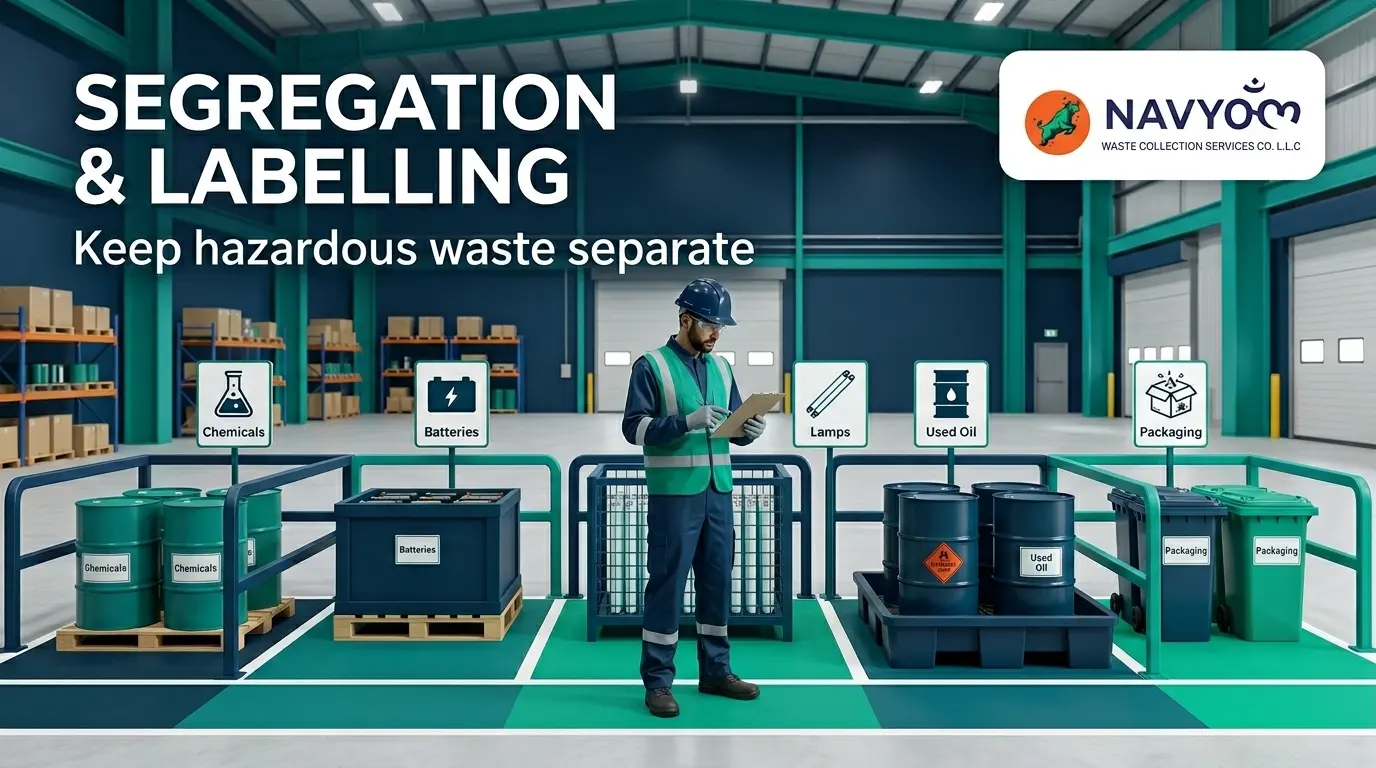
You are required to classify hazardous waste at source and keep it segregated from general waste, recyclables, and food waste. Mixing hazardous and non-hazardous waste doesn’t make the hazardous component disappear — it upgrades the entire load to hazardous status, at greater treatment cost and regulatory exposure. On-site segregation isn’t optional; it’s the foundation everything else rests on.
Storage Requirements
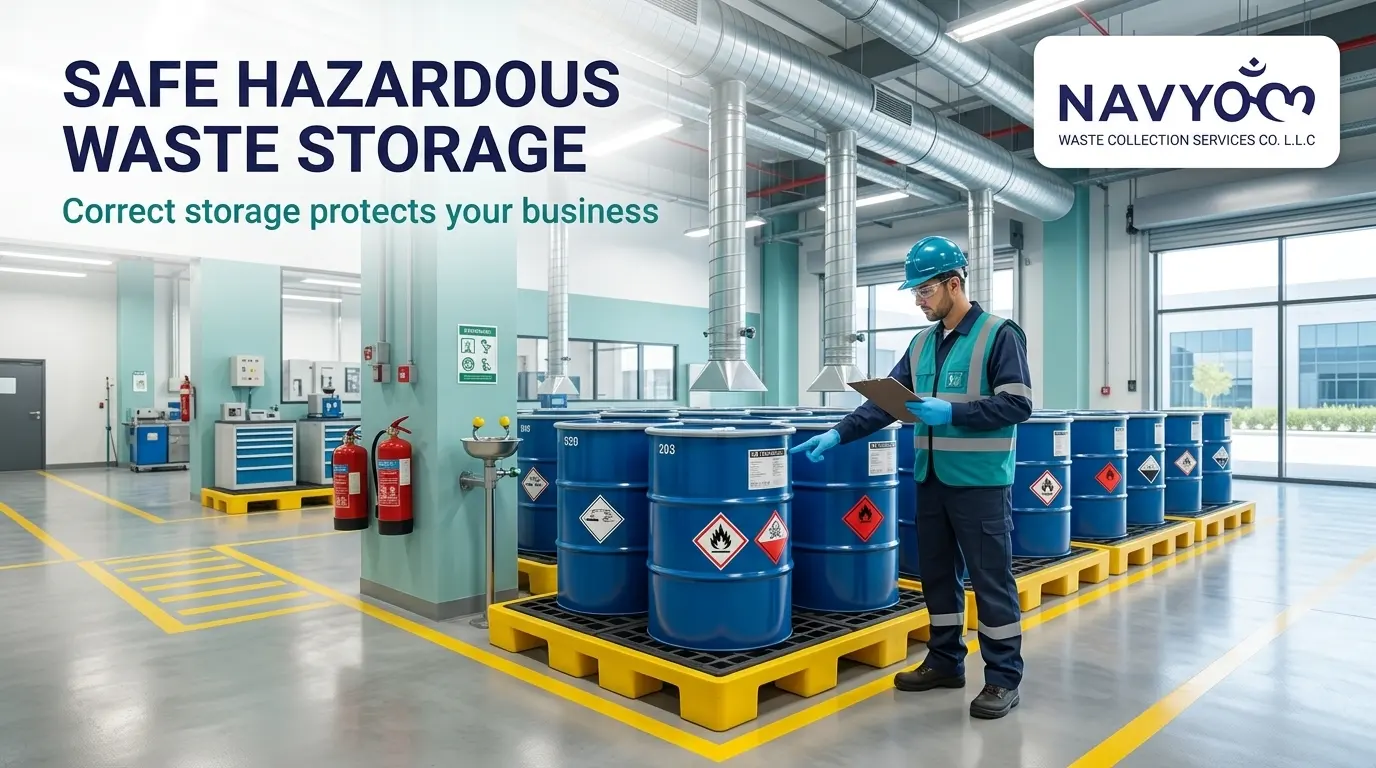
Hazardous waste must be stored in designated, secure, labelled containers that are compatible with the material. Leaking drums, unlabelled containers, and waste stored in general-access areas are among the most common non-compliance findings during inspections. Storage areas should have secondary containment, ventilation where required, and should be inaccessible to unauthorised personnel. The specific requirements vary by waste type — flammable materials have different storage standards than corrosive or infectious waste.
Licensed Contractor Requirement
Hazardous waste in Dubai must be collected, transported, and disposed of by a contractor licensed by Dubai Municipality (or the relevant free zone authority) specifically for hazardous waste. Using a general waste contractor who is not licensed for hazardous materials — even if they offer to take it — is a compliance violation. Always verify licence status before signing any service agreement.
Documentation and Record-Keeping
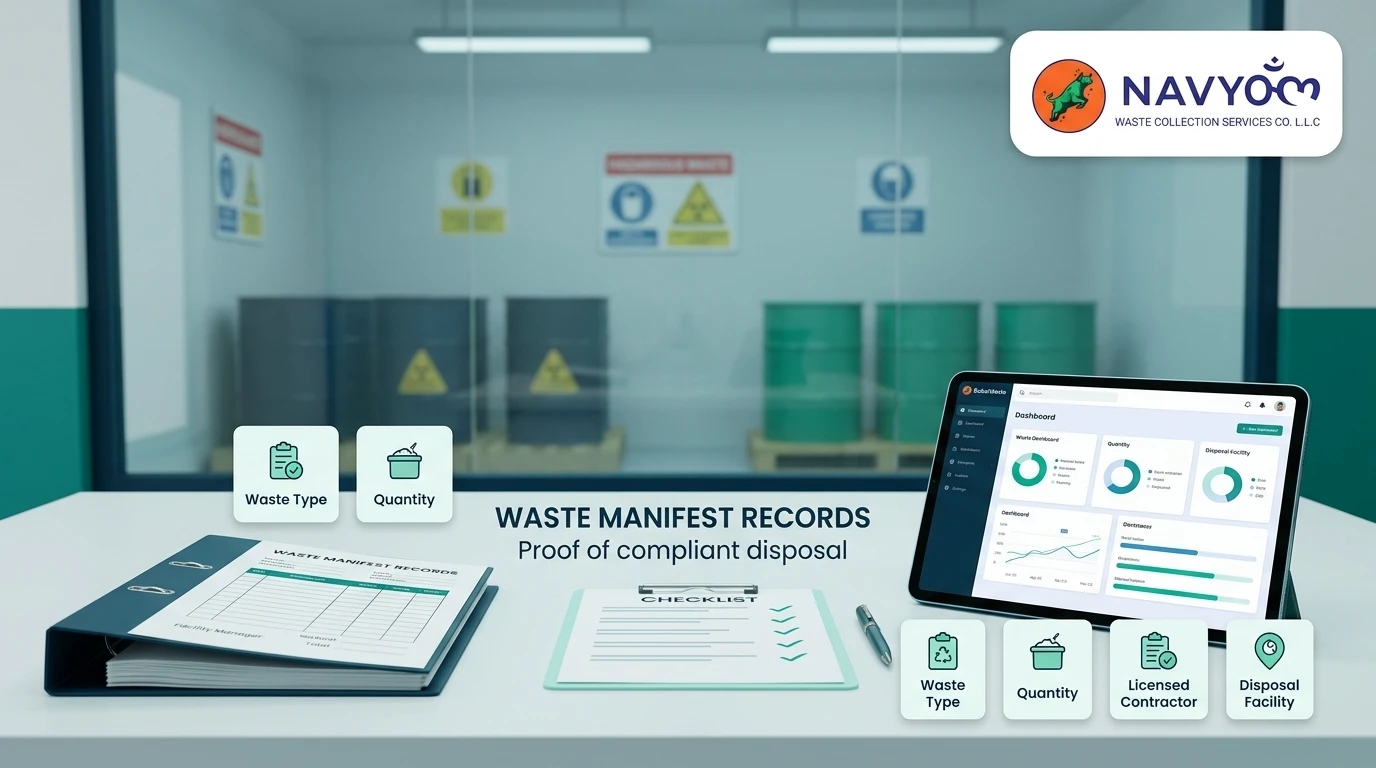
Each hazardous waste collection must be supported by a waste manifest or equivalent documentation that records the waste type, quantity, generator details, collector details, and disposal destination. These records should be retained — typically for a minimum of three years — and must be available for inspection. Missing or incomplete documentation is treated as seriously as the absence of a licence.
Hazardous vs General Waste: Key Differences for Dubai Businesses
| Factor | General Waste | Hazardous Waste |
|---|---|---|
| Classification requirement | Basic segregation (recyclable vs residual) | Formal classification by waste type and hazard characteristic |
| Contractor licensing | Licensed general waste contractor | Must hold specific hazardous waste licence from Dubai Municipality or free zone authority |
| Storage standards | Standard waste bins; scheduled collection | Compatible containers, labelled, secondary containment, restricted access |
| Documentation | Collection receipts; basic records | Waste manifest required for every collection movement |
| Disposal route | Transfer station; landfill or energy recovery | Licensed treatment, storage, or disposal facility (TSDF) — varies by waste type |
| Mixing with other waste | Segregation by recyclable type | Strict prohibition on mixing with general waste; contamination upgrades entire load |
| Cost level | Lower | Higher — treatment costs reflect hazard level and volume |
| Regulatory risk | Moderate | High — fines, permit suspension, or shutdown possible |
The Step-by-Step Compliance Process for Dubai Businesses
- Conduct a waste stream audit. Map every material leaving your premises. Identify anything that could qualify as hazardous — check your SDS sheets, chemical inventory, and maintenance logs. This audit is the foundation of your compliance posture.
- Classify and document your hazardous waste streams. For each hazardous stream identified, document the waste type, approximate monthly volume, hazard characteristic, storage method, and generation point. This record becomes your waste profile, which licensed contractors will typically request before quoting.
- Review storage and containment against requirements. Confirm that your current storage meets the minimum requirements for each waste type. Address any gaps before your next collection — particularly labelling, container integrity, and access control.
- Select and verify a licensed hazardous waste contractor. Request the contractor’s current Dubai Municipality licence — specifically confirming it covers hazardous waste collection, transport, and disposal. Don’t rely on verbal confirmation; request the licence documentation and check expiry dates.
- Establish a manifest process. Agree with your contractor on how waste manifests will be generated, signed, and retained. Every collection movement should produce a manifest. Build a simple filing system — physical or digital — to retain these records by date and waste type.
- Schedule collections based on storage capacity and volume. Hazardous waste should not accumulate beyond your storage capacity or beyond any time limit set by your permit or zone authority. Establish a collection schedule that keeps volumes manageable and documentation current.
- Conduct periodic internal reviews. Quarterly at minimum, review your waste streams, documentation, and contractor compliance. As your operations change — new chemicals, new processes, changed volume — your waste profile and collection arrangements need to update accordingly.
Many businesses in Dubai try to minimise hazardous waste disposal costs by consolidating collections — running infrequent bulk pickups instead of scheduled regular ones. In practice, this approach often backfires. Storage limits get breached, container integrity deteriorates, and a single inspection during an over-accumulation period generates more penalty exposure than a year of scheduled collections would cost. Frequency isn’t just a logistics decision; it’s a risk management one.
How Compliance Needs Change by Business Type
Hazardous waste isn’t a single challenge with a single answer. The right approach varies significantly depending on what your business does and where it operates.
Clinics, Dental Practices, and Diagnostic Labs
Healthcare facilities generate clinical and pharmaceutical waste that falls under both Dubai Municipality oversight and Dubai Health Authority (DHA) requirements. Sharps must be stored in UN-certified puncture-resistant containers. Pharmaceutical waste — including expired medications — requires specific disposal routes. Clinical waste cannot be collected by a general waste contractor regardless of what that contractor offers. The DHA licensing framework and Dubai Municipality’s requirements need to be read together for any regulated healthcare facility.
Automotive Workshops and Service Centres
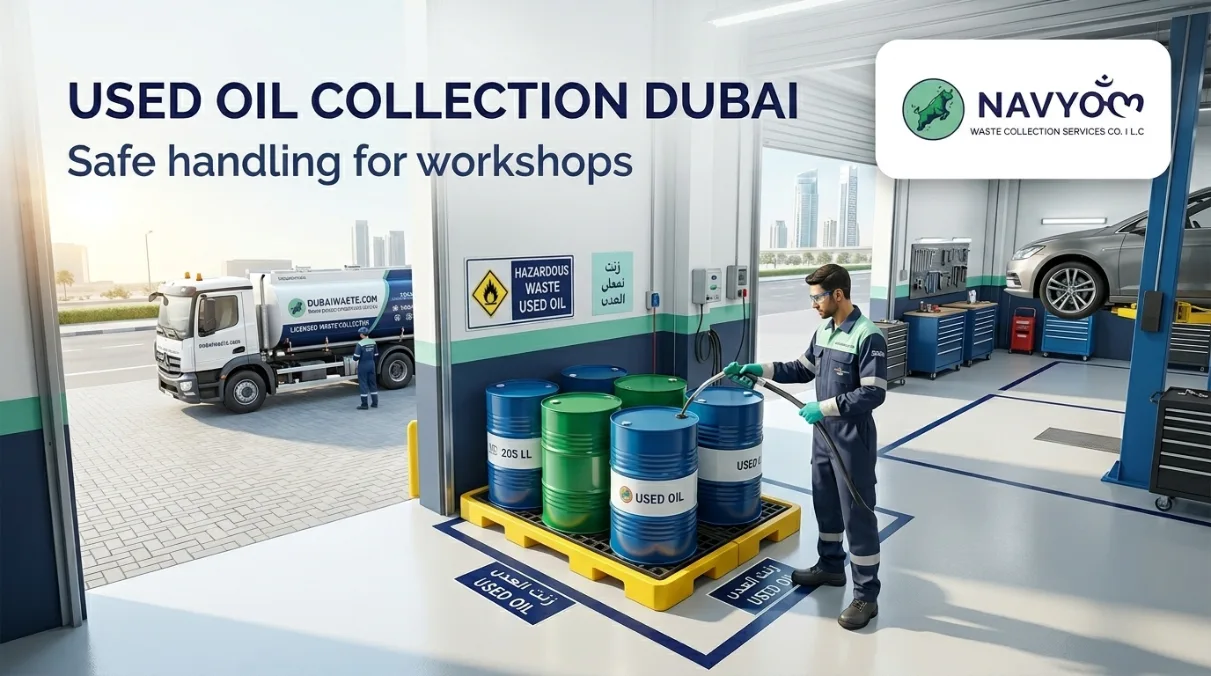
Used engine oil, brake fluid, contaminated rags, and spent filters all qualify as hazardous. Used oil is one of the most frequently mishandled waste streams in Dubai’s automotive sector — it’s sometimes poured into drains or mixed with general waste, both of which are serious violations. Licensed used oil collectors operate across Dubai; many will collect used oil at no charge or at a net-zero cost because of the recovery value. There’s rarely a cost justification for non-compliant disposal in this sector.
Printing and Graphics Operations
Solvent-based inks, cleaning agents, and photochemicals make print businesses consistent hazardous waste generators. The challenge here is volume variability — busy periods generate significantly more chemical waste than quiet ones. A consistent collection schedule with documented manifests is essential, even during slower months where volumes are low.
Hotels and Hospitality Businesses
Large hotels often overlook the hazardous waste generated through maintenance operations: fluorescent lamps containing mercury, batteries from emergency systems, solvent-based cleaning and paint products, and sometimes pool chemical waste. These are typically low-volume but high-hazard streams that need a separate collection arrangement from the facility’s general or food waste contracts.
Warehouses and Light Industrial Operators
If your operation handles, stores, or repackages chemicals, solvents, or industrial materials, the waste generated from damaged stock, expired inventory, and contaminated packaging can be substantial. A clear chemical inventory linked to your waste profile is critical — it makes both contractor briefings and regulatory inspections significantly smoother.
Not Sure Where Your Business Stands?
Use the DubaiWaste.com tools to check your risk exposure and estimate compliance costs before your next inspection catches you off guard.
Check Your Compliance Risk Try the Cost EstimatorCommon Mistakes — and When This Advice Has Limits
It’s worth being direct about where businesses routinely go wrong, and also where this guidance reaches its limits.
Mistakes That Create the Most Exposure
- Assuming the contractor handles classification. Contractors are responsible for transport and disposal. Classification at source — and the segregation that follows from it — is the generator’s responsibility. If you hand over a mixed or misclassified load, the problem doesn’t disappear with the truck.
- Using an unlicensed or incorrectly licensed contractor. Not every waste contractor in Dubai is licensed for hazardous waste. Some general waste operators will offer to take hazardous materials, sometimes at a lower price. This is not a compliant arrangement and won’t protect you if an inspection or incident occurs.
- Treating documentation as optional. Some businesses run compliant physical operations but have no paper trail. That creates a compliance gap that’s invisible until it isn’t. Waste manifests are the documented proof that disposal happened correctly — without them, you have no defence.
- Overlooking small-volume hazardous streams. A handful of batteries, a few used fluorescent tubes, some expired cleaning chemicals — these often get thrown into general waste because the volume seems trivial. Regulatory frameworks don’t always have a minimum-volume exemption for hazardous waste classification.
- Not updating the waste profile when operations change. A new piece of equipment, a new cleaning product, a new process — any of these can generate a new hazardous waste stream. Waste profiles need to be living documents, not one-time exercises.
When This Guide Has Limits
This article covers general compliance principles for hazardous waste disposal for businesses in Dubai. It is not a substitute for regulatory advice specific to your waste streams, site type, or zone authority. Businesses in free zones — particularly those under JAFZA, DMCC, Dubai Science Park, or DAFZA oversight — may face additional or different requirements that this guide cannot fully anticipate. If your business handles specialised waste streams such as radioactive materials, large-scale pesticide disposal, or classified pharmaceutical waste, engage a specialist waste consultant alongside your licensed contractor.
Using DubaiWaste.com Tools to Strengthen Your Process
Compliance documentation and cost estimation don’t have to start from scratch. The Waste Management Cost Estimator lets businesses input their waste stream types and approximate volumes to get a realistic picture of what compliant disposal should cost — which is useful both for budgeting and for benchmarking against contractor quotes.
The Waste Fine Risk Checker walks through the key risk factors in your current waste management setup and surfaces the areas most likely to create exposure under Dubai Municipality’s inspection framework. It’s not a regulatory audit, but it’s a practical starting point for identifying gaps before an inspector does.
For businesses managing clinical or medical waste alongside general commercial operations, the site’s medical waste guide covers the DHA-specific overlay in detail. And for sites producing construction or demolition waste alongside hazardous streams, the construction waste guide addresses how mixed-site operations should approach documentation and contractor selection.
Frequently Asked Questions about Hazardous Waste Disposal Businesses
Do businesses in Dubai need a special permit to generate hazardous waste?
Can a general waste contractor collect hazardous waste from my business?
What documentation do I need to keep for hazardous waste disposal in Dubai?
How much does hazardous waste disposal cost for businesses in Dubai?
What happens if a business is caught disposing of hazardous waste illegally in Dubai?
Are small businesses exempt from hazardous waste regulations in Dubai?
Can businesses in Dubai free zones use the same hazardous waste contractors as mainland businesses?
What should I do if I discover hazardous waste on my site that wasn’t properly disposed of by a previous tenant?
⚡ Your Fast-Track Cheat Sheet: Top 3 Actions
- Audit your waste streams today. Walk through every material leaving your site — including maintenance chemicals, batteries, lamps, used oils, and process waste. Identify what’s hazardous, where it’s currently going, and whether that route is documented and licensed. Most compliance gaps are discovered in this step.
- Verify your contractor’s hazardous waste licence. Don’t rely on verbal assurances. Request the current licence documentation from your waste contractor and confirm it specifically covers hazardous waste collection, transport, and treatment for your waste type. An unlicensed arrangement transfers zero liability — it adds to yours.
- Establish a manifest process and stick to it. Set up a simple record-keeping system — even a folder, physical or digital — where every waste collection manifest is filed by date. Three years of clean, complete documentation is the most effective compliance defence you can build, and it costs nothing beyond time to maintain.